The Korean War and Division — What the 38th Parallel Left Behind
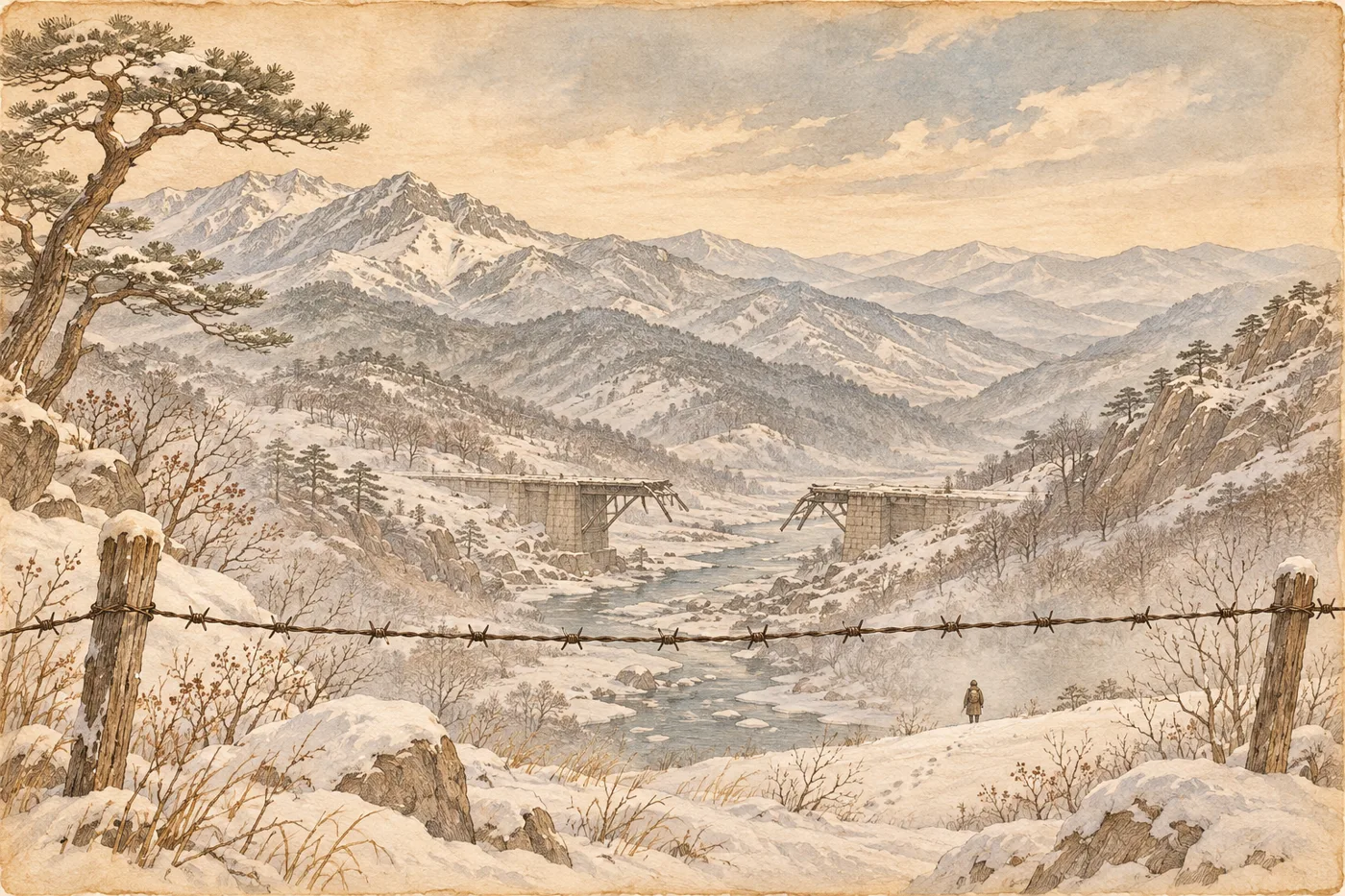
Why did a ferocious war break out on a peninsula where a single people lived, lasting over three years, with no peace treaty even today?
In August 1945, following the Soviet Union's entry into the war against Japan and Japan's defeat, Soviet forces entered the northern part of the Korean Peninsula and U.S. forces the south. Two U.S. Army officers, working with limited materials, are said to have come up with the idea of using the 38th parallel as a dividing line, and the peninsula was split into two occupation zones. What was meant as a temporary line gradually became something like an immovable border. This was the starting point of a division that has lasted more than 80 years.
In 1948, after an election held only in the south, the Republic of Korea was established in August with Syngman Rhee as its president. In the north, Kim Il-sung founded the Democratic People's Republic of Korea. Each government considered itself the representative of the entire peninsula. Small-scale clashes along the border are said to have occurred repeatedly. It was a difficult start, with two states of the same people standing side by side.
On June 25, 1950, North Korean forces crossed the 38th parallel and attacked the south, beginning the war. The UN condemned the North's action, and a UN force led by the United States came to the South's aid. In September, UN forces landed at Incheon, advanced north, and approached the Yalu River. This turn of events dramatically changed the shape of the conflict in just a few months. The capital, Seoul, changed hands several times during the fighting.
In October, China sent a large army called the 'Volunteer Army.' The term 'volunteer' is said to have been used to avoid a direct war between the United States and China. The front line was pushed back, and eventually the fighting seesawed around the 38th parallel. Even during two years of negotiations, the fighting continued. The people of the peninsula, which had become a battlefield, suffered greatly.
On July 27, 1953, representatives of the UN Command, the Korean People's Army, and the Chinese People's Volunteers signed an armistice agreement, and the fighting stopped (South Korea is said not to have signed). The agreement established the Military Demarcation Line and the Demilitarized Zone (DMZ), but no peace treaty was signed, and the 1954 Geneva Conference also failed to resolve the issue. Estimates of casualties vary widely, but combining North and South Korean civilians and soldiers, Chinese forces, and UN forces, the total number of dead and wounded on the peninsula is said to be in the millions. More than 70 years after the armistice, this state of affairs continues.
This war has several names. It is said to be called the 'June 25 War' in South Korea, the 'Fatherland Liberation War' and other names in North Korea, and the 'War to Resist U.S. Aggression and Aid Korea' in China. Differences in the names are explained as reflecting differences in how the war is viewed. Without declaring any one name as correct, understanding each perspective is a starting point for thinking about this war.
Mini timeline
- 1945After Japan's defeat, the peninsula is divided into U.S. and Soviet occupation zones along the 38th parallel.
- 1948The Republic of Korea is established in August, followed by the Democratic People's Republic of Korea.
- June 25, 1950North Korean forces cross the 38th parallel, and the war begins.
- September 1950UN forces land at Incheon.
- October 1950China's 'Volunteer Army' enters the war.
- July 27, 1953An armistice agreement is signed. No peace treaty exists.
People in this chapter
He became president after the 1948 election in the south.
He is known as the figure who established the northern government.
Meanwhile, elsewhere
Connection to Japan
Japan was under Allied occupation (1945–1952). During the Korean War, it served as a supply base for UN forces, and the resulting 'special procurement' is said to have revived the economy. In 1950 (Showa 25), the National Police Reserve was created, which later led to the Self-Defense Forces. In 1951, the San Francisco Peace Treaty was signed.
Why it still matters
On the Korean Peninsula, the Military Demarcation Line and the Demilitarized Zone (DMZ) still exist, and the two Koreas remain divided. The issue of families separated by the war is also spoken of as a legacy of this conflict.
Perspectives differ
- Origins and Responsibility for the War
- Based on the release of former Soviet documents and other evidence, the view that Kim Il-sung prepared the attack on the South with the consent of Stalin and others is currently the leading one in research. North Korea, however, still officially states that the United States and South Korea attacked first. There are also differing views on how much weight to give the clashes along the 38th parallel before the war and the Cold War structure.
- Number of Fatalities
- Counts of casualties and deaths vary greatly by source, and estimates have a wide range. One encyclopedia gives about 600,000 casualties for the North Korean military, over one million casualties for the Chinese Volunteer Army, about two million civilian losses, about 70,000 South Korean military deaths, and about 33,000 US deaths, but other sources give larger figures for South Korean deaths and others. North Korean figures are rarely published and rest on estimates.
- Name of the War
- It is said that the war is called the 'June 25 War' in South Korea, the 'Fatherland Liberation War' in North Korea, and the 'War to Resist U.S. Aggression and Aid Korea' in China. In the English-speaking world, 'Korean War' is common. Each name carries the perspective of the respective country.
- 'Armistice' vs. 'End of War'
- The 1953 agreement is explained as an armistice that stopped the fighting, not a legal end to the war. Because there is no peace treaty, it is sometimes said that 'the war is still ongoing.'
Facts checked (10, verified by AI on the web)
- Unverified In 1945, two U.S. Army officers set the 38th parallel as a dividing line based on limited materials, splitting the peninsula into U.S. and Soviet occupation zones. World History Encyclopedia: Korean War
The cited US State Department Office of the Historian page can no longer be opened (404) and could not be rechecked. Previous note: Confirmed on the State Department Office of the Historian page. - Unverified An election was held only in the south in May 1948, leading to the establishment of the Republic of Korea under Syngman Rhee in August; in the north, Kim Il-sung established the Democratic People's Republic of Korea. Both sought unification, and border clashes occurred. World History Encyclopedia: Korean War
The cited US State Department Office of the Historian page can no longer be opened (404) and could not be rechecked. Previous note: Confirmed on the same page. The date of the North's founding (said to be September 9) is not on that page, so it is not written in the text. - Unverified On June 25, 1950, North Korea crossed the 38th parallel and attacked; a U.S.-led UN force aided the South, landing at Incheon in September and advancing to the Yalu River. The responsibility and background of the war's start are debated. World History Encyclopedia: Korean War
The cited US State Department Office of the Historian page can no longer be opened (404) and could not be rechecked. Previous note: Confirmed on the same page. The page states 'the question of who fired the first shot remains a matter of debate.' The text presents both views and avoids a definitive statement. - Unverified In October 1950, China sent a 'Volunteer Army.' The name is said to have been chosen to avoid direct confrontation between the U.S. and China. World History Encyclopedia: Korean War
The cited US State Department Office of the Historian page can no longer be opened (404) and could not be rechecked. Previous note: Confirmed on the same page. - Confirmed An armistice agreement was signed on July 27, 1953. It established the Military Demarcation Line and the DMZ. No peace treaty was signed, and the 1954 Geneva Conference also failed to resolve the issue. World History Encyclopedia: Korean War(事典)
Confirmed by encyclopedia. - Corrected & confirmed Casualty and death estimates (the encyclopedia's figures): about 600,000 North Korean military casualties, about 2 million civilian losses, over 1 million Chinese Volunteer casualties, about 70,000 South Korean military deaths, about 33,000 US deaths World History Encyclopedia: Korean War(事典)
The encyclopedia's figures were checked. It distinguishes casualties from fatalities, and estimates differ greatly by source, so the text says there is a wide range. Larger figures exist for South Korean and Chinese losses but could not be confirmed in readable public sources. - Confirmed Japan served as a supply base for UN forces, and an occupation official said 'Korea saved Japan.' The San Francisco Peace Treaty was signed in 1951. U.S. Department of State, Office of the Historian: Reconstruction and Reorientation of Japan
Confirmed on the State Department Office of the Historian page. The term 'special procurement' and the amount are not on that page. - Confirmed The National Police Reserve was created in 1950, which later led to the Self-Defense Forces. 国立国会図書館「日本国憲法の誕生」警察予備隊
Text confirms the creation of the National Police Reserve (75,000 men) via MacArthur's letter on July 8, 1950, and the Police Reserve Order on August 10, 1950. Transition to the Self-Defense Forces is not described on this page (Ministry of Defense page returns 403). - Unverified The war is called 'June 25 War' in South Korea, 'Fatherland Liberation War' in North Korea, and 'War to Resist U.S. Aggression and Aid Korea' in China. World History Encyclopedia: Korean War
The cited US State Department Office of the Historian page can no longer be opened (404) and could not be rechecked. Previous note: The Nation (2025) text confirms South Korea calls it '6·25' and North Korea calls it 'Fatherland Liberation,' but China's name for the war is not confirmed in a reliable source text. - Confirmed Events in other regions in the 'meanwhile' section / The problem of families separated between North and South. Wilson Center: Farewell Reunions
Text confirms approximately 130,000 applicants for family reunion (over half deceased), and the reunion program starting in 1985. Events in other regions are unverified.
Sources
World History Encyclopedia: Korean War(事典)
U.S. Department of State, Office of the Historian: Reconstruction and Reorientation of Japan
* AI-drafted and cross-checked; human review is in progress. Status: