Seas of the Monsoon — Winds That Linked the Islands
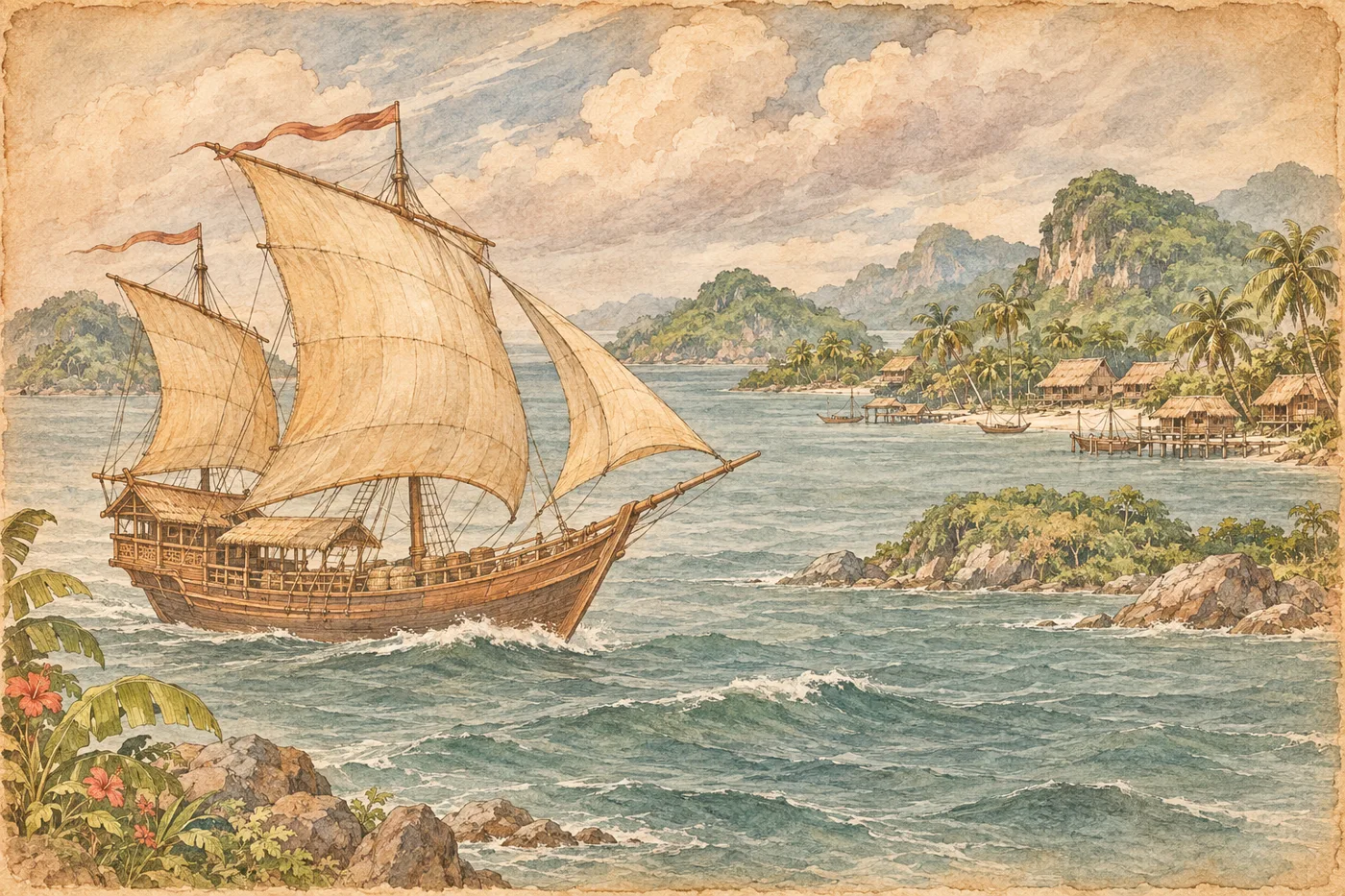
Why did Southeast Asia become a 'crossroads of the sea'?
Southeast Asia is a region of peninsulas and countless islands. Winds that change direction with the seasons blow across these seas: the monsoons. In summer they blow mainly from the southwest, in winter mainly from the northeast. For sailing ships, this was a reliable ally. If you waited for the wind to shift, you could ride it both ways.
There were people who first mastered these winds and seas: the Austronesian language family, thought to have spread southward from around Taiwan. In outrigger canoes that could withstand heavy swells, they crossed to the islands of the Philippines and Indonesia, and even far into the Pacific. To the west, they are believed to have reached as far as Madagascar, off the east coast of Africa.
This region held treasures essential to the world: spices. Cloves and nutmeg in particular were valuable goods that grew only on small islands in the distant Maluku (Molucca) Islands. People in China to the east, and India and the Mediterranean to the west, sought the aromas carried along the long sea routes.
From around the 1st to the 6th century, a kingdom called Funan flourished in the lower Mekong River region. Artifacts found at port ruins include goods from India and gold medallions (including coin-like ornaments) said to be from the Roman Empire. This shows that ships from east and west exchanged goods in this area.
In the 7th century, a maritime kingdom based on Sumatra, Srivijaya, grew in power. It charged fees for using its ports from ships passing through the straits and was also known as a center for Buddhist learning. The Tang-dynasty monk Yijing, on his way to India, stayed there for about half a year to study Sanskrit and other subjects.
More than a kingdom, it was a network of linked ports. Reading the wind, crossing the sea, exchanging goods, beliefs, and languages—the history of Southeast Asia is less the story of land kings and more the story of the people of the sea.
Mini timeline
- about 3000–2000 BCAustronesian peoples begin spreading southward from Taiwan (various theories)
- about 5th century BC onward (dates vary)Dong Son culture in northern Vietnam; bronze drums are made
- 1st–6th century ADFunan flourishes in the lower Mekong
- 671 ADYijing stays in Srivijaya (Palembang) on Sumatra en route to India
- 7th centurySrivijaya prospers from strait trade
People in this chapter
He traveled to India by sea and stayed in Southeast Asia on his return journey, leaving travel records.
Guided by stars, waves, and wind, they crossed vast oceans. Their names are lost, but their voyages are monumental in world history.
Meanwhile, elsewhere
Connection to Japan
Japan moved from the Yayoi period into the Kofun and Asuka periods. The maritime routes of Southeast Asia would later connect to Japanese ships in ages to come.
Why it still matters
Southeast Asia is still said to have about 1,000 languages today. The history of people and cultures mixing as they crossed the sea lies behind this diversity. The aromas of world cuisines, such as pepper and cloves, were also carried by this region's maritime history.
Perspectives differ
- Austronesian homeland
- A Taiwan origin is the leading theory, but there are dissenting views. The timeframe of their expansion also varies.
- Timing of arrival in Madagascar
- When and how people reached Madagascar is unknown. Estimates suggest about 1,500 years ago, but researchers disagree.
- Srivijaya's center
- Palembang (on Sumatra) is widely thought to have been the center, but the kingdom's structure and extent remain unclear due to scarce records.
- Reality of the 'kingdoms'
- Funan and Srivijaya are largely known from Chinese records; some view them as loose confederations of port cities rather than centralized states.
Facts checked (5, verified by AI on the web)
- Confirmed Yijing stayed in Srivijaya (Palembang) for about six months in 671 AD New World Encyclopedia: I Ching (monk)
Text correction: 'studying scriptures' → 'studied Sanskrit and other subjects'. Some records emphasize Sanskrit study in India. - Corrected & confirmed A Roman-period medallion was unearthed at the Oc Eo site (Funan's port) The Power of Images: Coin Portraits of Roman Emperors on Jewellery Pendants in Early Southeast Asia (Angkor Database 掲載PDF)
PDF text read and confirmed. The gold disk from Óc Eo (diam. 19mm) is a thin gold foil repoussé imitating a coin of Antoninus Pius (138-161), a decorative pendant (not a Roman coin itself). Another gold disk has been attributed to Marcus Aurelius, but the paper argues the inscription better matches Commodus (issue type of 192), with attribution uncertain. Therefore, 'gold ornament imitating Roman coins' is more accurate than 'Roman gold coin.' - Corrected & confirmed Dong Son bronze drums date to about the 5th century BC Encyclopaedia Britannica: Dong Son culture
Dates range from 7th century BC to after 3rd century BC depending on sources (Britannica gives oldest artifact around 300 BC). The timeline says 'about 5th century BC onward (dates vary)'. - Confirmed Arrival in Madagascar is likely between the 5th and 8th centuries AD, with firm evidence from the middle of the 1st millennium AD onward Oxford School of Archaeology: Settling Madagascar
The text says 'believed to have reached' and the debates section shows a range, which is consistent. - Corrected & confirmed Austronesian Taiwan origin (about 5,000 years ago) Liu, Ko & Stoneking (2023), PNAS Nexus: Taiwanese Austronesian genomic diversity (PMC)
Checked with papers: Linguistics strongly supports a Taiwan origin, with the split between Taiwan languages and Malayo-Polynesian estimated about 5,000 years ago. Genetic estimates range from 4,000 to 8,000 years ago, and migration patterns are debated. The text retains 'various theories'.
Sources
New World Encyclopedia: I Ching (monk)
Encyclopaedia Britannica: Dong Son culture
Oxford School of Archaeology: Settling Madagascar
Liu, Ko & Stoneking (2023), PNAS Nexus: Taiwanese Austronesian genomic diversity (PMC)
The Power of Images: Coin Portraits of Roman Emperors on Jewellery Pendants in Early Southeast Asia
* AI-drafted and cross-checked; human review is in progress. Status: