EU — From a Battlefield Continent to Building a Community
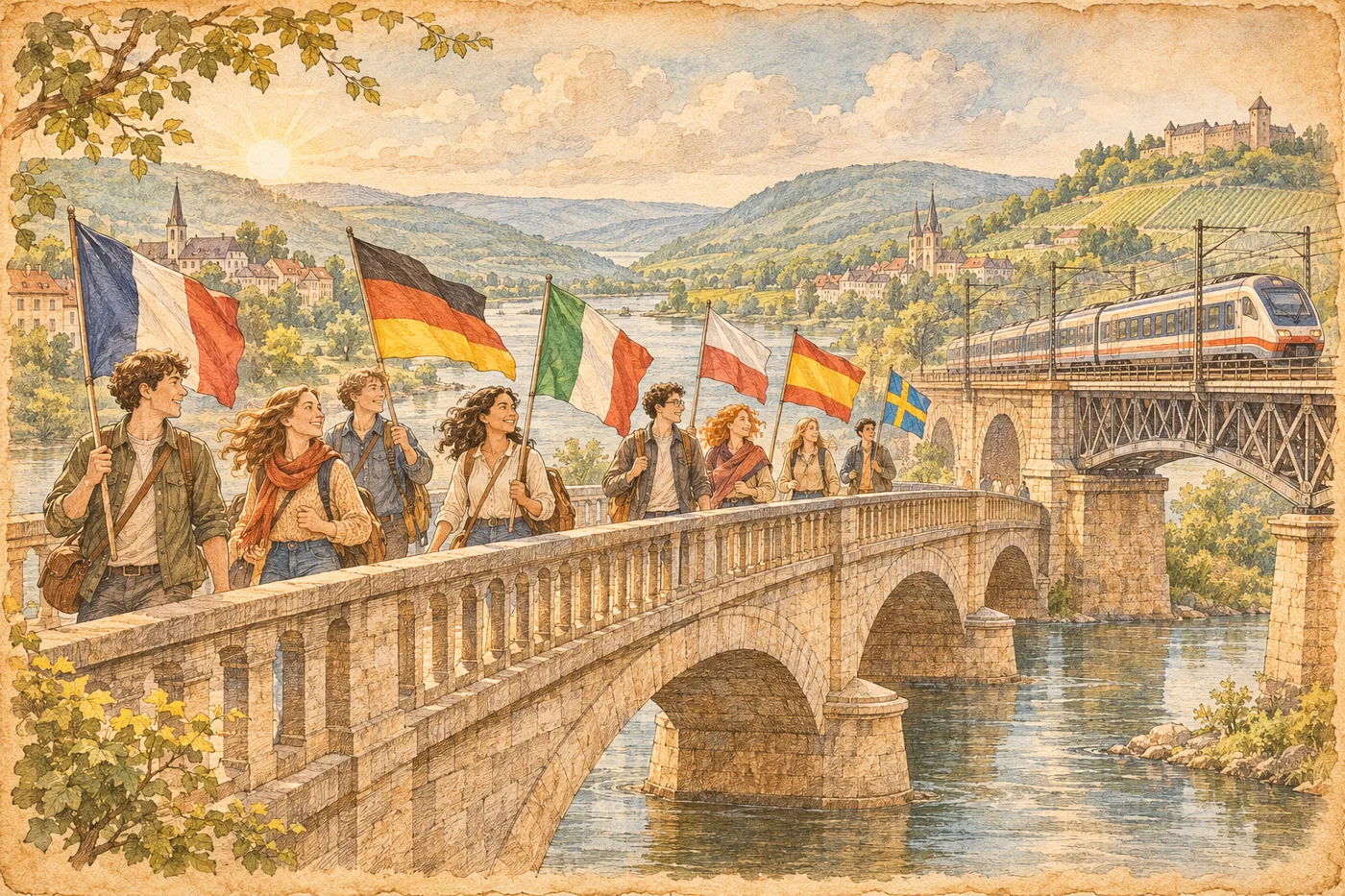
Why did countries that had fought each other so many times decide to create a shared system together?
After World War II, many cities in Europe lay in ruins. Furthermore, the confrontation between the United States and the Soviet Union (the Cold War) began, dividing Europe into East and West. In 1946, Britain's Churchill described this situation with the phrase "Iron Curtain," which separated East and West. From 1948, the United States supported the reconstruction of Western Europe with the Marshall Plan.
As an answer, French politician Robert Schuman made a proposal in 1950. He suggested that France and Germany jointly manage the coal and steel that were the materials of war (the Schuman Declaration). In 1951, six countries—France, West Germany, Italy, and the Benelux three—signed a treaty, and in 1952 the European Coal and Steel Community was established.
The Treaty of Rome in 1957 created the European Economic Community (EEC), aiming for a common market in the broader economy. This later became the European Community (EC), and Britain and others joined (1973). In the 1980s, Greece, Spain, and Portugal also joined, supporting their transitions from dictatorships to democracies.
In November 1989, the Berlin Wall fell, and Germany was reunified the following year in 1990. Communist regimes also fell in Eastern Europe. Then, after the Maastricht Treaty of 1992, the European Union (EU) was established in 1993. Unprecedented challenges began, such as the free movement of people across borders and the unification of currency.
The euro was introduced in 1999 (with cash circulation in 2002), and in 2004 ten countries including Eastern European nations joined. Bulgaria and Romania joined in 2007, bringing the number of member states to 27 at that time. Countries once divided into opposing sides now share a parliament and a court. It was an experiment with few precedents in the world.
However, there are also many challenges. From around 2010, fiscal crises in Greece and elsewhere raised questions about the euro system. There is also debate over how much authority should be transferred between national sovereignty and integration. The long experiment of a continent that was once a battlefield continues to this day.
Mini timeline
- 1948Reconstruction of Western Europe begins with the Marshall Plan
- 1952Six countries establish the European Coal and Steel Community
- 1957Treaty of Rome; steps toward a common market begin
- 1989–90Fall of the Berlin Wall, German reunification
- 1993European Union (EU) is established
People in this chapter
One of the originators of European integration, deeply involved in preparing the Schuman Declaration.
In his 1950 declaration, he proposed joint management of French and German coal and steel, creating the first step toward integration.
Meanwhile, elsewhere
Connection to Japan
Japan and the European Community issued a joint declaration in 1991, confirming cooperation in politics and economics.
Why it still matters
Today, the common currency, the euro, is used in many EU member states. Many people cross borders for work or study, and European countries have grown closer than they used to be.
Perspectives differ
- Motives for integration
- Whether for peace, for economic reasons, or to counter the US and Soviet Union during the Cold War—the motives differed depending on the countries and politicians involved, and which is emphasized varies among scholars.
- Evaluation of the euro
- The common currency is praised for making transactions easier, but criticized for highlighting disparities between fiscally weak and strong countries.
- Sovereignty vs. integration
- Opinions are divided even within countries on whether integration should proceed or national powers should be protected. The background of 'Euroscepticism' also varies by country.
- End of the Cold War
- Views differ on whether the Cold War ended in 1989 (fall of the Wall) or 1991 (dissolution of the Soviet Union).
- Scope of this chapter
- This chapter covers up to around 2011. As developments since then are fast-changing, please check reliable reporting elsewhere for confirmation.
Facts checked (4, verified by AI on the web)
- Confirmed Churchill's 'Iron Curtain' speech in 1946 / Marshall Plan from 1948 Britannica: Iron Curtain speech (1946)
Marshall's proposal was in 1947; implementation 1948–51. - Confirmed Schuman Declaration in 1950 EU: Schuman Declaration May 1950
May 9, 1950. Monnet prepared the draft. - Corrected & confirmed European Coal and Steel Community established by six countries in 1952 EU: Founding agreements
Text correction: treaty signed April 18, 1951; entered into force July 23, 1952, so the text reads 'signed a treaty in 1951, established in 1952'. - Confirmed Treaty of Rome (EEC) in 1957 / Maastricht Treaty 1993 establishes EU / Euro introduced 1999 (cash in 2002) / 27 member states in 2007 EU: History of the European Union 1990-99
EEC entered into force in January 1958 (date varies by source: 1st or 18th).
Sources
Britannica: Iron Curtain speech (1946)
EU: Schuman Declaration May 1950
EU: Founding agreements
EU: History of the European Union 1990-99
Britannica: European Union (EU)
* AI-drafted and cross-checked; human review is in progress. Status: