The Nomads of the Steppe — A World Changed by the Horse
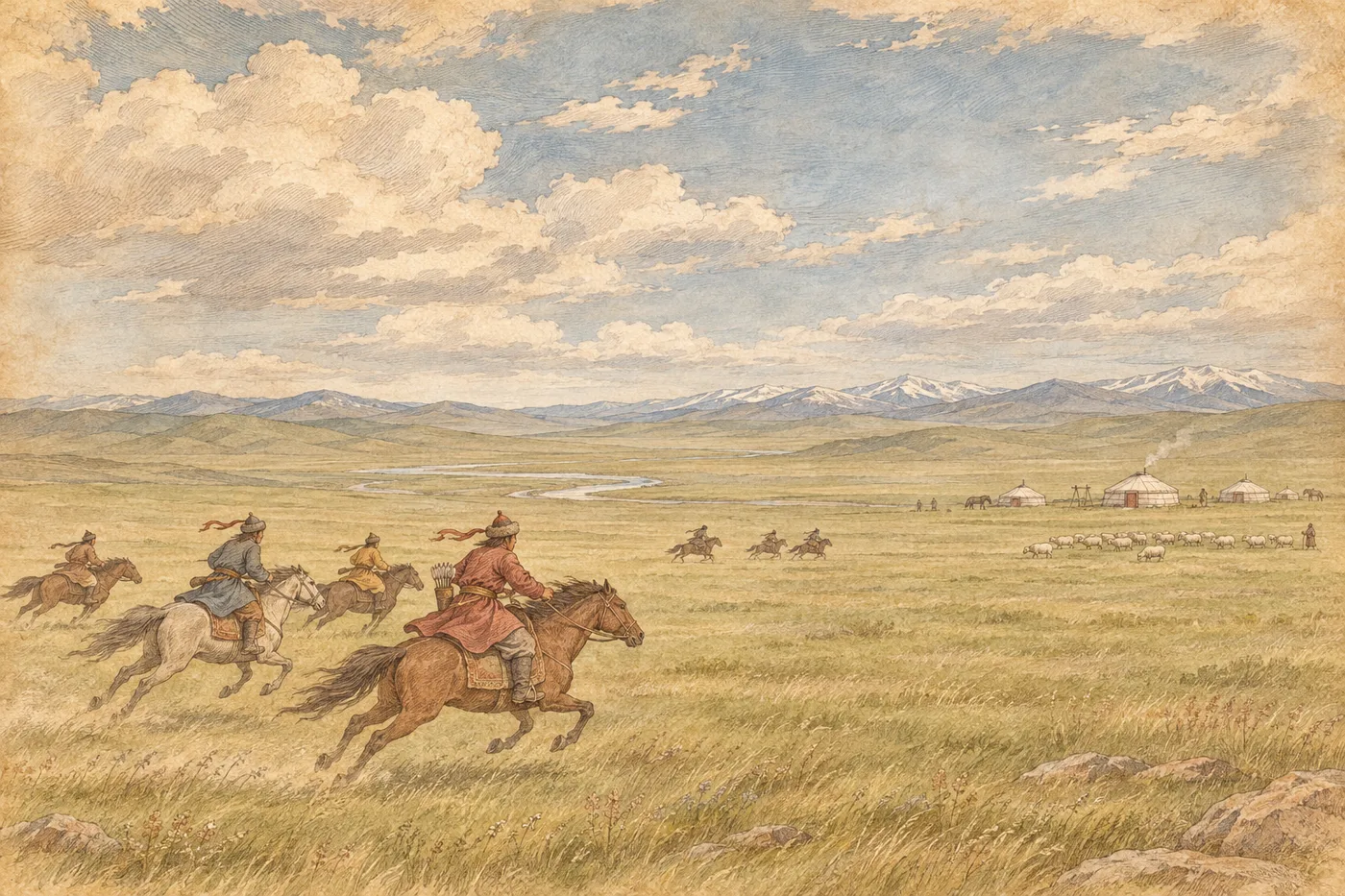
Why did people of the grass plains, with no farms, gain enough power to move great nations?
From the shores of the Black Sea to present-day Kazakhstan and Mongolia. Through the middle of Eurasia runs a vast belt of grassy steppe with few trees. Rainfall is scarce, unsuitable for growing wheat. But grass grows abundantly. Sheep and horses eat this grass, and people live alongside their herds. That is nomadic pastoralism.
There are various theories about when and where people first began to keep horses. Candidates include the central Eurasian steppe around 3500 BC and the steppe north of the Black and Caspian Seas in the 3rd millennium BC (until about 2200 BC). The initial purpose seems to have been to obtain milk and meat. Eventually, horses were also used to pull chariots. Remains from a steppe site around 1900 BC show traces of what appears to have been chariot use.
When people began to ride horses directly in battle, warfare around the world changed. Around the 7th century BC, horse-riding people called the Scythians appeared on the steppe north of the Black Sea. Later, in the 5th century BC, the Greek historian Herodotus wrote about their way of life. Scythian tombs have yielded splendid gold ornaments carved with animal figures.
The steppe people moved seasonally with their herds across a vast, borderless space. They lived in portable tents (called gers in Mongolia, yurts in Central Asia) and made fermented drinks from horse milk. Their lifestyle, unbound by land or fixed houses, was also well-suited to moving information and goods quickly.
At the end of the 3rd century BC, on the eastern steppe, a leader named Modun Chanyu united many tribes and created a large nomadic state called the Xiongnu. Those troubled by this were the Qin, who had unified China, and the Han dynasty that followed. The Great Wall of China was created by connecting earlier walls during the Qin dynasty and was rebuilt by later dynasties.
Around 139 BC, the Han emperor Wu sent Zhang Qian west to the Greater Yuezhi in an effort to attack the Xiongnu from both sides. The alliance did not succeed, but the information Zhang Qian brought back about the West opened the way for the later Silk Road. The steppe people were not just enemies; they were also a bridge connecting East and West.
Mini timeline
- about 3500 BCHorse keeping is thought to have begun on the central Eurasian steppe (timing and location debated)
- about 1900 BCChariots pulled by horses are used on the steppe
- about 7th century BCScythian horse-riding nomads appear north of the Black Sea
- about 209 BCModun Chanyu becomes leader of the Xiongnu and expands the state
- about 139 BCThe Han emperor Wu sends Zhang Qian west
People in this chapter
He united the tribes, built a strong state, and put great pressure on the Han.
He traveled west, was held captive for a long time, but returned to report what he had seen, sparking East-West exchange.
Meanwhile, elsewhere
Connection to Japan
The Japanese archipelago was transitioning from the Jōmon to the Yayoi period around this time. Rice cultivation was spreading (the exact timing is debated).
Why it still matters
In Mongolia, Kazakhstan, and elsewhere, people still practice nomadic herding today. The ger (yurt) is still used as a portable, easy-to-assemble dwelling.
Perspectives differ
- Where and when horses were first domesticated
- The Botai culture of northern Kazakhstan has been known as an early example, but recent genetic research suggests the ancestors of modern domestic horses came from a different area (the Volga and Don River basins). The 'when and where' is still debated.
- What ethnic group the Xiongnu were
- There are various theories about their language family—Turkic, Mongolian, or others—and it is not clear. It should also be noted that most historical records come from the Chinese side, who were their enemies.
- The purpose of the Great Wall
- The common explanation is to prevent invasions by nomads, but some researchers emphasize its roles in border management, controlling trade, and serving as a road for military movements.
- The image of nomads
- It is pointed out that because most historical records were written by people of agricultural societies, nomads are often depicted as 'barbarian invaders'. In reality, they played a major role in trade and the transmission of technology.
Facts checked (5, verified by AI on the web)
- Corrected & confirmed The Botai culture (c. 3500 BC) shows evidence of horse keeping and milk use, but modern domestic horses are not descended from them Librado et al. 2021 "The origins and spread of domestic horses from the Western Eurasian steppes"
Modern domestic horses (DOM2) are thought to have originated in the 3rd millennium BC in the Volga-Don region north of the Black and Caspian Seas and spread rapidly from around 2000 BC. Text correction: 'about 2200 BC' changed to 'the 3rd millennium BC (until about 2200 BC)' - Unverified Modun Chanyu took the throne in 209 BC and united the Xiongnu Britannica「Maodun」
The entry recording Modu's accession year (209 BCE) cannot be verified: World History Encyclopedia page is a list view, Britannica returns 403. - Confirmed Zhang Qian departed for the Greater Yuezhi around 139 BC Britannica「Zhang Qian」
The departure year is given as either 139 BC or 138 BC. The text uses 'around' which is already noted. - Confirmed The Scythians appeared north of the Black Sea around the 7th century BC, and Herodotus (5th century BC) recorded them Britannica「Scythian」
The Scythians moved into southern Russia and Ukraine in the 8th–7th centuries BC. Herodotus lived in the 5th century BC. - Confirmed Traces of chariots from around 1900 BC have been found in Sintashta culture tombs Antiquity (Cambridge Univ. Press): Chariots in the Eurasian steppe: a Bayesian approach to the emergence of horse-drawn transport in the early second millennium BC
Text correction: 'about 2000 BC' changed to 'about 1900 BC'. The chariot burial at Kamenny Ambar 5 is dated by Bayesian analysis to 1950–1880 BC. There is debate over whether these were true chariots or carts, and the text says 'appears to have been'.
Sources
Librado et al. 2021 "The origins and spread of domestic horses from the Western Eurasian steppes"
Britannica「Maodun」
Britannica「Zhang Qian」
Britannica「Scythian」
Antiquity (Cambridge Univ. Press): Chariots in the Eurasian steppe: a Bayesian approach to the emergence of horse-drawn transport in the early second millennium BC
* AI-drafted and cross-checked; human review is in progress. Status: