Oases and Sogdian Merchants — The People Who Linked the Desert Routes
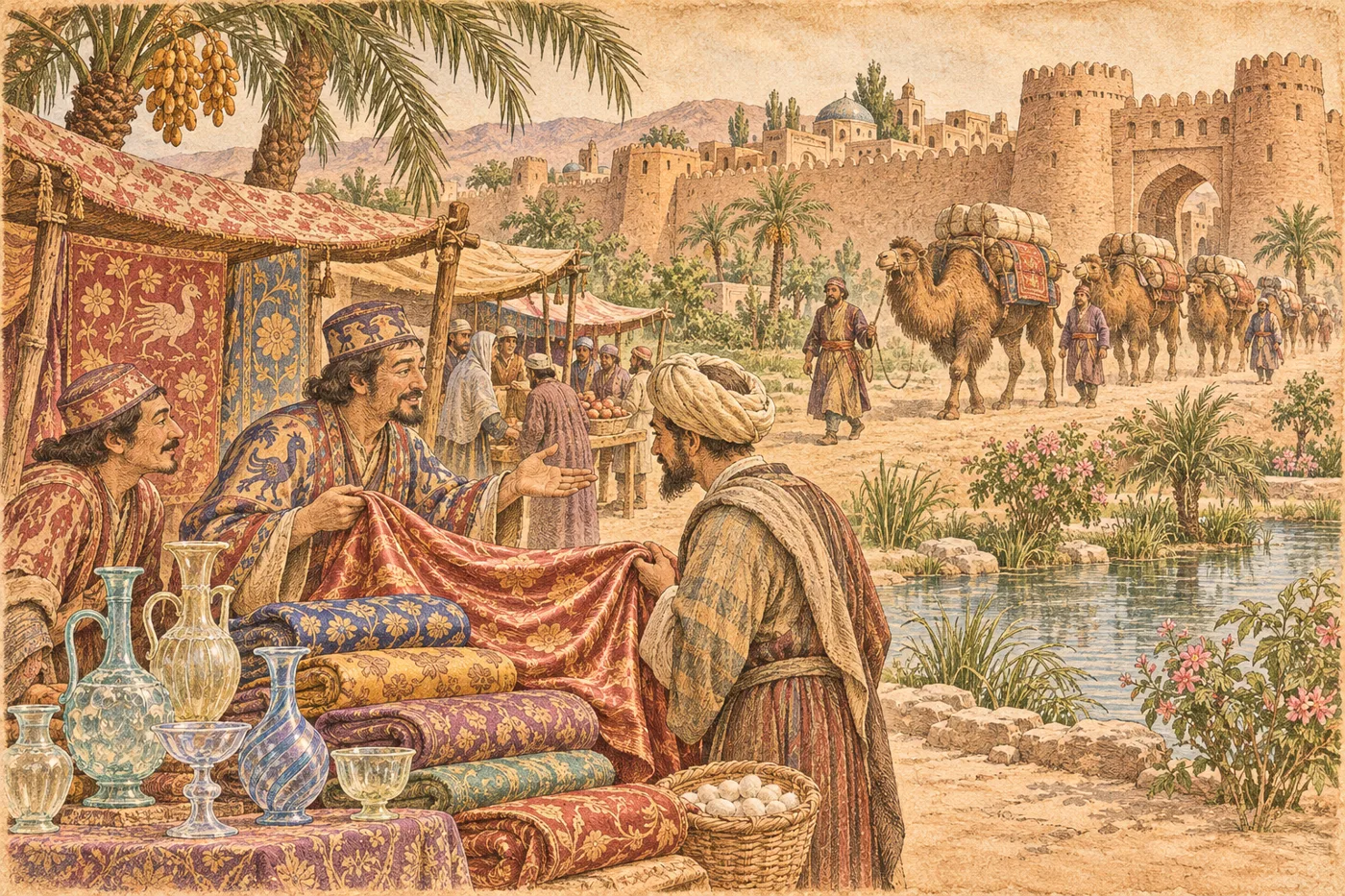
Why did small towns in the middle of the desert become the main players on the routes linking East and West?
Using the information brought back by Zhang Qian in the previous chapter, routes from China westward were gradually developed. Around 60 BC, the Han established the 'Protectorate of the Western Regions' to assert control over the area of modern-day Xinjiang. Around the Taklamakan Desert, small towns called oases, fed by melting snow, were strung along like beads.
Dunhuang, Khotan, Kucha, Kashgar, and further west, Samarkand and Bukhara—these oasis towns provided travelers with water, food, lodging, and markets. In Turfan, people developed techniques for living in the desert, such as digging underground canals (karez) to channel mountain water.
The name 'Silk Road' was actually popularized in the 19th century by the German geographer Ferdinand von Richthofen. In reality, it was not a single road but a network of routes linked like a mesh. It is thought that most merchants did not travel the entire journey alone, but transported goods from town to town, passing them on.
The most prominent merchants active on this network were the Sogdians, from the region of Sogdiana centered on Samarkand in modern Uzbekistan. They spoke an Iranian language, and Sogdian became a common language of trade. Their letters, believed to date from around the early 4th century, were discovered near Dunhuang and reveal the lives of Sogdian merchants living in far-off Chinese towns.
What was transported was not only silk, jade, glass, spices, and horses. Religions such as Buddhism, Zoroastrianism, Manichaeism, and a branch of Christianity (Nestorianism), as well as music, clothing, and technology, also moved east and west with merchants and traveling monks. The Tang monk Xuanzang traveled this route to India and back from around 629, leaving the travel record 'Great Tang Records on the Western Regions.'
The Sogdians also had a significant presence in China. An Lushan, who later shook the Tang dynasty, is said to have had a Sogdian father. Their merchant network was an 'invisible road' that crossed borders. But the fate of that road would soon be profoundly affected by new powers and faiths arriving from the western steppes.
Mini timeline
- around 60 BCThe Han establishes the Protectorate of the Western Regions and advances along the western route
- around early 4th centuryThe Sogdian 'Ancient Letters' are believed to have been written
- around 629Xuanzang departs for India
- 755An Lushan rebels (the An Lushan Rebellion)
People in this chapter
After a difficult journey, he studied Buddhism in India and brought back many scriptures. His travel record is a valuable historical source.
He is said to have had a Sogdian father and a Turkic mother. He gained the Tang court's trust and rose to prominence, but later led a major rebellion.
Meanwhile, elsewhere
Connection to Japan
The Shōsōin Repository in Nara (8th century) preserves glass vessels said to be in the style of the Sasanian Persian Empire, suggesting that the eastern end of the Silk Road reached even Japan.
Why it still matters
Samarkand in Uzbekistan is registered as a World Heritage site as a 'crossroads of culture,' and the Mogao Caves at Dunhuang in China as a treasure house of Buddhist art.
Perspectives differ
- The term 'Silk Road'
- Popularized by Richthofen in 1877, this is a later name. People at the time did not call it the 'Silk Road.' Moreover, it was not a single road, and the trade was not limited to silk.
- Dating of the Sogdian Ancient Letters
- The letters found near Dunhuang are widely believed to date from around the early 4th century (around 313), but estimates vary among researchers.
- The role of the Sogdians
- While the image of 'merchants' is strong, documents and artifacts show they also worked as farmers, craftsmen, envoys, and soldiers.
- An Lushan's origins
- His father is said to be Sogdian and his mother Turkic, but the records are mainly from the Tang side, and there is debate among researchers about his actual background and ethnic identity.
Facts checked (5, verified by AI on the web)
- Confirmed Around 60 BC, the Han established the Protectorate of the Western Regions ChinaKnowledge: Political History of the Han Period
The Protectorate was established in 60 BC, with its first seat at Wulei (Wulei). The first protector is said to be Zheng Ji (some say it was established in 59 BC). - Confirmed The Sogdian 'Ancient Letters' date from the early 4th century (around 313) Smithsonian「Sogdian ancient letters」
Believed to be from around 312/313; the British Library catalog gives 313–314. Discovered by Stein in 1907 at a watchtower west of Dunhuang. - Confirmed The term 'Silk Road' was popularized by Richthofen Mertens「Did Richthofen Really Coin the Silk Road?」
Popularized by Richthofen in 1877, but there are earlier uses, so he was not the sole originator. The text's phrasing 'popularized' is consistent. - Confirmed Xuanzang departed around 629 and left the 'Great Tang Records on the Western Regions' University of Washington: Xuanzang's Record of the Western Regions
He departed Chang'an in 629, returned in 645, and the 'Records' were completed in 646 (some theories suggest a departure year of 627). - Confirmed An Lushan's father was Sogdian and his mother Turkic; he rebelled in 755 EBSCO Research Starters: Rebellion of An Lushan
His father is said to be Sogdian and his mother Turkic. The rebellion began in 755 and was suppressed in 763 (An Lushan himself was killed in 757). There are alternative theories about his origins.
Sources
Smithsonian「The Sogdians: Ancient Letters」
ChinaKnowledge: Political History of the Han Period
Mertens「Did Richthofen Really Coin the Silk Road?」
University of Washington: Xuanzang's Record of the Western Regions
EBSCO Research Starters: Rebellion of An Lushan
* AI-drafted and cross-checked; human review is in progress. Status: