The Talas River and Islamization — A New Faith Spreads Across the Steppe
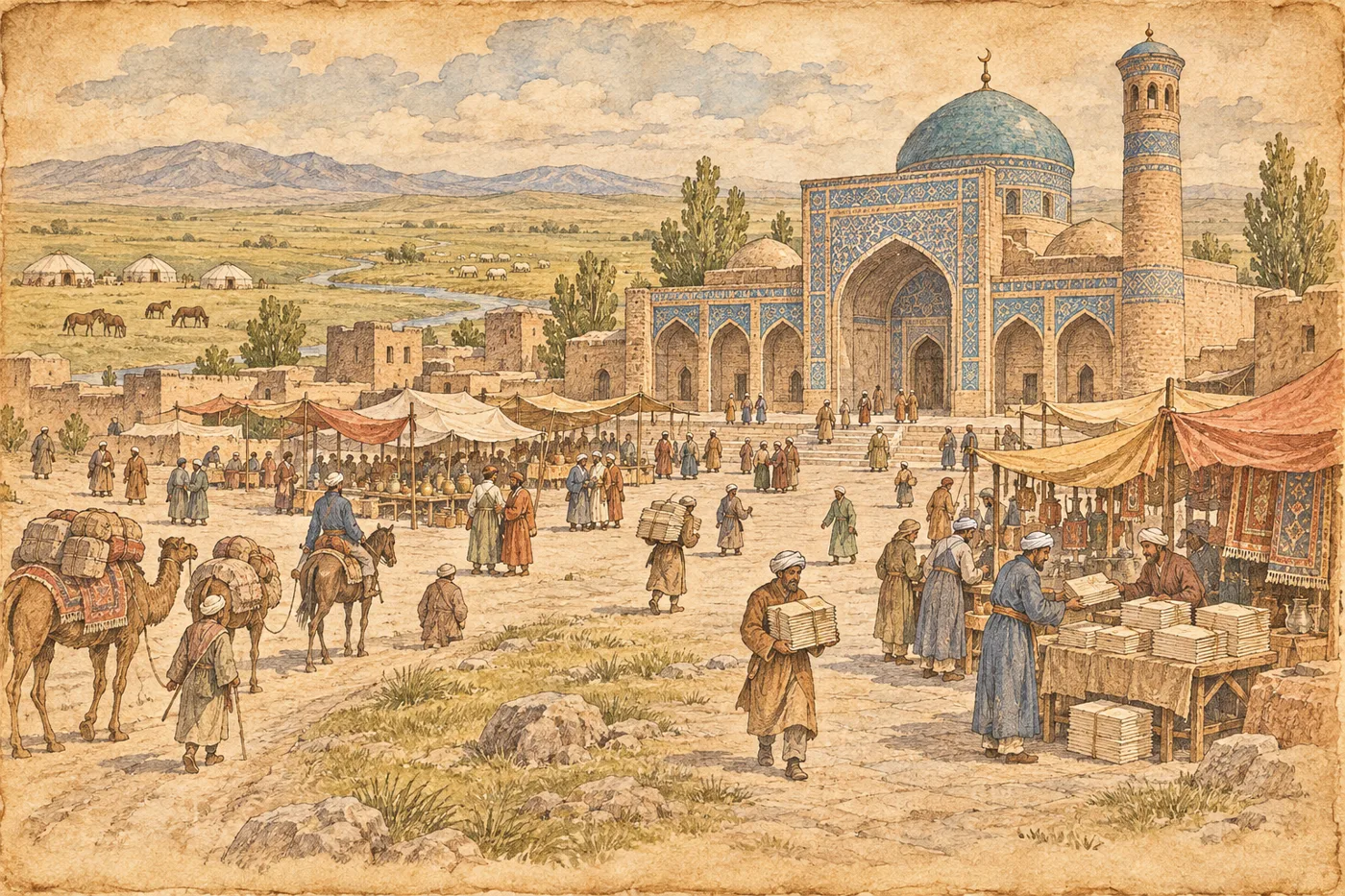
Why did the people of Central Asia gradually come to accept Islam over time?
In 651, when the Sassanid Persian Empire was destroyed by Islamic forces, their momentum turned further east. The Arab people called the land beyond the Amu Darya 'Mā warāʾ an-nahr' (the land beyond the river). By the early 8th century, oasis towns like Samarkand and Bukhara had come under Arab control.
Meanwhile, from the east, the Tang dynasty was expanding westward, bringing oasis kingdoms under its sway. In 751, the two great powers clashed at the Talas River, near the present-day border of Kyrgyzstan and Kazakhstan. The Tang general was Gao Xianzhi, and the Abbasid side was led by the governor Ziyad ibn Salih. It is said that the Turkic Karluk tribe, who were serving in the Tang army, switched sides, and the Tang forces were defeated.
However, it goes too far to consider this battle a 'decisive clash that divided the world.' When the An Lushan Rebellion broke out in Tang China a few years later in 755, the Tang gradually lost the strength to hold the Western Regions on their own. As a result, a rough division emerged: the western part of Central Asia deepened its ties with the Islamic world, while the eastern part maintained ties with China.
Conversion to Islam did not happen all at once immediately after the conquest. Merchants, scholars, and mystics (Sufis) blended into people's lives over many generations. In the 9th–10th centuries, the Samanid dynasty, with its capital at Bukhara, patronized Persian-language culture, fostering scholarship and poetry.
Central Asia at this time was one of the world's leading centers of knowledge. The scholar al-Biruni, born in the Khwarazm region, was versed in astronomy, geography, and history; he traveled to India and wrote the 'India' (Kitab al-Hind). Ibn Sina (980–1037), born near Bukhara, wrote the 'Canon of Medicine' (also introduced in the Middle East chapter on Baghdad's golden age).
After that, the number of people speaking Turkic in addition to Persian increased in the region. Central Asia gradually changed into a region that suited the name 'Turkistan' (land of the Turks).
Mini timeline
- 651The Sassanid Persian Empire falls
- c. 705–715Arab forces take control of Samarkand, Bukhara, etc.
- 751Battle of the Talas River
- 9th–10th centuriesPersian-language culture flourishes under the Samanid dynasty
- First half to middle of the 10th centuryThe Qarakhanid dynasty accepts Islam (dates are debated)
People in this chapter
Said to have been born in the Khwarazm region in 973. He was versed in astronomy, mathematics, and history, and recorded Indian culture in detail.
Born near Bukhara, he studied in Central Asia. Later active in various parts of West Asia, he left a classic work of medicine.
Meanwhile, elsewhere
Connection to Japan
Japan was in the Nara period. The year after the Battle of the Talas River in 751, in 752, the eye-opening ceremony for the Great Buddha of Tōdai-ji was held.
Why it still matters
Today, Muslims form the majority in Uzbekistan, Kazakhstan, Kyrgyzstan, Tajikistan, and Turkmenistan. In Samarkand, there is a workshop that recreates the papermaking techniques of that era.
Perspectives differ
- Significance of the Battle of the Talas River
- It is sometimes described as a 'great battle that changed history,' but the prevailing view is that it was not particularly large in scale and was merely one trigger that halted Tang expansion westward. The main cause of Tang's decline is considered to be the An Lushan Rebellion.
- Spread of papermaking
- The famous story says that papermaking techniques were passed on from captured Tang craftsmen after this battle, but it is possible they had already spread via another route; the actual facts are not confirmed.
- Process of conversion
- Conversion is thought to have taken place over several centuries after the conquest. The degree of coercion and differences by region and class are debated among scholars.
- The Karluk defection
- This is often cited as the reason for the Tang defeat, but the content of the records differs depending on the historical source.
Facts checked (5, verified by AI on the web)
- Confirmed Battle of Talas River (751): Tang's Gao Xianzhi vs. Abbasid's Ziyad ibn Salih World History Encyclopedia: Abbasid Dynasty
The Abbasid victory in 751 is confirmed by WHE. The commanders' names (Gao Xianzhi, Ziyad) are not in WHE but match multiple secondary sources. The Karluk defection is the most debated point; the text says 'it is said.' - Confirmed The Samanid dynasty (819–999) patronized Persian-language culture from Bukhara Britannica「Samanid dynasty」
It contributed to the establishment of New Persian as a literary language. Poets like Rudaki and scholars like Ibn Sina were active. - Corrected & confirmed Conversion of the Qarakhanid dynasty around the mid-10th century EBSCO「Qarakhanids convert to Islam」
There are theories that Satuk Bughra Khan converted in 934 and around 950–955. Text revised: 'mid-10th century' → 'first half to middle of the 10th century (dates are debated).' - Confirmed al-Biruni was born in 973 in Khwarazm and wrote the 'India' MacTutor (St Andrews): Abu Arrayhan Muhammad ibn Ahmad al-Biruni
Confirmed by the University of St Andrews MacTutor that he was born near Kath, Khwarazm in September 973, and his major work 'India' appeared around 1030. Year of death is debated. - Confirmed Ibn Sina lived 980–1037 Britannica「Samanid dynasty」
Also mentioned as a scholar gathered at the Samanid court. 'Born near Bukhara' was unconfirmed in this search.
Sources
World History Encyclopedia: Abbasid Dynasty
Britannica「Samanid dynasty」
EBSCO Research Starters「Qarakhanids Convert to Islam」
MacTutor (St Andrews): Abu Arrayhan Muhammad ibn Ahmad al-Biruni
* AI-drafted and cross-checked; human review is in progress. Status: