The Mongols and Timur — Two Great Empires Born from the Steppe
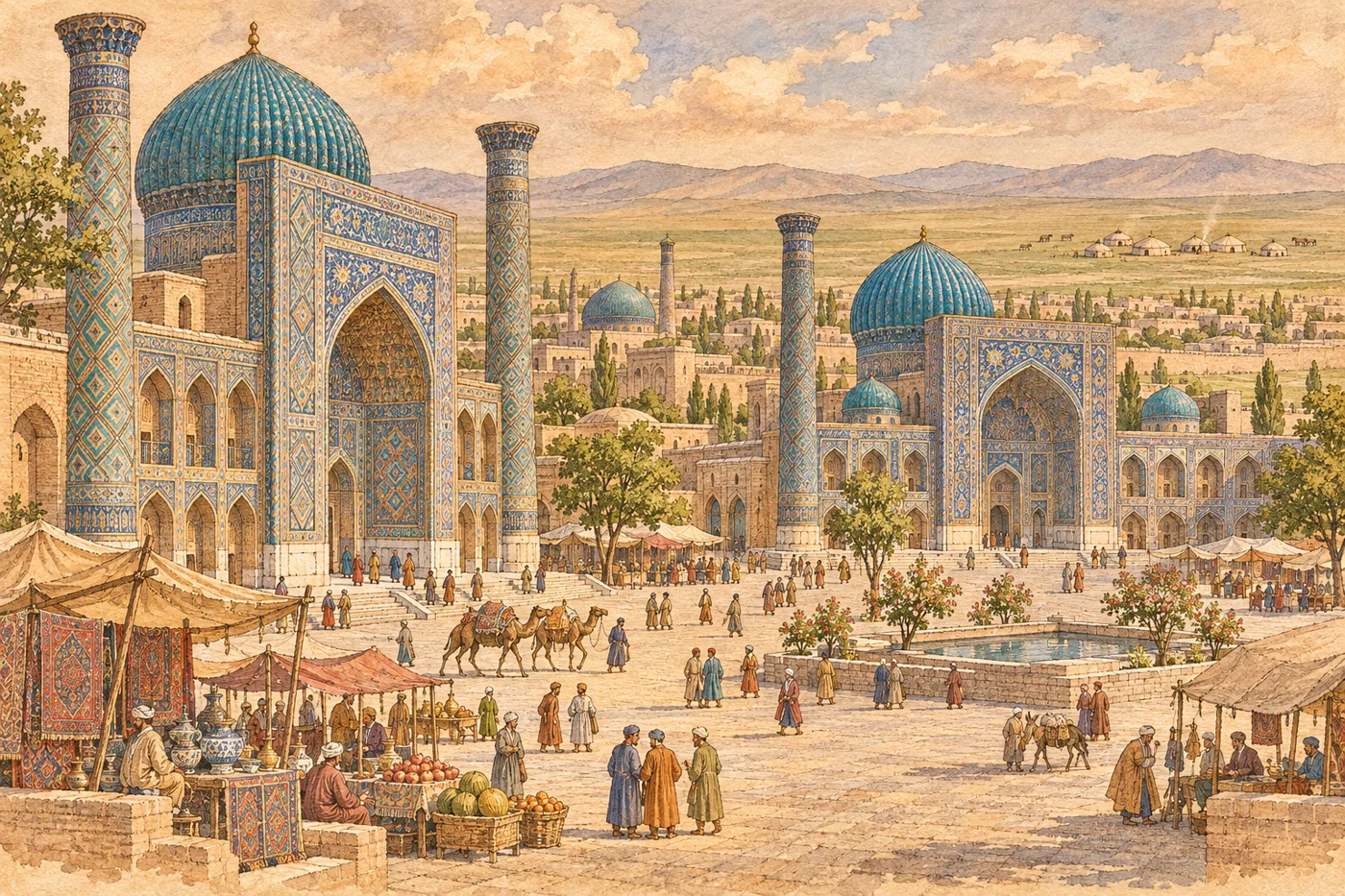
How did two powers from the grasslands come to dominate the oasis towns and build great empires?
In 1206, Temüjin, who had united the tribes of the Mongolian Plateau, received the title 'Genghis Khan.' The Mongol army expanded its power through the mobility of its cavalry and the flexibility to incorporate surrendered enemies into its ranks. From 1219, they began a campaign into Central Asia against the Khwarazmian dynasty.
The trigger is said to have been an incident in which the Khwarazmians killed a Mongol trade caravan (the Otrar Incident). Major cities such as Samarkand and Bukhara were successively taken in 1220. Many residents are said to have lost their lives, but the number of casualties varies greatly depending on the source.
After Genghis Khan died in 1227, the empire was inherited by his sons and grandsons, splitting into several khanates. Central Asia became part of the Chagatai Khanate, ruled by the line of his second son, Chagatai. The 'Pax Mongolica' that united east and west is also credited with temporarily boosting trade and the flow of information.
In the 14th century, a new hero appeared in this region: Timur (c. 1336–1405). Born into the Barlas tribe, a Turco-Mongol clan, he established Samarkand as his capital in 1370 and founded the Timurid dynasty. Since he was not of Genghisid descent, he took the title 'Amir' (commander-in-chief or chieftain), not 'Khan.'
Timur repeatedly launched campaigns; in 1402, at the Battle of Ankara, he defeated the Ottoman sultan Bayezid I. At the same time, he brought craftsmen and scholars from various regions to settle in Samarkand, commissioning magnificent buildings adorned with blue tiles. He died in 1405 during a campaign against the Ming dynasty.
His grandson Ulugh Beg (1394–1449) was both a ruler and an astronomer, building a large observatory in Samarkand. His star catalog was used for a long time afterward. However, the Timurid dynasty fell in 1507, defeated by the Uzbeks (Shaybanids) who came from the north. Prince Babur fled south and later founded the Mughal Empire in India.
Mini timeline
- 1206Temüjin becomes Genghis Khan
- 1220Mongol forces capture Bukhara and Samarkand
- 1370Timur establishes Samarkand as his capital
- 1402Defeats the Ottoman Empire at the Battle of Ankara
- 1507The Timurid dynasty falls
People in this chapter
He combined a fierce warrior on campaign with a patron of culture.
During his reign, he gathered scholars, built an observatory, and advanced precise star observations.
Meanwhile, elsewhere
Connection to Japan
Japan was invaded by the Mongols (Yuan) in the Kamakura period (1274 and 1281), and the age of Timur corresponds to the Muromachi period.
Why it still matters
In Uzbekistan, after independence, Timur was honored as a national symbol, and a statue of him stands in the capital Tashkent. The blue-tiled architecture of Samarkand's Registan Square and other sites is a legacy of the Timurid dynasty.
Perspectives differ
- Casualties of the Mongol conquests
- The populations of many cities are said to have been heavily depleted, but estimates of the number of victims range from hundreds of thousands to millions. Contemporary sources are believed to contain exaggerations.
- Assessment of Mongol rule
- Some views emphasize the 'Pax Mongolica' that promoted East-West exchange, not just destruction. Other researchers weigh the scale of damage heavily, and opinions remain divided.
- Assessment of Timur
- In Uzbekistan, Timur is cherished as a national hero. On the other hand, there are critical views that emphasize the heavy damage he inflicted on the cities he campaigned against.
- Ulugh Beg's observatory
- Construction is said to date to the 1420s, with many accounts placing the start around 1428, but there is some variation in dates. It is also reported that he later lost his life in a political struggle.
Facts checked (5, verified by AI on the web)
- Confirmed In 1206, Temüjin received the title of Genghis Khan Britannica「Genghis Khan: Rise to power」
At a great assembly on the banks of the Onon River. The title is interpreted as 'Universal Ruler' or similar. - Views differ The Otrar Incident (1218) triggered the Khwarazm campaign; the campaign began in 1219 Britannica: Genghis Khan (Rise to power)
Britannica cites the killing of merchants under the protection of the Otrar governor as the trigger and dates the Khwarazm war to 1219–25. World History Encyclopedia cites the execution of envoys as the cause and dates the campaign's start to 1218. Details of the cause and start year differ by source. - Confirmed Samarkand and Bukhara were captured in 1220 Foreign Exchanges「Today in Central Asian history: the Mongols take Samarkand (1220)」
Confirmed by brief explanatory articles only (academic sources not verified for this entry). - Confirmed Timur lived c. 1336–1405 and made Samarkand his capital in 1370 World History Encyclopedia「Timur timeline」
Some sources give the capital's establishment as 1369. His death date is February 1405. - Confirmed In 1402, Timur defeated Bayezid I at the Battle of Ankara World History Encyclopedia「Timur timeline」
The date is given as July 20 or 28 depending on the source, but the year is uniformly 1402.
Sources
Britannica「Genghis Khan」
World History Encyclopedia: Genghis Khan
World History Encyclopedia「Timur」
Foreign Exchanges「Mongols take Samarkand (1220)」
* AI-drafted and cross-checked; human review is in progress. Status: