The Observatory of Samarkand — Ulugh Beg and Central Asian Scholarship
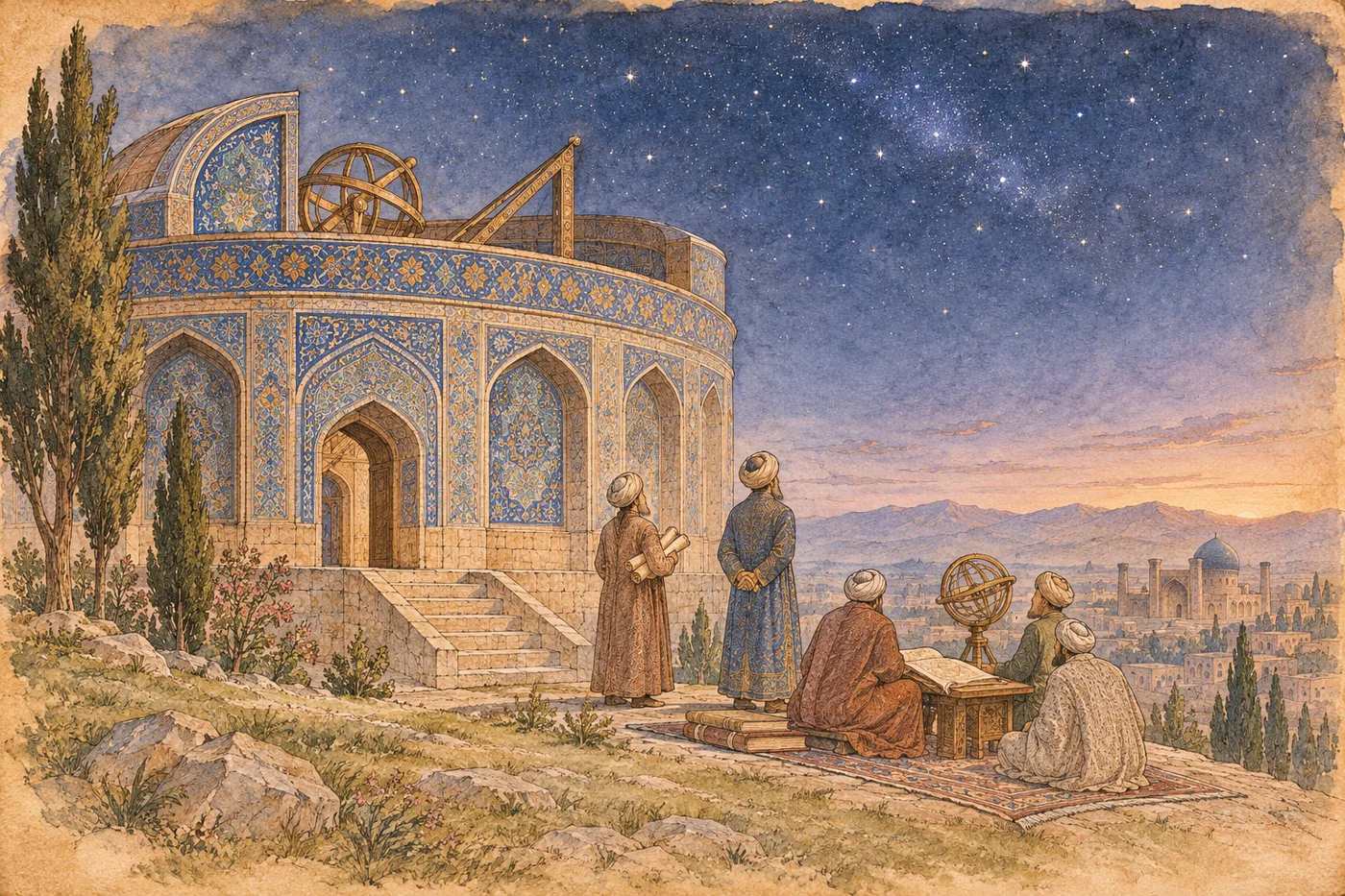
Why did Tamerlane's grandson, a ruler famed for his conquests, spend his nights gazing at the stars?
Ulugh Beg was born in 1394, the grandson of Timur. When his father Shah Rukh moved the capital to Herat, Samarkand was entrusted to the young Ulugh Beg; it is said he was about 16 at the time. He was a man more inclined to scholarship than to politics or war, and he aimed to make the city a center for scholars. The Timurid capital was a city known for its buildings with blue tiles.
Around 1417–1420, he built a madrasa (college) in the city center and invited mathematicians and astronomers from many lands. Well-known names include Jamshid al-Kashi, Qadi-zada, and later Ali Qushji. The scholars are said to have advanced their work through lively debate. The college became a center for astronomy and mathematics.
Construction of the observatory is thought to have begun around 1428 (some accounts say 1424). It was a three-story circular building, estimated to be about 46–48 meters in diameter and 30–35 meters high. In an age without telescopes, the instruments themselves were made huge to improve accuracy. It was a large project carried out with the cooperation of the college's scholars. The size of the instruments determined the precision of the observations.
The centerpiece was a massive meridian arc with a radius of over 40 meters. Each degree on the scale was about 70 centimeters long, allowing the sun's altitude to be read in fine detail. Later studies estimate the observational error at about 1 minute of arc (1/60 of a degree), which is considered the highest standard of pre-telescope observation. This large size was chosen because a larger instrument allows for finer graduations.
The astronomical tables known as the Zij-i Sultani, completed around 1437, included a star catalog of 1018 stars. Many of the positions are said to have been newly determined from years of observations in Samarkand. The work also contained trigonometric tables and calendar calculations, and was used for centuries afterward. The arrangement of the stars followed the order of the ancient Almagest by Ptolemy.
After his father died in 1447, Ulugh Beg was placed in a difficult position, and in 1449 he is said to have been executed on the orders of his son. Nevertheless, his astronomical tables remained a standard reference until the 17th century; a Latin edition was even published in Oxford in 1665. Scholarship outlasted the life of a single ruler, continuing to be read around the world. Manuscripts were copied in many places and read in Persian, Arabic, and Latin.
Mini timeline
- 1394Ulugh Beg is born
- c. 1417–1420The madrasa (college) is built in Samarkand
- c. 1428Construction of the observatory is thought to have begun
- c. 1437Astronomical tables including a star catalog are completed
- 1449Ulugh Beg is executed
- 1908Russian archaeologist excavates the underground part of the observatory
People in this chapter
He built the college and observatory in Samarkand and conducted observations together with scholars.
Invited by Ulugh Beg, he is said to have been one of his closest collaborators. He is also reported to have died before the astronomical tables were completed.
Meanwhile, elsewhere
Connection to Japan
In 1428, Japan was in the Muromachi period; that year saw the peasant uprising known as the Shōchō Uprising in the Kinki region, demanding debt cancellation. In 1449, when Ulugh Beg was executed, Ashikaga Yoshimasa became shogun.
Why it still matters
The arc that remains underground at the observatory site was revealed in excavations in 1908. Ulugh Beg's tomb in the Samarkand mausoleum was also opened and examined in 1941, confirming his remains.
Perspectives differ
- Number of stars and proportion of new observations
- Some sources say the star catalog contains 1018 stars, while others say 992. There are also differing views on how many are based on new observations and how many were carried over from older catalogs; various opinions exist.
- Year the observatory was begun
- Construction is thought to have started around 1428, but this is stated with a caveat such as 'probably'. The completion date and the year it began operation are not clear.
- Appearance of the instrument
- Whether the giant instrument was a quadrant or closer to a sextant—researchers disagree on the overall form, based on reconstructions from the remaining underground portion.
- Circumstances of his death
- Various backgrounds are cited, such as conflict with his son and tensions with religious authorities. Which was the main cause is not clear, and multiple accounts exist.
- Interpreting the accuracy of the astronomical tables
- The tables contain very fine digits, but some studies suggest these are results of later calculations and that the observations themselves were not quite that precise. Even so, the observations are regarded as being of a very high standard for the pre-telescope era.
Facts checked (5, verified by AI on the web)
- Confirmed Construction of the observatory began around 1428; it was over 50 meters in diameter and about 35 meters high. MacTutor (University of St Andrews): Ulugh Beg
MacTutor says construction began in 1428, circular, three stories, over 50m in diameter, 35m high. University of Utrecht pages add 'probably' 1428. The text uses neutral phrases like 'is said to have begun' and 'estimated to be'. - Confirmed The star catalog was compiled around 1437 and contains 1018 stars. Stanford University: The Significance of Ulugh Beg's Zij-i Sultani
Stanford University and Utrecht University pages say 1437 and 1018 stars. MacTutor says 992 stars, so the text states 1018 but notes the discrepancy in the debates section. - Confirmed The meridian arc had a radius of over 40 meters; the underground part was excavated by Vyatkin in 1908. Shchetnikov, Large meridian instrument of the Samarkand Observatory (Schole 20(2), 2026)
A paper gives the radius as 40.2m, with 1 degree = 70.2cm, and an error of about 1 minute. There is debate over whether the reconstruction is a quadrant or a sextant. - Confirmed The madrasa was built around 1417–1420, and scholars were invited there. MacTutor (University of St Andrews): Ulugh Beg
MacTutor says construction began in 1417 and was completed in 1420. Al-Kashi and Qadi-zada were invited. Ali Qushji is mentioned by Stanford as one involved in completing the tables. - Confirmed Ulugh Beg was executed in 1449 on the orders of his son. His tomb was discovered in 1941. MacTutor (University of St Andrews): Ulugh Beg
MacTutor says he lost power after his father's death (1447) and was executed on the orders of his son Abd al-Latif. Stanford gives the date as October 27, 1449. Accounts of the background vary.
Sources
MacTutor (University of St Andrews): Ulugh Beg
Shchetnikov, Large meridian instrument of the Samarkand Observatory (Schole 20(2), 2026)
Utrecht University: Ulugh Beg's star catalogue
Stanford University: The Significance of Ulugh Beg's Zij-i Sultani
* AI-drafted and cross-checked; human review is in progress. Status: