The Great Game — Between the Great Powers
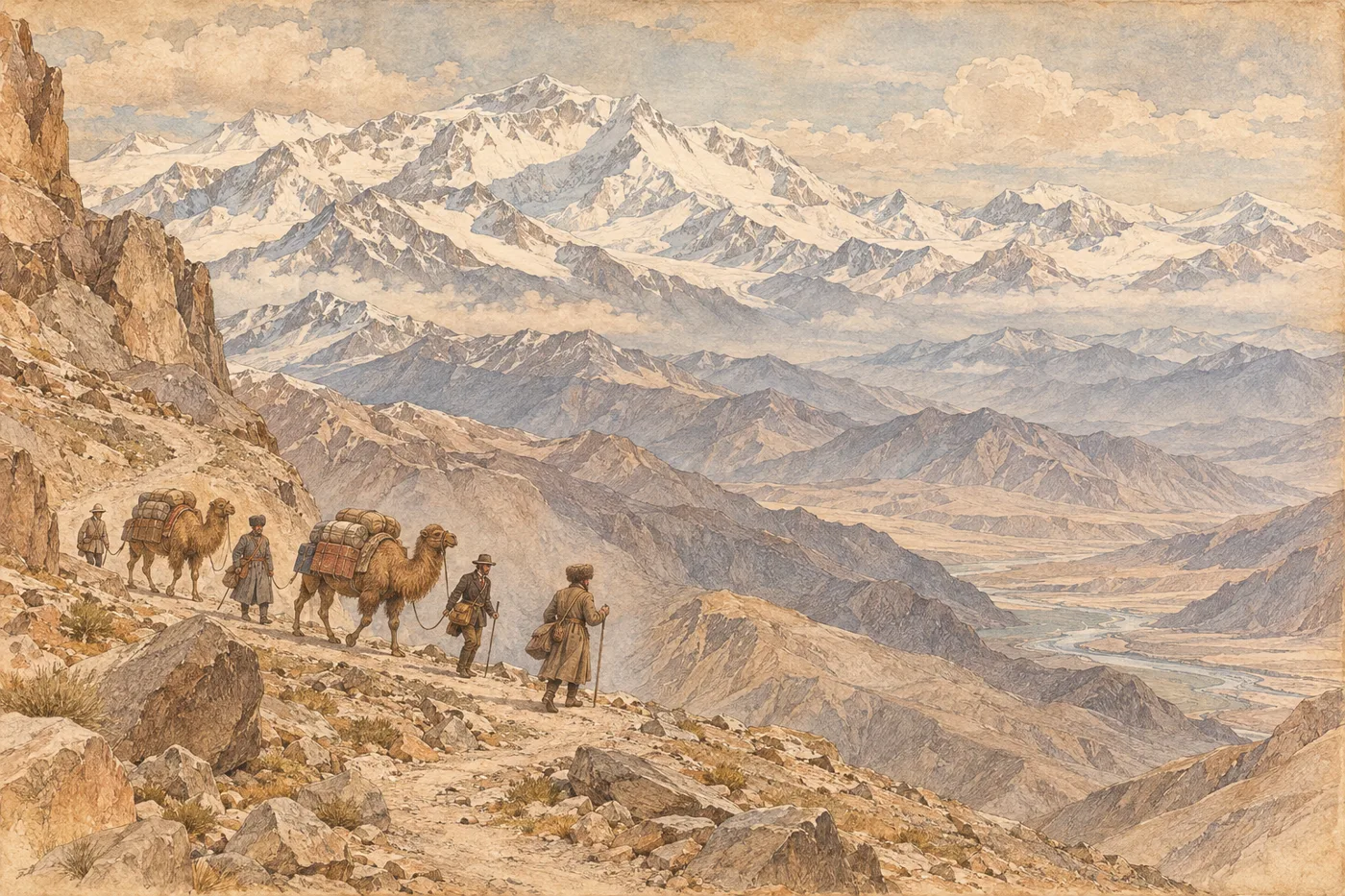
Why was Central Asia described as a 'game board' between Russia and Britain?
In the 19th century, Central Asia was home to three states—the Emirate of Bukhara (also called the Khanate of Bukhara), the Khanate of Khiva, and the Khanate of Kokand—surrounded by nomadic peoples. From the north, the expanding Russian Empire took interest; from the south, Britain sought to protect its colony in India.
The term 'Great Game' was reportedly used by the British officer Arthur Conolly and later popularized by Rudyard Kipling's novel 'Kim' (1901). It refers to an era of maneuvering in which explorers, soldiers, and spies made maps and probed for borders and allies.
Russia captured Tashkent in 1865 and Samarkand in 1868. Bukhara and Khiva became protectorates, and the Khanate of Kokand was annexed in 1876. The Turkmen were defeated at the Battle of Geok Tepe in 1881, and Merv was incorporated in 1884. Russia gradually unified the region, governing it as 'Turkestan.'
Britain, wary of Afghanistan falling under a hostile power, fought two Anglo-Afghan Wars (1839–42 and 1878–80). As a result, Afghanistan became a buffer zone between Russia and Britain. In 1895, the border in the Pamir Mountains was drawn, leaving a narrow strip—the Wakhan Corridor.
Under Russian rule, the region was transformed into a major cotton-producing area. Railways were built, and Russian settlers increased. At the same time, discontent over land and water grew, leading to the Andijan Uprising in 1898 and a major revolt in 1916. Among Muslim intellectuals, some advanced the 'Jadid' movement, setting up new schools to reform education.
In 1907, Britain and Russia signed the Anglo-Russian Convention, delineating their spheres of influence in Iran, Afghanistan, and Tibet. A major factor was the rise of Germany, pushing the two powers to cooperate; Russia's defeat in the Russo-Japanese War is also said to have contributed. The 'Game' thus settled, but the people of Central Asia were still not the main players.
Mini timeline
- 1865Russia occupies Tashkent
- 1868Russia occupies Samarkand; Bukhara becomes a protectorate
- 1878–80Second Anglo-Afghan War
- 1884Russia incorporates Merv
- 1907Anglo-Russian Convention
People in this chapter
Is said to have coined the term 'Great Game.' He was executed in Bukhara in 1842.
From Samarkand. He aimed to reform public consciousness through new education and plays.
Meanwhile, elsewhere
Connection to Japan
Japan was transitioning from the end of the Edo period to the Meiji era. It is said that Russia's defeat in the Russo-Japanese War (1904–05) was one factor that pushed Britain and Russia toward the Anglo-Russian Convention.
Why it still matters
The narrow strip of territory stretching east from Afghanistan, the Wakhan Corridor, is a remnant of the Anglo-Russian agreements of this era. The border with Pakistan (the Durand Line, 1893) was also drawn during this period.
Perspectives differ
- The term 'Game'
- The contemporaries did not view it as a game. Some point out that later imagery has been overemphasized, and others note that Russia and Britain not only competed but also negotiated.
- Russia's intentions
- Scholars remain divided on whether Russia seriously planned an invasion of India or whether British fears were exaggerated.
- Assessment of rule
- From the Russian side, it brought railways and education. For local people, however, it meant losing land and autonomy—a colonial experience. Evaluation differs depending on perspective.
- Number of casualties in the 1916 revolt
- Estimates of those killed in the 1916 revolt and its suppression range from tens of thousands to over a hundred thousand; exact figures are unknown.
Facts checked (5, verified by AI on the web)
- Confirmed Russia gained Tashkent (1865), Samarkand (1868), and annexed the Khanate of Kokand in 1876 Hamilton College, Central Asian History (Keller): Russia Expands East
Russia took Tashkent from Kokand in 1865, made Bukhara a protectorate in 1868, and abolished the Khanate of Kokand in 1876, incorporating it into Turkestan (per Keller: Russian Turkestan). - Confirmed Geok Tepe (1881); incorporation of Merv (1884) Library of Congress Country Study(countrystudies.us): Turkmenistan, Incorporation into Russia
US Library of Congress country study notes the Russian capture of Geok Tepe in 1881 (by Skobelev); UK House of Commons records (Feb 18, 1884) report the submission of four Turkmen tribes of Merv to Russia at Ashgabat. - Confirmed Conolly used the term 'Great Game'; executed in Bukhara in 1842; Kipling's 'Kim' 1901 BRANCH Collective: Najarian, Alexander Burnes's Travels into Bokhara (1834)
BRANCH Collective states Conolly was publicly beheaded in Bukhara in 1842 and is credited with coining 'Great Game.' 'Kim' 1901 confirmed by WHE. Execution date varies between June 17 and 24 per sources. - Confirmed 1895 Pamir boundary delimitation left the Wakhan Corridor Exeter Special Collections: The Pamir Commission
Britain, Russia, and Afghanistan delimited the Pamir border July–September 1895 (Exeter; Protocol of Sept 14). Explanations for the creation of the Wakhan Corridor vary. - Confirmed Anglo-Russian Convention of 1907 UK Government History Blog: Anglo-Russian Entente 1907
Signed in St. Petersburg on August 31, 1907; combined three agreements on Persia, Afghanistan, and Tibet (UK government).
Sources
Hamilton College, Central Asian History (Keller): Russia Expands East
Library of Congress Country Study(countrystudies.us): Turkmenistan, Incorporation into Russia
World History Encyclopedia: The Great Game
Exeter Special Collections: The Pamir Commission
UK Government History Blog: Anglo-Russian Entente 1907
UK Parliament Hansard: Central Asia, Annexation of Merv (HC Deb 18 February 1884)
BRANCH Collective: Najarian, Alexander Burnes's Travels into Bokhara (1834)
* AI-drafted and cross-checked; human review is in progress. Status: