The Soviet Era — Lines Drawn on the Map, Cotton Fields Spread
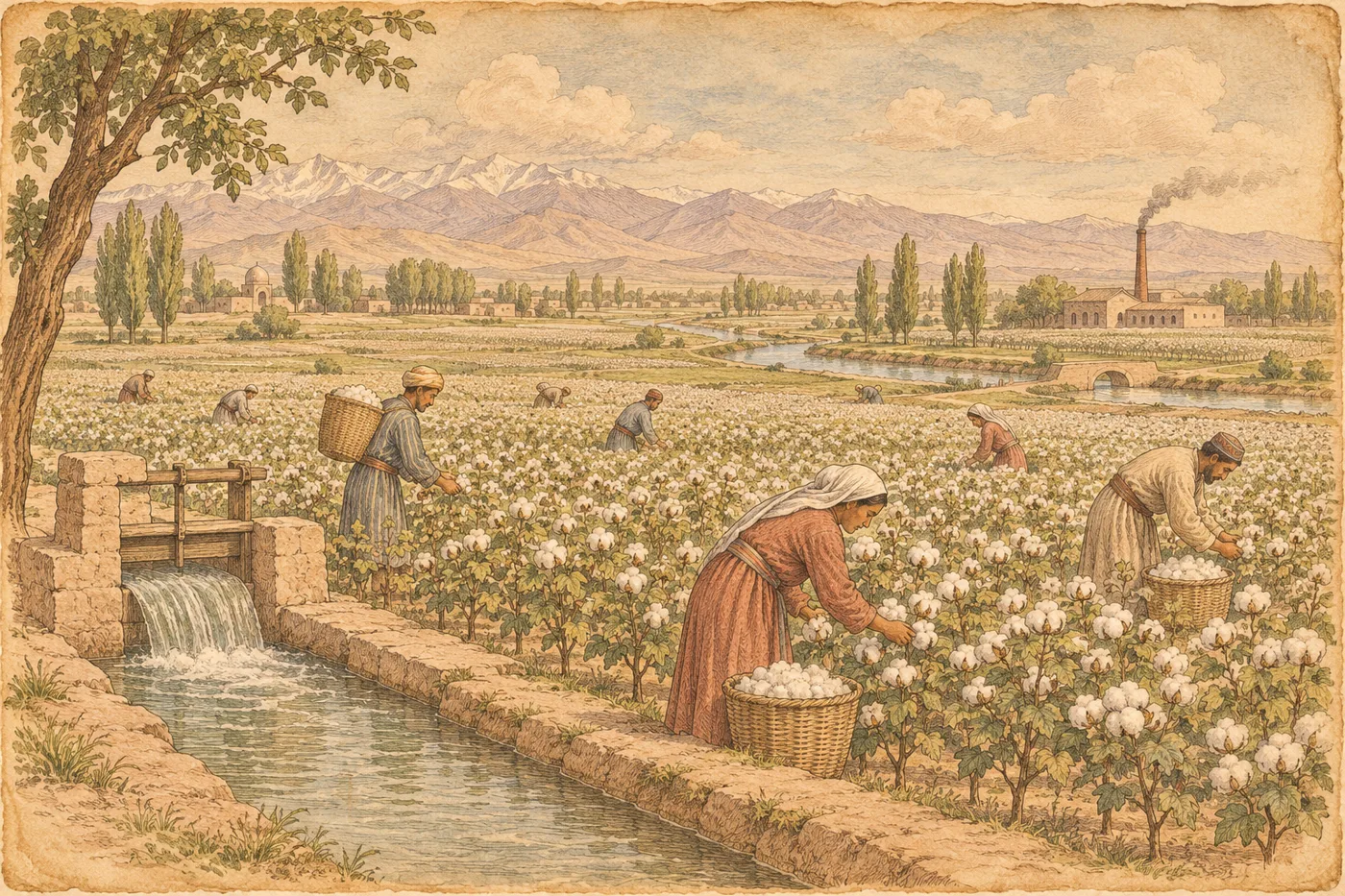
Why did Central Asia change so dramatically under the Soviet Union?
When the Russian Revolution occurred in 1917, Central Asia was also swept up in the turmoil. In the 1920s, armed groups opposing the new government (the Basmachi movement) continued to fight in various places. Even so, the Soviet Union incorporated the region into its own territory.
From 1924, the Soviet Union began drawing borders in Central Asia based on ethnicity. The Uzbek, Turkmen, and later Kazakh, Tajik, and Kyrgyz republics were created. These are the origins of the five current nations. Some see this border-drawing as a way to unify people, while others see it as a way to divide and rule more easily.
In the 1930s, under Stalin, agricultural collectivization was pushed forward. The Kazakhs, many of whom were nomads, had their livestock taken away and were forced to settle. As a result, a major famine occurred in Kazakhstan from 1930 to 1933, in which over one million people died—with many estimates around one and a half million. Intellectuals like the Uzbek writer Abdulla Qadiri also lost their lives in the purges.
During World War II, many factories were evacuated from the western Soviet Union to Central Asia, advancing industrialization. Also under Stalin, ethnic groups such as the Koreans from the Far East, the Germans from the western Soviet Union, and the Crimean Tatars were forcibly relocated to Central Asia. This history is part of the reason why such diverse ethnic groups live in Central Asia today.
After the war, the Soviet Union expanded cotton cultivation in Central Asia, using enormous amounts of water. Large quantities of water were diverted from the Amu Darya and Syr Darya rivers, and the Aral Sea began to shrink from the 1960s. In Kazakhstan, at Semipalatinsk, nuclear tests were also conducted repeatedly from 1949 to 1989.
There were also positive aspects, such as the spread of schools and hospitals and higher literacy rates. In the late 1980s, under Gorbachev's reforms, previously suppressed discussions about history and environmental issues began to emerge. Then in 1991, the Soviet Union dissolved, and the five Central Asian republics gained their independence.
Mini timeline
- 1924Uzbek and Turkmen republics established; ethnic border-drawing begins
- 1930–33Great famine in Kazakhstan
- 1937Koreans forcibly relocated from the Far East to Central Asia
- 1949First nuclear test at Semipalatinsk
- 1991Dissolution of the Soviet Union
People in this chapter
He is considered a founder of modern Uzbek literature. He was executed in the purges in 1938, and later rehabilitated.
Internationally known for works such as 'Jamilia.' He depicted life in the Soviet era and the memory of his people.
Meanwhile, elsewhere
Connection to Japan
After World War II, Japanese internees were sent not only to Siberia but also to Central Asia. In Tashkent, Uzbekistan, Japanese internees helped build the Navoi Theater, which is said to have withstood the major earthquake of 1966.
Why it still matters
The Aral Sea has shrunk dramatically, but on the northern side, a dam built in 2005 has helped partially restore water levels. The Semipalatinsk nuclear test site was closed in 1991, and support continues for those affected.
Perspectives differ
- The Kazakh Famine
- Estimates of the number of deaths vary, with over one million widely accepted. Whether to call it 'genocide' or view it as the result of policy failures and violence is a point of divergence between the Kazakh government and some researchers on one side, and other researchers and countries on the other.
- The 1924 Border-Drawing
- There is a view that the Soviet Union artificially divided the region, and another view that it became an opportunity for shaping ethnic self-awareness. Some point out that neither perspective alone can fully explain the situation.
- Assessment of the Soviet Era
- Some value the spread of education and healthcare, while others place heavier weight on the repression and environmental destruction. People's memories are not uniform.
- The Shrinking of the Aral Sea
- The area decreased dramatically in the latter half of the 20th century, and is sometimes said to be less than one-tenth of its original size, but the figures vary depending on the measurement method.
Facts checked (4, verified by AI on the web)
- Confirmed 1,000,000 to around 1,500,000 deaths in the 1930–33 Kazakh famine Wilson Center: The Kazakh Famine of 1930-33 and the Politics of History in the Post-Soviet Space
The Wilson Center (S. Cameron of the Kennan Institute) gives about 1,500,000 dead (about 1,300,000 of them Kazakhs), with more than a quarter of the total population either dead or having fled. Estimates range from 1,500,000 to 2,300,000. Whether to call it 'genocide' is debated. - Confirmed In 1937, Koreans were forcibly relocated from the Far East to Central Asia Michigan State University: Seventeen Moments in Soviet History, Mass Deportation of National Minorities
By October 1937, almost the entire population of about 170,000 (official tally 171,781) had been moved from the Far East to the Kazakh and Uzbek republics (MSU, Wilson Center). The decision was dated August 21, 1937. - Confirmed Semipalatinsk nuclear test site operated 1949–1989 NTI「Semipalatinsk Test Site」
The first test was on August 29, 1949, and the last in November 1989. A total of 456 tests (116 atmospheric, 340 underground) are recorded. Some sources give 124 atmospheric tests. - Confirmed The Aral Sea began to shrink in the 1960s NASA Earth Observatory: The Shrinking Aral Sea Recovers
The text states, 'Water diversion from the Amu Darya began in 1960, and the Aral Sea started shrinking.' Consistent.
Sources
Wilson Center: The Kazakh Famine of 1930-33 and the Politics of History in the Post-Soviet Space
Michigan State University: Seventeen Moments in Soviet History, Mass Deportation of National Minorities
NTI「Semipalatinsk Test Site」
NASA Earth Observatory: World of Change: Shrinking Aral Sea
* AI-drafted and cross-checked; human review is in progress. Status: