After Independence — The Paths of Five Nations
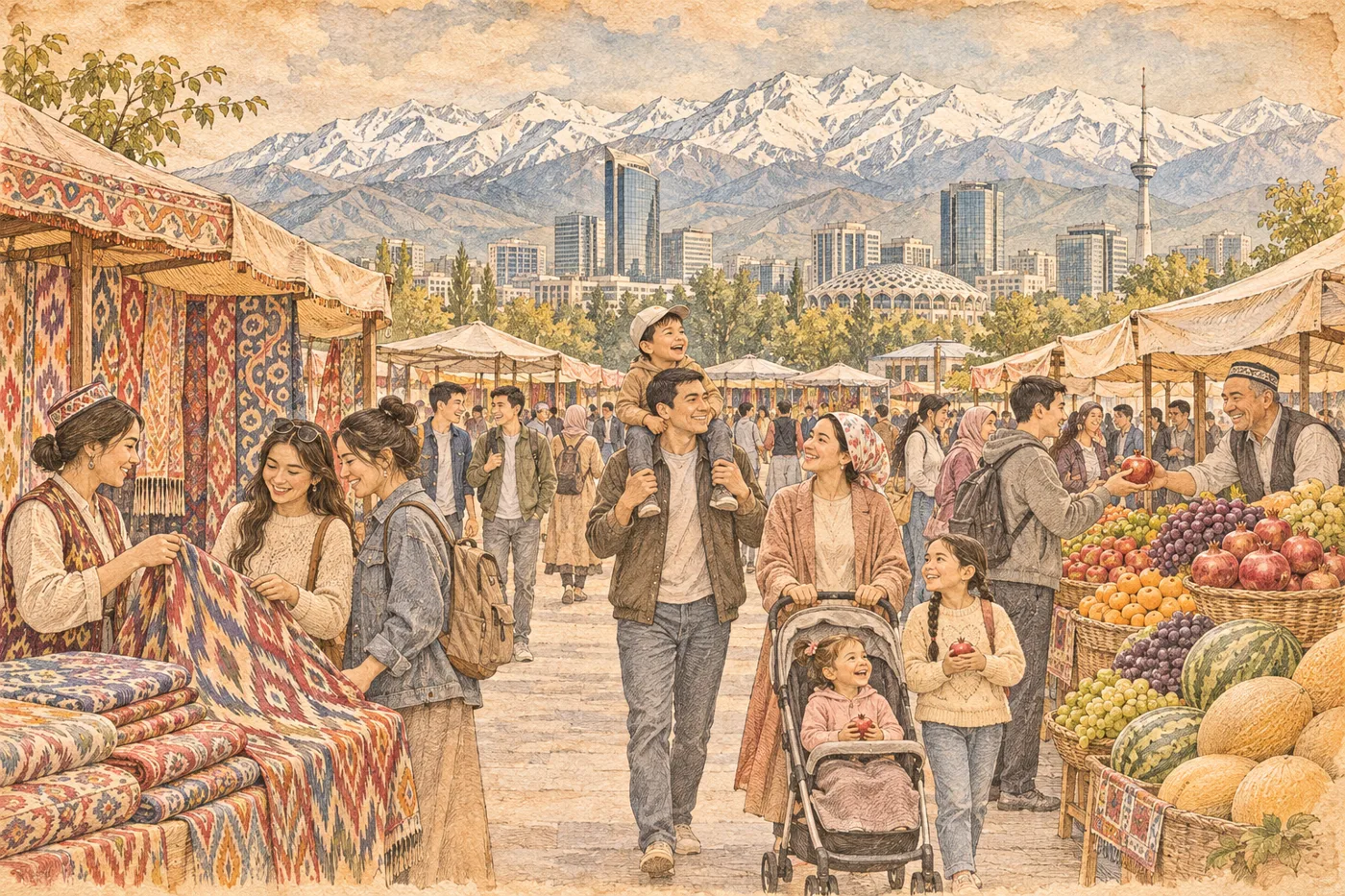
Why did the five newly independent nations take different paths, even though they are all in Central Asia?
In 1991, the Soviet Union collapsed, and five countries became independent: Kazakhstan, Uzbekistan, Turkmenistan, Kyrgyzstan, and Tajikistan. However, in a referendum held in March 1991, the majority in much of this region voted to preserve the Soviet Union. Some view independence as not necessarily having been eagerly awaited.
After independence, each country was busy building its national identity. They changed place names, revived ethnic heroes, and brought back the traditional spring equinox festival Nowruz as a national holiday. Regarding language, moves began to shift from Russian to native languages and from the Cyrillic to the Latin alphabet.
Economically, natural resources played a major role. Kazakhstan has oil and uranium, Turkmenistan has natural gas, and Uzbekistan has cotton and gold as major sources of income. On the other hand, mountainous Kyrgyzstan and Tajikistan are resource-poor, and many people went abroad as migrant workers.
In politics, there were difficult starts. A civil war broke out in Tajikistan from 1992, and peace was concluded in 1997. Kyrgyzstan experienced political upheavals in 2005 and 2010. Some countries, like Kazakhstan, which moved its capital in 1997, focused on building national symbols.
Issues between countries also remained. Borders drawn during the Soviet era became national borders after independence, but in places like the Fergana Valley, the borders of Uzbekistan, Kyrgyzstan, and Tajikistan are intricately entangled. Managing water resources and border controls remain challenges for each country.
Meanwhile, Central Asia, taking advantage of its location between great powers, sought to build relations with Russia, China, the United States, Japan, and others. In 2001, the Shanghai Cooperation Organization (SCO) was established with China, Russia, and others. This region, once a crossroads of the Silk Road, is again attracting global attention.
Mini timeline
- 1991Five countries gain independence
- 1992–97Tajikistan Civil War
- 1997Kazakhstan moves its capital from Almaty to Akmola (renamed Astana the following year)
- 2001Shanghai Cooperation Organization (SCO) founded
- 2005 & 2010Political upheavals in Kyrgyzstan
People in this chapter
A 15th-century figure. He wrote poetry in Turkic and is revered as a 'national poet' in Uzbekistan.
The protagonist of a vast epic passed down orally by storytellers, symbolizing national pride.
Meanwhile, elsewhere
Connection to Japan
In 1997, Japan launched diplomacy with the 'Silk Road region,' and later economic cooperation and cultural exchange advanced.
Why it still matters
The total population of the five Central Asian countries is about 70 million (as of around 2020). The nomadic tradition of living in yurts and new capitals with skyscrapers coexist within the same countries.
Perspectives differ
- Was independence wanted?
- In the March 1991 referendum, many voted in favor of preserving the Soviet Union, but after the August coup attempt, the republics moved toward independence. How to evaluate independence varies by country and person.
- Evaluation of political systems
- Many countries had long-serving leaders after independence. There are views that this brought 'stability' and others that 'free speech and elections were restricted.' The circumstances differ by country.
- Number of casualties in Tajikistan Civil War
- The exact number is unknown, with estimates ranging from tens of thousands to about 100,000.
- Recent events
- This chapter covers up to around 2011. For later developments, which change rapidly, please verify based on reliable reports.
Facts checked (4, verified by AI on the web)
- Confirmed Kazakhstan moved its capital from Almaty to Astana (formerly Akmola) in 1997 Inform.kz「Capital's move to Astana」
By presidential decree on October 20, 1997, Akmola became the capital from December 10. Renamed Astana in 1998. - Confirmed Tajikistan Civil War from 1992 to 1997, peace in 1997 UNHCR資料
Peace agreement signed in Moscow on June 27, 1997. About 700,000 people are said to have been displaced. - Confirmed Shanghai Cooperation Organization (SCO) founded in 2001 SCO事務局(上海協力機構): What is the SCO?
The SCO official website states it was 'declared on June 15, 2001 in Shanghai.' - Confirmed In the March 1991 referendum, the majority in this region voted to preserve the Soviet Union Michigan State University: Seventeen Moments in Soviet History「The March Referendum」
The text states that in all nine participating republics, over 70% voted in favor, with the highest support in the Central Asian republics.
Sources
Britannica「Kazakhstan: Independent Kazakhstan」
Inform.kz「Capital's move to Astana」
UNHCR「Tajikistan」
SCO事務局(上海協力機構): What is the SCO?
Michigan State University: Seventeen Moments in Soviet History「The March Referendum」
* AI-drafted and cross-checked; human review is in progress. Status: