Napoleon and the 19th Century — The Empire That Became a Great Power, Then Falters
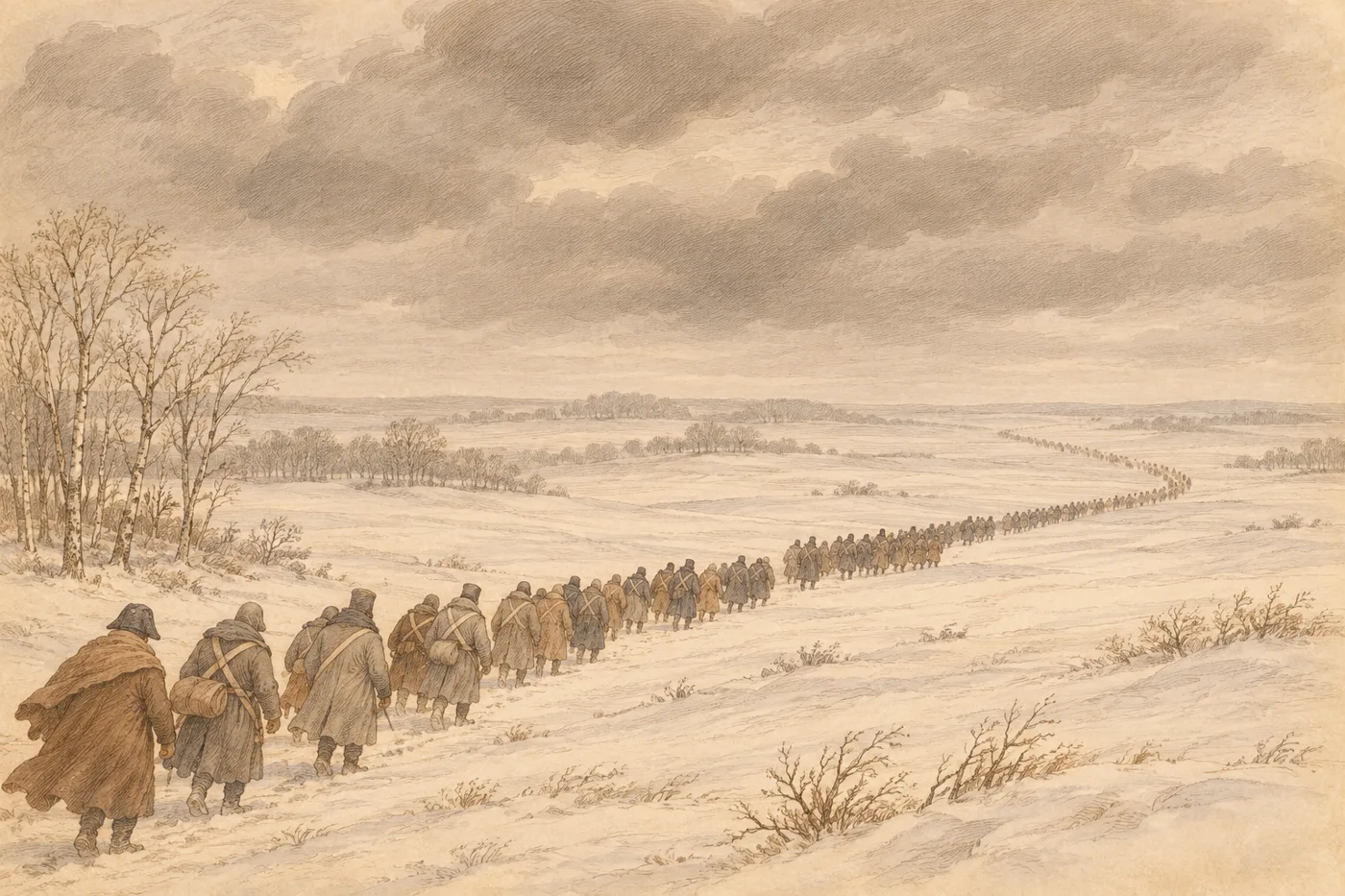
Why did Napoleon’s army, called “the strongest in Europe,” lose in Russia?
In June 1812, Napoleon led a huge army of about 600,000 including troops from allied states (figures vary by source) into Russia. The Russian army avoided a direct fight, retreating while burning villages and food supplies.
In September the two armies clashed at the Battle of Borodino, with heavy losses on both sides. Napoleon entered Moscow, but the city was engulfed in a great fire (causes disputed), and Tsar Alexander I refused to negotiate peace.
In October Napoleon began to retreat. But due to lack of food, an early bitter cold, and Russian pursuit and attacks, the army disintegrated; only a handful are said to have made it back alive. In Russia the war is called the Patriotic War and became an event that boosted national consciousness.
The Russian army pressed on all the way to Paris (1814), and at the Congress of Vienna it gained most of Poland. Russia became a “great power of Europe.” Meanwhile, some young officers who had seen Western Europe on the campaign demanded reforms of serfdom and autocracy, and in 1825 they rose in revolt (the Decembrist Revolt), but it was suppressed.
In the Crimean War (1853–56) Russia was defeated by the Ottoman Empire, Britain, and France, and keenly felt its backwardness in modernization. In 1861 Alexander II issued the Emancipation of the Serfs. Peasants gained freedom but also bore the burden of long-term payments for land, and their lives are said to have remained hard. In 1881 the tsar was assassinated by a bomb thrown by a revolutionary group.
That century, Russian literature transformed the world: Pushkin, Dostoevsky, Tolstoy. Tolstoy’s War and Peace depicts the war of 1812. Meanwhile Russia expanded its territory in the east, clashing with Japan in the Far East, and after losing the Russo-Japanese War of 1904–05 revolutionary movements spread at home.
Mini timeline
- 1812Napoleon invades Russia
- 1825Decembrist Revolt
- 1853–56Crimean War
- 1861Emancipation of the Serfs
- 1904–05Russo-Japanese War
People in this chapter
He carried out the emancipation of the serfs as well as reforms of local government and the judiciary, and is sometimes called the “Tsar Liberator.”
With works such as War and Peace and Anna Karenina, he had a huge impact on world literature.
Meanwhile, elsewhere
Connection to Japan
Japan went from the end of the Edo period into the Meiji era. In 1855 the Treaty of Shimoda set the border between Etorofu and Urup Islands. In 1904–05 Japan and Russia fought a war.
Why it still matters
Moscow’s Cathedral of Christ the Saviour was built to commemorate the 1812 victory (completed 1883). It was later demolished in the Soviet era and rebuilt in the 1990s. Tchaikovsky’s 1812 Overture also takes this war as its subject.
Perspectives differ
- Size and losses of Napoleon’s army
- Figures for both the 600,000 troops and the number of survivors vary widely among sources. It is also important to note that many troops came from allied states.
- Cause of the Moscow fire
- There are various theories — that the Russians set it, that it was accidental arson by occupying soldiers, etc. — and no clear conclusion.
- Was “General Winter” the cause of defeat?
- The cold was a major factor, but in fact severe damage from supply difficulties and the scorched-earth tactics had already occurred before winter set in.
- Napoleon for the people of Poland
- In Poland, some saw Napoleon as a hope for the restoration of the nation, and many Poles joined his army — a memory quite different from Russia’s history.
- Assessment of the emancipation of the serfs
- There are views that see the emancipation as a great step forward, and others that judge it as insufficient, with the peasants’ burden remaining heavy.
Facts checked (6, verified by AI on the web)
- Confirmed Napoleon’s army numbered about 600,000 (estimates vary) Britannica: French invasion of Russia
Britannica gives about 612,000 entering and about 112,000 returning. Other sources suggest around 450,000 — estimates vary. - Confirmed Battle of Borodino (Sep 7 1812); Moscow fire cause disputed Smithsonian Magazine: Moscow burned in 1812 (Rostopchin)
Mid-September 1812. The theory of Russian arson is influential, but Governor Rostopchin denied it; some suggest both sides were involved. Borodino: see Britannica ‘French invasion of Russia’. - Confirmed 1825 Decembrist Revolt; 1861 Emancipation Edict; 1881 Tsar assassination Britannica: Alexander II
Emancipation edict: March 1861 (New Style). Assassination: March 13 (Old Style March 1) 1881 by the People’s Will party. - Confirmed Russia lost the Crimean War (1853–56) Paris, Congress and Treaty of 1856(Encyclopedia.com)
Text confirmed: Russia removed its Black Sea naval forces, returned Southern Bessarabia to Moldavia, and made peace in March 1856 on Allied terms. 'Defeat' is not used; described as concessions. Safe phrasing: 'made peace on Allied terms.' - Confirmed Russia gained most of Poland at the Congress of Vienna The Victorian Web: The Congress of Vienna
Confirmed in text: At the 1815 Congress of Vienna Russia received most of the Duchy of Warsaw, which became the separate Kingdom of Poland. - Confirmed Allied forces including Russia entered Paris in March 1814 Battle of Montmartre or Paris, 30 March 1814(History of War)
The text states: 'The Allies entered Paris to unexpectedly enthusiastic welcomes. Tsar Alexander of Russia and King Frederick William III of Prussia joined the victory march.' (Page title: Battle of March 30, 1814).
Sources
Britannica: French invasion of Russia
Smithsonian Magazine: Moscow burned in 1812 (Rostopchin)
Britannica: Alexander II
Britannica: Treaty of Paris (1856)
The Victorian Web: The Congress of Vienna
* AI-drafted and cross-checked; human review is in progress. Status: