The Collapse of the Soviet Union — The Day One Country Became 15
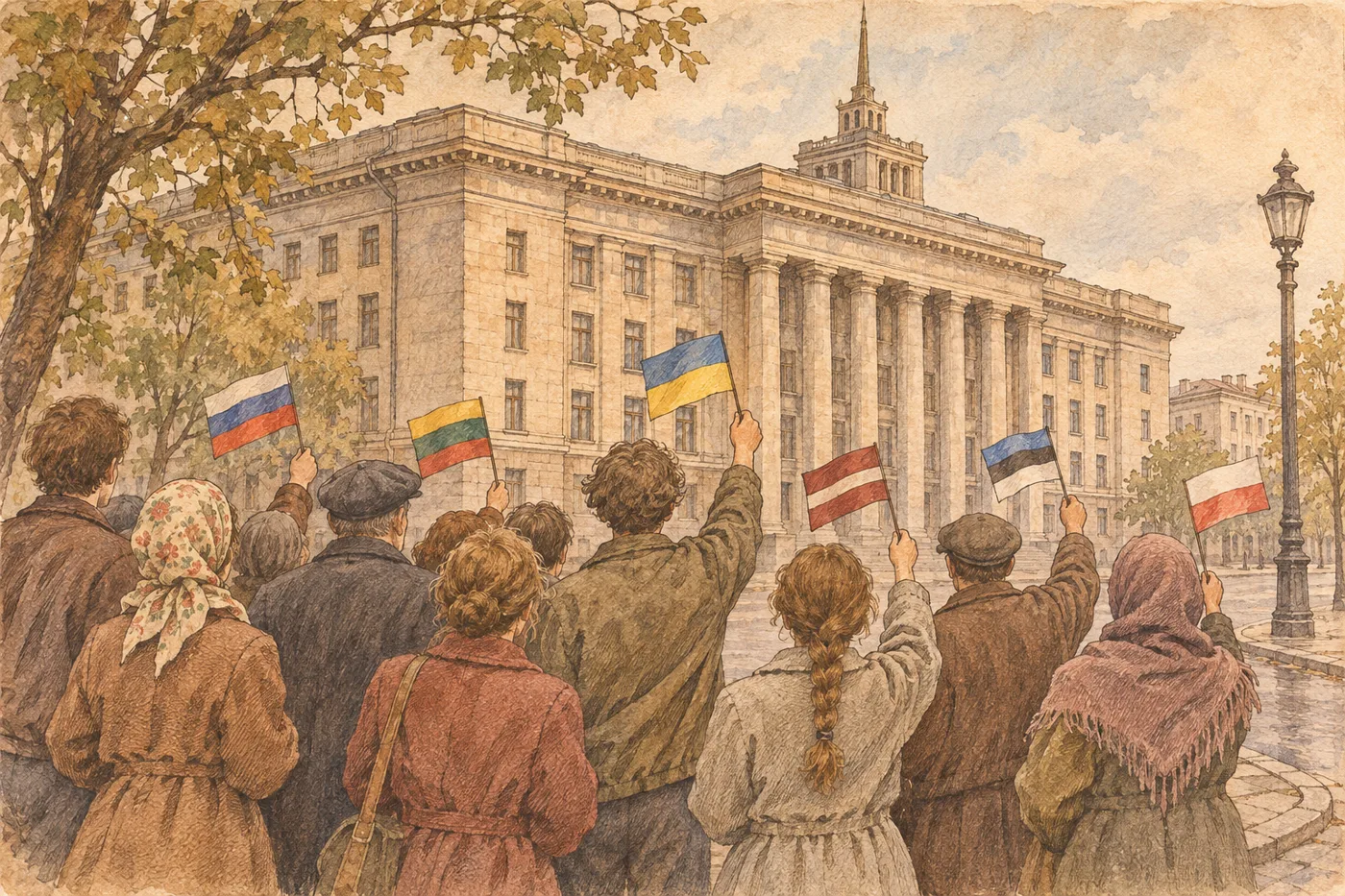
Why did a world superpower vanish in just a few years?
In 1985, Mikhail Gorbachev, age 54, became General Secretary of the Communist Party of the Soviet Union. The Soviet economy was stagnating, weighed down by military spending and the burden of the invasion of Afghanistan (1979–89). Gorbachev promoted 'Perestroika' (restructuring) and 'Glasnost' (openness).
In 1986, an accident occurred at the Chornobyl (Chernobyl) nuclear power plant. The delay in information immediately after the accident drew criticism both at home and abroad, and is said to have become one of the triggers for the push toward greater information disclosure. In 1989, multi-candidate elections were also held.
On August 23, 1989, in the Baltic states, people joined hands to form a human chain stretching about 600 km (the Baltic Way, with participants said to have numbered about 2 million). In 1990, Lithuania declared the restoration of its independence.
In August 1991, conservative leaders in the government, military, and Communist Party who opposed the reforms and the loosening of the federation attempted a coup, but it failed within days due to resistance from Moscow citizens and the President of the Russian Republic, Boris Yeltsin, among others. After that, declarations of independence by the republics followed one after another. Ukraine declared independence in August, and about 90% voted in favor in a December referendum.
On December 8, the leaders of Russia, Ukraine, and Belarus declared the dissolution of the Soviet Union and the creation of the Commonwealth of Independent States (CIS). On December 25, Gorbachev resigned as president, and on the following day, December 26, the Soviet Union dissolved. The 15 republics each became independent countries.
In the 1990s, the former Soviet countries faced a rapid transition to a market economy. Soaring prices and the chaos of privatizing state-owned enterprises made life hard for many people. At the same time, they gained new freedoms. Conflicts over territory and ethnicity also arose in various parts of the former Soviet Union, and the dissolution of Yugoslavia was accompanied by war.
Mini timeline
- 1985Gorbachev becomes General Secretary
- 1986Chornobyl nuclear power plant accident
- 1989Berlin Wall falls; Baltic Way takes place
- August 1991Coup attempt fails
- December 1991Soviet Union dissolves
People in this chapter
He worked toward reform and ending the Cold War, and received the Nobel Peace Prize in 1990.
He gained broad public support for his resistance to the 1991 coup.
Meanwhile, elsewhere
Connection to Japan
Japan was at the start of the Heisei era. Around 1991, the bubble economy began to collapse, and relations between Japan and Russia, the Soviet Union's successor, entered a new phase.
Why it still matters
Where the Soviet Union once stood, there are now 15 countries. In many of these former Soviet states, Russian is still used in daily life and work. Many country and place names also changed with independence.
Perspectives differ
- Causes of the collapse
- Various factors are cited, such as economic stagnation, reforms that ironically created chaos, independence movements by ethnic groups, and the burden of the arms race. Researchers differ on which to emphasize.
- Assessment of the collapse
- Vladimir Putin, then President of Russia, called the collapse of the Soviet Union 'the greatest geopolitical catastrophe of the 20th century' in 2005. On the other hand, in Eastern Europe, the Baltic states, Ukraine, and elsewhere, many view it as the restoration of independence or liberation. Assessments vary greatly by country and person.
- March 1991 referendum
- In a referendum on preserving the federation, about 76% of participants voted in favor, but six republics including the Baltic states did not participate. How to interpret this result is also a matter of debate.
- Chornobyl casualties
- The direct death toll is said to be several dozen, but estimates of long-term health damage range widely, from the WHO's figure of about 4,000 deaths to tens of thousands or more.
- Recent events
- This chapter covers up to around the 1990s. Since subsequent developments have unfolded rapidly and opinions are deeply divided, they are not addressed here.
Facts checked (6, verified by AI on the web)
- Confirmed In 1985, Gorbachev, age 54, becomes General Secretary Britannica: Mikhail Gorbachev
Became General Secretary in March 1985 (Britannica). Received the 1990 Nobel Peace Prize (Britannica). - Confirmed Chornobyl nuclear accident in April 1986 WHO: Chernobyl: the true scale of the accident
Accident on April 26, 1986. Death toll estimates (less than 50 directly; about 4,000 ultimately) confirmed by WHO/IAEA Chernobyl Forum. - Confirmed About 2 million in the Baltic Way (1989) U.S. Helsinki Commission (CSCE): 35 Years After the Baltic Way
An article by the U.S. congressional independent agency CSCE states that about 2 million people formed a human chain from Tallinn to Vilnius on August 23, 1989 (the text retains the expression 'said to be about 2 million'). - Confirmed Lithuania declared restoration of independence in 1990 Soviet History (Michigan State University): The Baltic Republics Achieve Independence
A Michigan State University website states that on March 11, 1990, Lithuania's new parliament declared the republic's independence, and Moscow responded with economic sanctions. - Confirmed The August 1991 coup was by conservative leaders Office of the Historian (U.S. Department of State): The Collapse of the Soviet Union
The failed coup by conservatives is said to have sealed the Soviet Union's fate (Office of the Historian). It involved the Vice President, KGB chairman, Defense Minister, and others. - Confirmed December 8 agreement, Gorbachev resigns on 25th, Soviet Union dissolves on 26th Britannica: Collapse of the Soviet Union
Britannica also notes formal dissolution as of December 31. The Supreme Soviet's declaration was on December 26. The Office of the Historian also records the resignation on December 25 and the founding of the CIS in early December. Ukraine's referendum had about 90% in favor (Britannica).
Sources
Britannica: Mikhail Gorbachev
Britannica: Collapse of the Soviet Union
U.S. Helsinki Commission (CSCE): 35 Years After the Baltic Way
Soviet History (Michigan State University): The Baltic Republics Achieve Independence
Office of the Historian (U.S. Department of State): The Collapse of the Soviet Union
WHO: Chernobyl: the true scale of the accident
* AI-drafted and cross-checked; human review is in progress. Status: