The Byzantine Empire — The Other Rome That Lasted a Thousand Years
The Roman Empire supposedly ended in 476, so why is there another thousand years?
In 330, the Roman emperor Constantine I founded a new capital on the site of the old town of Byzantium, on the Bosporus Strait. The city, later called Constantinople (City of Constantine), was well situated for both defense and trade, overlooking the strait that separates Europe and Asia.
In 395, after the emperor's death, the empire's eastern and western halves began to be ruled separately. In the West, the line of emperors ended in 476, but the empire continued in the East. The name 'Byzantine Empire' was given later; the people themselves are said to have thought of themselves as Romans.
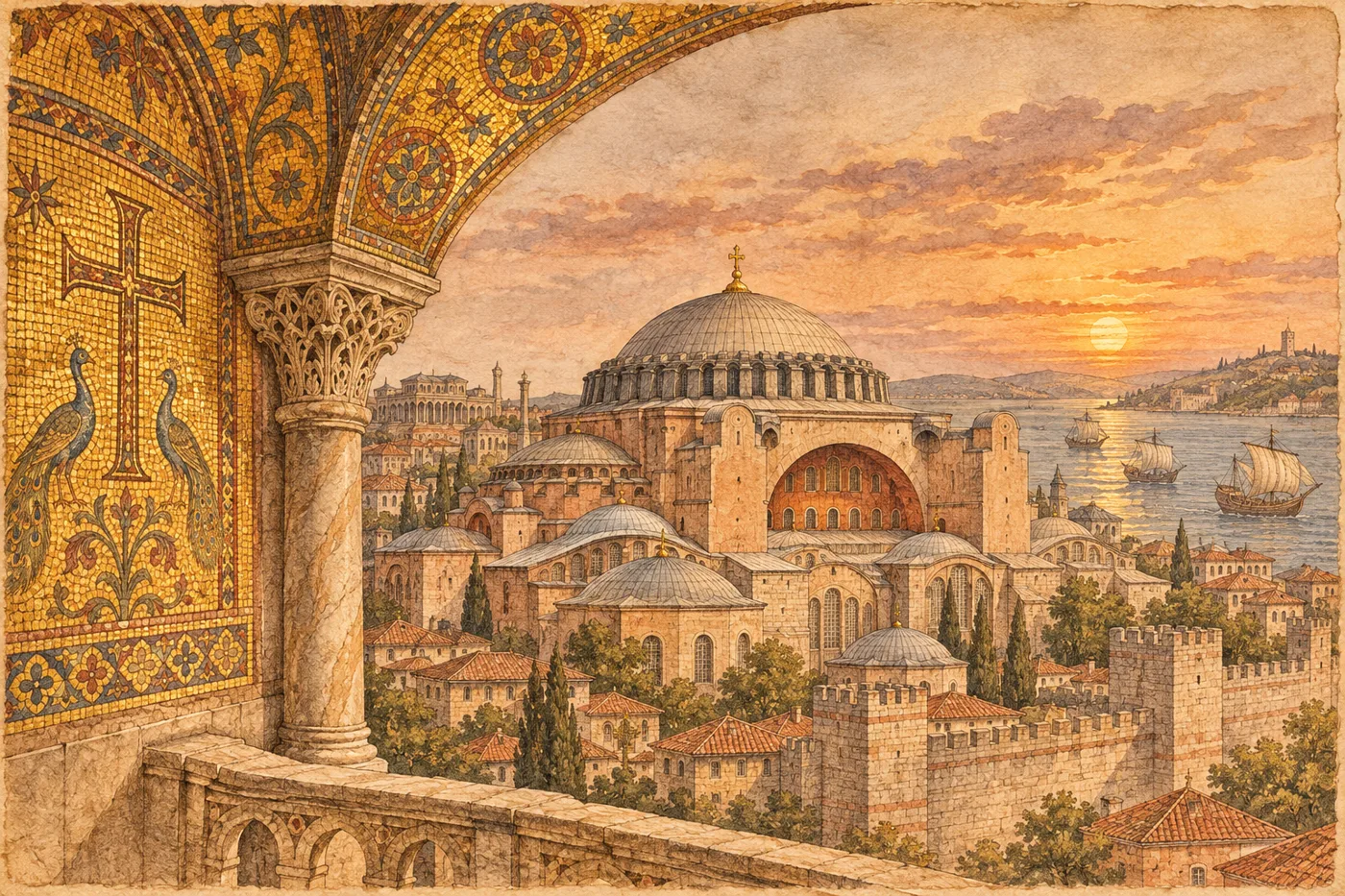
In the 6th century, under Justinian I (r. 527–565), campaigns were launched to recover some of the old territories around the Mediterranean. A law code later known as the Corpus Juris Civilis was compiled, and the great church Hagia Sophia was completed in 537. Its dome was rebuilt after an earthquake, but it still amazes visitors today.
In the 7th century, war with the Sasanian Empire severely weakened the state, and afterward the rise of Islamic forces led to the loss of Syria and Egypt. The empire shrank, and its official language shifted from Latin to Greek. The 8th and 9th centuries saw a major controversy over religious images (icons), which is said to have shaken society.
Still, the empire recovered. Under Basil II (r. 976–1025), after long campaigns Bulgaria was defeated, and most of the Balkan Peninsula came under Byzantine control. After his time, however, power waned, and in 1071 the empire lost much of its territory in Asia Minor following defeat by the Seljuks at the Battle of Manzikert.
In 1204, an unexpected event occurred: the Fourth Crusade captured Constantinople. The empire fragmented, and although the Nicaean forces recovered the city in 1261, the old strength never returned. Then, in 1453, the Ottoman army led by Mehmed II took the city, and the last emperor, Constantine XI, is said to have died in the fighting.
Mini timeline
- 330Constantine I founds the new capital
- 537Hagia Sophia is completed
- 1071Battle of Manzikert
- 1204Fourth Crusade captures the city
- 1453Ottoman army storms the city
People in this chapter
Known for codifying the law and building the great church, he aimed to restore the empire.
During his nearly half-century-long reign, he greatly expanded the empire.
Meanwhile, elsewhere
Connection to Japan
In Japan, this period overlaps with the Kofun period through the Muromachi period. The fall of Constantinople in 1453 came just before the Ōnin War (1467), in the middle of the Muromachi period.
Why it still matters
Hagia Sophia still stands in Istanbul. It has served as a church, a mosque, and a museum, and since 2020 has been used as a mosque again. Byzantine influence can be seen in the Orthodox cultures of Greece and Russia, as well as in the tradition of icons.
Perspectives differ
- When did the 'Byzantine Empire' begin?
- There are several views on when it began—the move of the capital in 330, the division of the empire in 395, the fall of the West in 476, or around the 7th century—and no clear line can be drawn.
- The name 'Byzantine'
- This name spread after the empire fell; at the time, people called themselves Romans. How to regard this naming issue is a matter of debate among scholars.
- The East-West Schism of 1054
- This is known as the year when the pope's legate and the Patriarch of Constantinople excommunicated each other. However, views differ on whether the split was decisive at that point or whether the rift deepened over a long period.
- Was the 1204 capture of the city planned?
- It has long been debated whether the crusaders aimed for the city from the start or ended up there due to money problems and imperial politics. Interpretations remain divided.
Facts checked (7, verified by AI on the web)
- Confirmed Hagia Sophia was completed in 537 Christianity.com: Consecration of Hagia Sophia
Consecrated in December 537. Based on Gemini's note, the text adds that the dome was rebuilt after a later earthquake. - Confirmed The new capital was founded in 330, and the people thought of themselves as Romans History.com: 10 things you may not know about the Byzantine Empire
Consecrated in 330. 'Byzantine' is a later name; the inhabitants called themselves Romans. - Confirmed In 1071, the empire was defeated by the Seljuks at Manzikert World History Encyclopedia: Byzantine Empire
Defeated by the Seljuks at Manzikert in 1071; the date is given as August 26. The battle is seen as a turning point. - Corrected & confirmed In 1204 the Fourth Crusade captured the city, and in 1261 the Nicaeans recovered it World History Encyclopedia: Byzantine Empire
The Fourth Crusade sacked Constantinople in 1204; the empire was divided between Venice and its allies. Recovered in 1261 by Michael VIII of the Empire of Nicaea. Text revised. - Confirmed In 1453 the Ottoman army took the city, and Constantine XI is said to have died in battle Britannica: Constantine XI Palaeologus
May 29, 1453. Britannica says he was killed fighting on the walls, but another entry notes his fate is uncertain. The text keeps 'is said to'. - Confirmed Basil II (r. 976–1025) defeated Bulgaria Britannica: Basil II
Britannica confirms reign 976–1025; the last resistance was crushed in 1018, and Bulgaria was incorporated into the empire. He is also said to have earned the nickname 'Bulgar-Slayer' after a great victory in 1014. - Confirmed In 395 the empire began to be ruled separately in East and West Britannica: Theodosius I
The death of Theodosius I (January 395) marked the division of the empire, with his sons Arcadius and Honorius ruling East and West. It was initially seen as a temporary arrangement.
Sources
World History Encyclopedia: Byzantine Empire
Christianity.com: Consecration of Hagia Sophia
History.com: 10 things you may not know about the Byzantine Empire
Britannica: Constantine XI Palaeologus
Britannica: Basil II
Britannica: Theodosius I
* AI-drafted and cross-checked; human review is in progress. Status: