The Slavs and Kyiv — The Birth of a Land of Plains
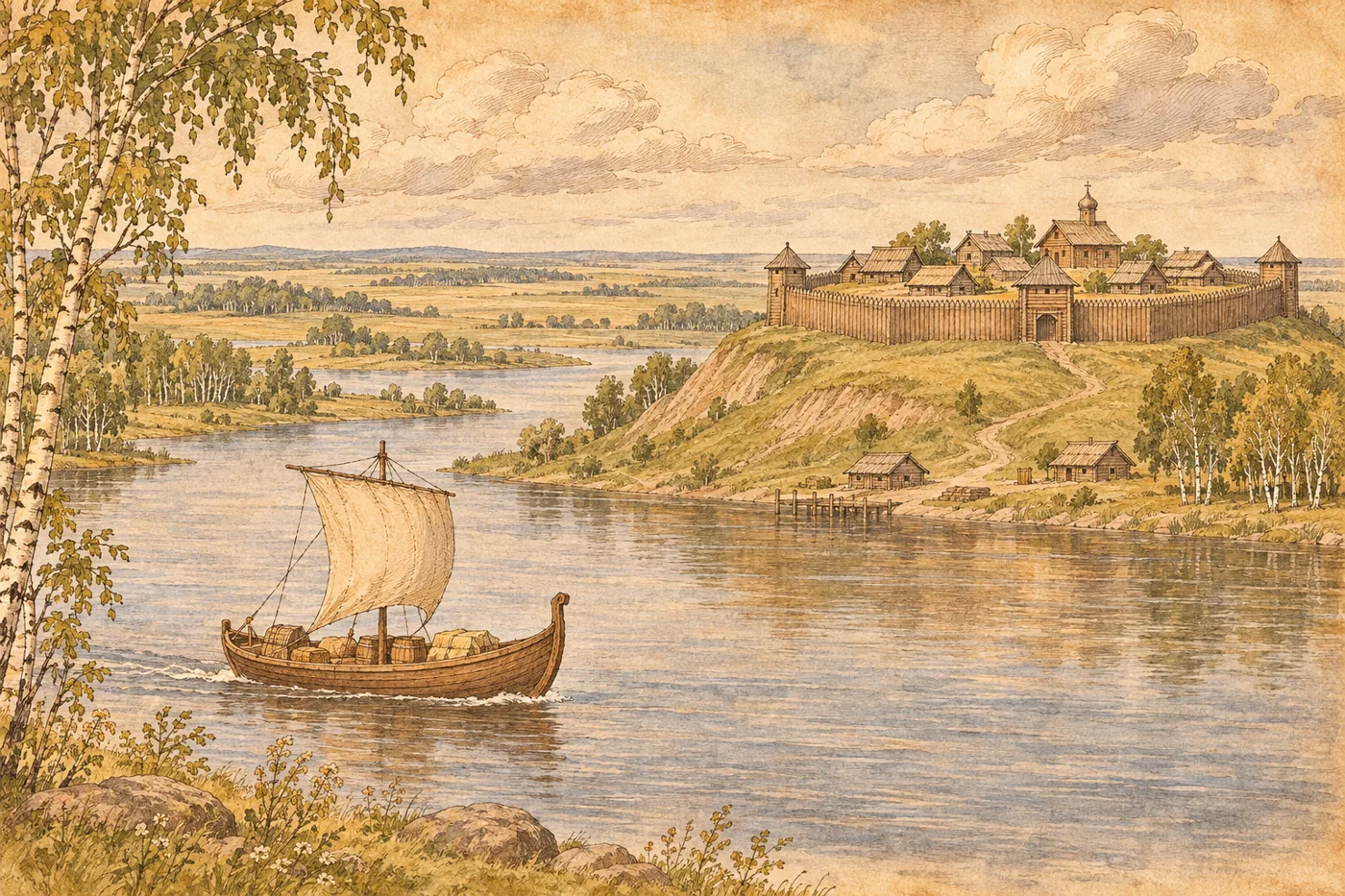
How did the first 'state' come into being on the vast plains?
Eastern Europe is a land of forests, rivers, and endless plains. From around the 6th century, peoples called Slavs spread across this region. They are thought to have lived in small villages and tribes, farming and hunting. The East Slavs, who spoke a language ancestral to modern Russian, Ukrainian, and Belarusian, were part of this group.
Around the 9th century, companions of the Vikings (the Varangians) came from the north, following the rivers. They transported furs, beeswax, and slaves along river routes that reached the Black Sea and the Byzantine Empire. They and their realm came to be called 'Rus'. This name later became the source for the names of Russia and Belarus, and was also adopted from early times by Ukrainians as a term for themselves.
According to the 'Primary Chronicle', compiled in the early 12th century, in 862, people tired of strife invited a man named Rurik from across the sea. Then, around 882, Oleg, a member of his clan, established himself at Kyiv (called Kyiv in modern Ukrainian) on the Dnipro River (Dnieper in Russian). However, this account contains later traditions and is not considered purely historical.
A major turning point for Rus came around 988 (the exact year is debated). It is said that Vladimir I, the Grand Prince of Kyiv, accepted Christianity (Orthodoxy) from the Byzantine Empire and was baptized. This brought Byzantine culture, writing, and architecture, linking Kyiv to the Eastern Orthodox world.
Its peak came under Yaroslav the Wise (reigned 1019–1054). The Saint Sophia Cathedral was built, and the earliest part of the law code 'Ruska Pravda' is said to have been compiled. Kyiv became one of the great cities of Europe. It is also known that Yaroslav's daughters married into European royal houses, including that of France.
However, feuds among the princes over the grand princely throne continued, and by the 12th century the realm had split into many principalities. Then, in 1240, Batu's Mongol army captured Kyiv. The era of Kyivan Rus came to an end, but its memory was passed down in various forms to the peoples of Eastern Europe.
Mini timeline
- 6th centurySlavs spread across Eastern Europe.
- 862 (traditional)The Primary Chronicle recounts that Rurik was invited.
- around 988Vladimir I accepts Orthodox Christianity.
- 1019–1054Reign of Yaroslav the Wise. Peak of Kyiv.
- 1240Batu's Mongol army captures Kyiv.
People in this chapter
He is said to have accepted Orthodox Christianity from Byzantium and made it the state religion.
He advanced law codes and built the Saint Sophia Cathedral, leading Kyiv to its peak.
Meanwhile, elsewhere
Connection to Japan
Japan was in the Heian period. This overlaps with the time from the abolition of the Tang missions in 894 to the regency government (Sekkan seiji) under the Fujiwara clan's power.
Why it still matters
The Cyrillic alphabet, used in Russia, Ukraine, and elsewhere, is said to be based on a script devised in the 9th century by Byzantine missionaries for Slavic peoples. And the Saint Sophia Cathedral in Kyiv remains a UNESCO World Heritage site (it was also placed on the List of World Heritage in Danger in 2023).
Perspectives differ
- The origins of Rus (Normanist theory)
- Regarding how much the Vikings were involved in the founding of the state, there is a 'Nordic founding' theory and an 'indigenous East Slavic development' theory, and they have long been debated. Today, the view that both elements were mixed is common.
- Historical accuracy of the Primary Chronicle
- The story of Rurik's invitation in 862 is thought to contain later editing and political intentions. How much is factual is unknown.
- Year of the baptism
- Vladimir I's conversion is often dated to '988', but theories for 987 or 989 also exist, and it is not certain.
- Slavic homeland
- Possible original homelands for the Slavs include north of the Carpathian Mountains or the Pripet Marshes, but nothing is known for sure.
- Whose history is Kyivan Rus?
- Kyivan Rus is considered the starting point of national history by Russia, Ukraine, and Belarus alike. Russia tends to see its legacy passing to Vladimir and Moscow; Ukraine views it as the history of a state continuing on Ukrainian soil. Most historians treat it as a 'common source' for the three modern nations, not belonging to any one alone. This issue requires special care as it ties to contemporary politics.
- Place and personal names
- This chapter uses the historical terms common in Japanese world history: 'Kyiv' and 'Vladimir'. In Ukrainian, these are 'Kyiv' and 'Volodymyr', and river names also differ between Russian and Ukrainian. Which language's terms are used can be linked to historical perspectives.
Facts checked (5, verified by AI on the web)
- Confirmed The Primary Chronicle recounts that Rurik was invited in 862 and Oleg established himself in Kyiv around 882 (historicity disputed). Britannica: Rurik dynasty
Rurik is said to have been welcomed in Novgorod around 862. Oleg's takeover of Kyiv is dated to 882 (some sources say 881/882). Pritsak and others raise objections to the chronicle's account. - Confirmed Vladimir I's baptism was around 988 (year debated). World History Encyclopedia: Kievan Rus
Vladimir I had the people baptized in the Dnipro River and chose Orthodoxy, confirmed by World History Encyclopedia. Dates vary from 987 to 989; the text already says 'around 988'. - Confirmed Yaroslav the Wise reigned 1019–1054. Encyclopedia of Ukraine (CIUS, University of Alberta): Yaroslav the Wise
The Encyclopedia of Ukraine (University of Alberta) states that Yaroslav regained the throne of Kyiv in 1019 and died on February 20, 1054. - Confirmed Saint Sophia Cathedral and the Ruska Pravda. Encyclopedia of Ukraine (CIUS, University of Alberta): Yaroslav the Wise
The same encyclopedia says Yaroslav began building Saint Sophia Cathedral in 1037 and that 'Yaroslav's Law' is the earliest part of the Ruska Pravda (the date of the law code is not specified). - Confirmed Batu's army captured Kyiv in 1240. Britannica: Kyivan Rus
WHE records the Mongol sack of Kyiv on December 6, 1240.
Sources
Britannica: Rurik dynasty
World History Encyclopedia: Kievan Rus
Britannica: Kyivan Rus
Encyclopedia of Ukraine (CIUS, University of Alberta): Yaroslav the Wise
* AI-drafted and cross-checked; human review is in progress. Status: