The Birth of Humanity — The Starting Point of All Journeys
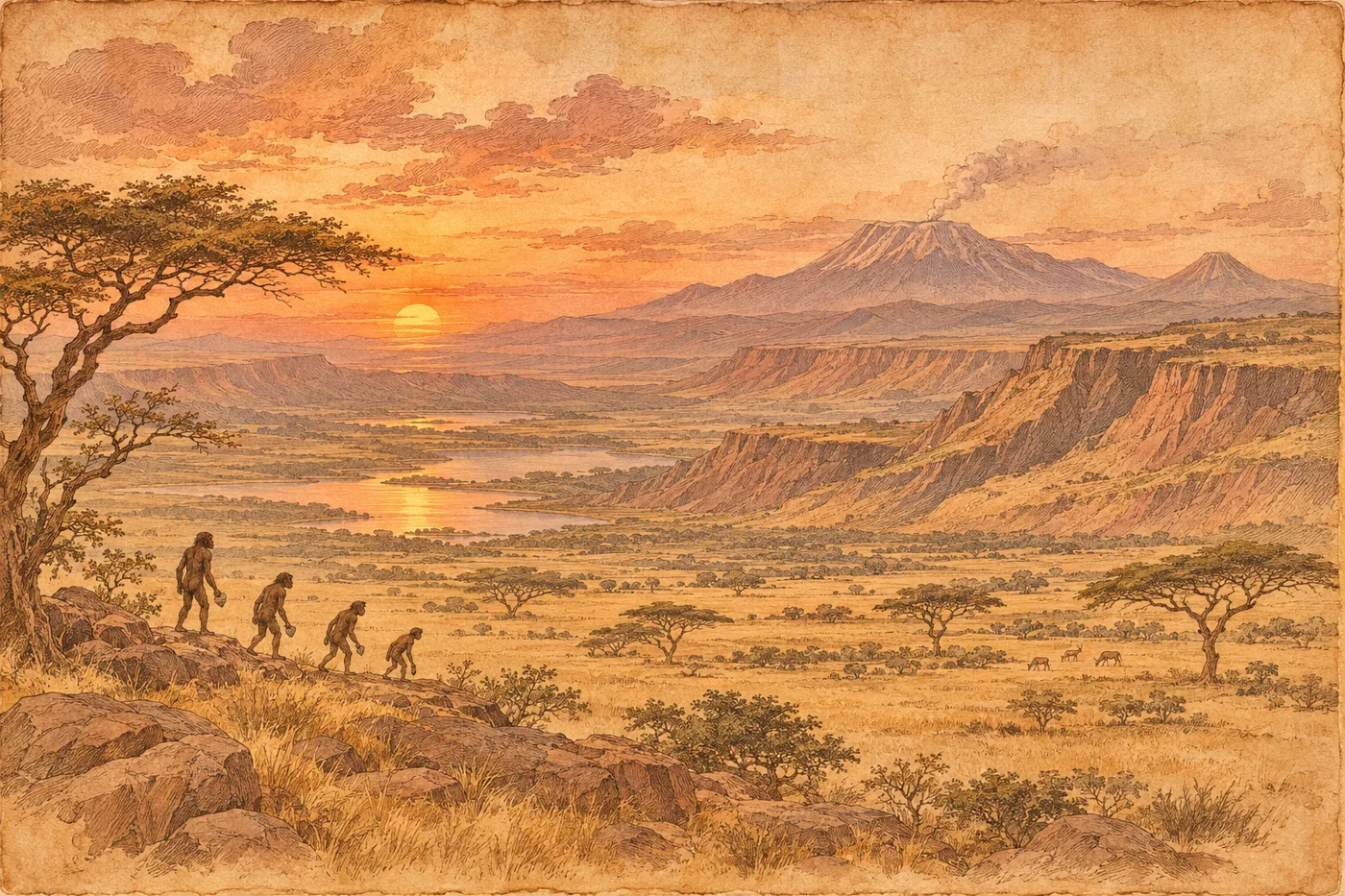
When and where did we become 'human'?
In eastern Africa, a long valley called the Great Rift Valley runs north to south, where the land has split open. This is in the area of modern-day Ethiopia, Kenya, and Tanzania. Many fossils of human ancestors have been found in and around this valley.
The main feature of early humans (australopithecines) is walking upright on two legs: bipedalism. The oldest candidates are said to be from about 7 million years ago, and around 3.6 million years ago, footprints from walking were left in volcanic ash at Laetoli in Tanzania. They were discovered by a research team that included Mary Leakey.
In 1974, about 40% of the skeleton of an australopithecine from around 3.2 million years ago was found in Ethiopia. Its nickname is 'Lucy,' said to have been named after a Beatles song the excavation team was listening to. She was small, with a brain about one-third the size of a modern human's, but she could already walk.
Once they walked on two legs, their hands became free. Around 3.3 to 2.6 million years ago, stone tools made by flaking stones began to be used (a site in Kenya from about 3.3 million years ago is considered among the oldest, with widespread use beginning around 2.6 million years ago). About 1.9 million years ago, Homo erectus (upright man), taller with a larger brain, appeared and eventually spread beyond Africa. This group is also thought to have started using fire.
We modern humans, Homo sapiens, appeared in Africa around 300,000 to 200,000 years ago. Old fossils have been found not only in Ethiopia but also in various parts of Africa, such as Morocco in North Africa. Then, around 70,000 to 50,000 years ago, part of the sapiens population is thought to have left Africa and spread to other continents (the Out of Africa migration).
Neanderthals and others were already living in Europe and Asia. Genetic research shows that sapiens encountered them and interbred a little. All people on Earth today, traced back far enough, are descendants of the same ancestors in Africa. Every journey began on this continent.
Mini timeline
- About 3.2 million years agoAustralopithecine 'Lucy' (Ethiopia)
- Around 2.6 million years agoStone tools begin to be used (examples from about 3.3 million years ago also reported)
- Around 1.9 million years agoHomo erectus appears
- About 300,000 to 200,000 years agoHomo sapiens appears
- Around 70,000 to 50,000 years agoPart of the sapiens population spreads outside Africa (Out of Africa)
People in this chapter
She led the team that discovered the footprints from about 3.6 million years ago at Laetoli, Tanzania.
An australopithecine believed to be a female who lived about 3.2 million years ago; she is one of the most famous fossils in understanding human evolution.
Meanwhile, elsewhere
Connection to Japan
People are thought to have begun living in the Japanese archipelago around 38,000 years ago (Paleolithic period). Compared to Lucy's time, that's much more recent.
Why it still matters
Today's roughly 8 billion people around the world can trace their genes back to common ancestors in Africa. It is also known that human genetic diversity is greatest among African peoples.
Perspectives differ
- Which is the 'earliest human'?
- Some theories consider fossils from about 7 million years ago (such as Sahelanthropus) to be the earliest humans, but researchers are divided on whether they are humans or closer to apes.
- Origin of modern humans
- The 'Recent African Origin' (or 'Single-Origin') hypothesis is currently dominant, but research is ongoing regarding the age of fossils and which regional populations were the main ancestors. Some advocate the 'Multiregional evolution' theory.
- Timing of the Out of Africa migration
- The main dispersal is thought to be around 70,000 to 50,000 years ago, but there are also fossils suggesting some groups left earlier (over 100,000 years ago), leading some researchers to believe there were multiple waves.
- The beginning of fire use
- Evidence of fire use has been reported at sites around 1 million years ago, but there is debate over whether humans were intentionally managing fire.
- Range of dates
- The dating of human fossils is frequently revised with new discoveries and advances in dating methods. The numbers here should be considered 'currently commonly used approximations.'
Facts checked (6, verified by AI on the web)
- Corrected & confirmed Laetoli footprints from about 3.6 million years ago, discovered by Mary Leakey's team The Leakey Foundation: Laetoli footprints
Leakey Foundation articles confirm that Mary Leakey and her team discovered footprints at Laetoli, dated to about 3.7 million years ago. Other sources give a range of 3.6–3.7 million years ago (discovery in 1976, footprint excavation mostly dated to 1978). - Confirmed Lucy, found in Ethiopia in 1974, is an australopithecine from about 3.2 million years ago, with about 40% of the skeleton Australopithecus afarensis (Australian Museum)
The nickname from the Beatles song also matches multiple sources such as HISTORY. - Confirmed Stone tools from about 3.3 million years ago in Kenya (Lomekwi 3) are the oldest known Oldest Stone Tools Go Back 3.3 Million Years (NBC News)
Nature 2015. The maker species is unknown. - Confirmed Homo erectus appeared around 1.9 million years ago, and fire use is attributed to this group Homo erectus (Britannica)
Britannica places fire control at about 1 million years ago. - Confirmed The oldest known Homo sapiens fossils are about 300,000 years old (Morocco, Jebel Irhoud) The first of our kind (Max Planck)
There are dissenting opinions on the species classification (consistent with the debates section). - Confirmed Out of Africa migration around 70,000–50,000 years ago, interbreeding with Neanderthals Neanderthals Interbred With Humans Around 50,000 Years Ago (Archaeology)
A 2024 study places interbreeding at about 43,500–50,500 years ago. The timing of the dispersal is actively researched.
Sources
The Leakey Foundation: Laetoli footprints
Australopithecus afarensis (Australian Museum)
Oldest Stone Tools Go Back 3.3 Million Years (NBC News)
Homo erectus (Britannica)
The first of our kind (Max Planck)
Neanderthals Interbred With Humans Around 50,000 Years Ago (Archaeology)
* AI-drafted and cross-checked; human review is in progress. Status: