The Bantu Expansion — Language and Iron Spread South Across the Continent
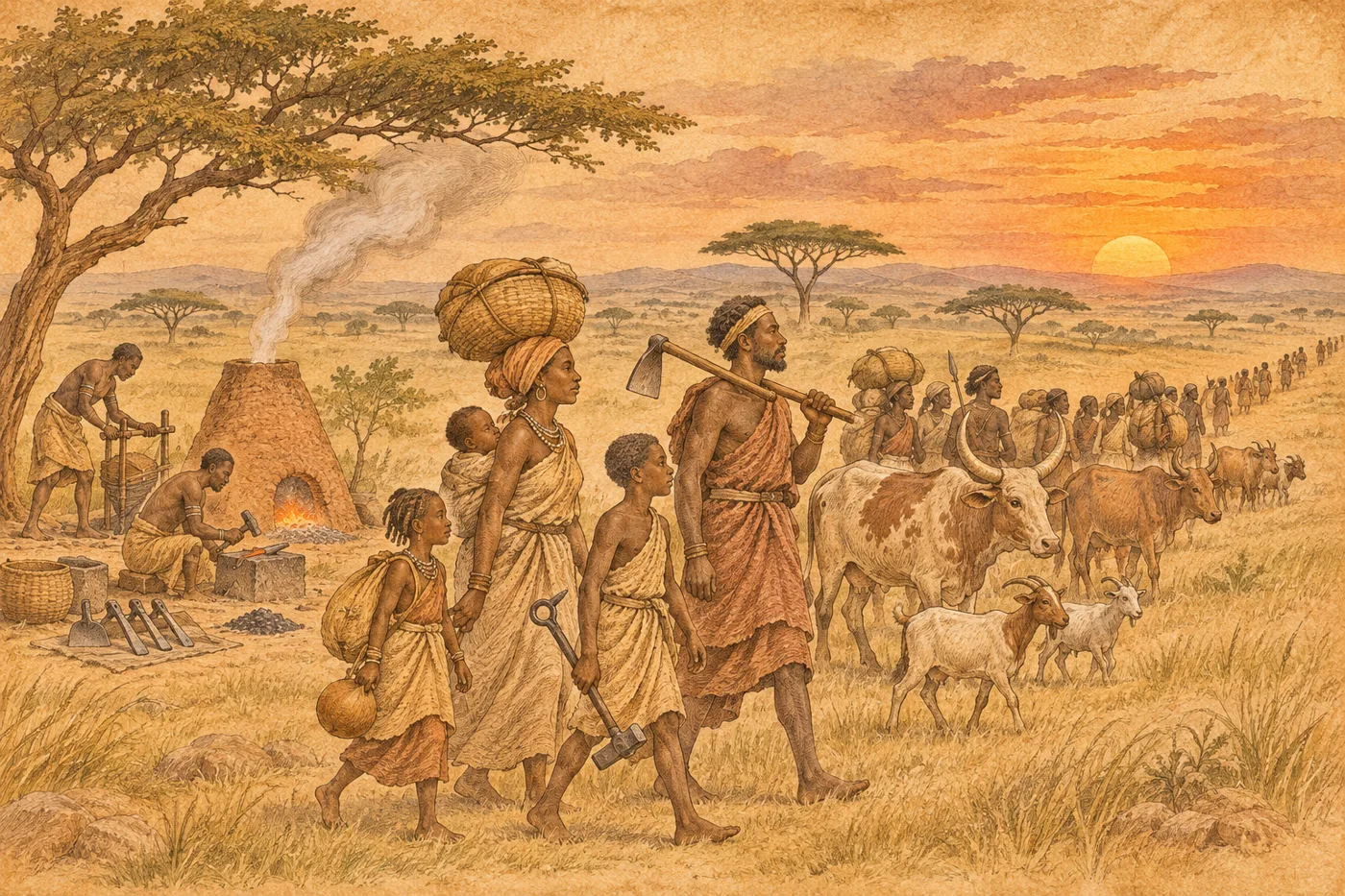
Why are such similar languages spoken across a vast area of eastern and southern Africa?
From eastern to southern Africa, a family of closely related languages called 'Bantu languages' is spread. Swahili, Zulu, Shona, and hundreds of other languages belong to this family. The word 'Bantu' comes from a word meaning 'people.' This expansion is one of the most significant events in the long history of humanity.
The homeland of the speakers of these languages is thought to be in the area around what is now eastern Nigeria to Cameroon. Starting around 4000 to 3000 years ago (around 2000–1000 BC), people gradually began to move east and south, going around the tropical rainforest or following rivers.
What supported this spread was farming, herding, and iron. By growing yams and millet, raising cattle and goats, and making axes and hoes from iron, they could clear forests and turn them into fields. In some societies, blacksmiths who made iron tools were treasured as people with special powers.
The people did not simply move forward into empty land. There were already hunter-gatherers and pastoralists living in the areas they moved into. As they interacted with the people they met, adopted each other's languages and customs, and sometimes fought over land, distinct regional societies gradually emerged.
By around the time of Christ, they had reached the Great Lakes region of East Africa, and by around the 3rd to 5th centuries AD, they had reached as far as South Africa. It was a slow spread that took over a thousand years. Many of the kingdoms and port towns that later arose were also built by the people speaking these languages.
Today, Bantu languages are spoken across a wide area of Africa. The number of speakers runs into the hundreds of millions. By examining a family of languages, you can see the route of a people's journey. That is the fascination of this chapter's story.
Mini timeline
- around 2000–1000 BCThe expansion of Bantu-speaking peoples begins from West/Central Africa
- around 500 BCIron tools begin to be used in sub-Saharan Africa (timing varies by region)
- around the time of ChristThey reach the Great Lakes region of East Africa
- around 3rd–5th centuries ADThey reach as far as South Africa
- around 1000 ADKingdoms and trading towns begin to develop in various regions
People in this chapter
They possessed the technology to make iron, crafting farming tools, weapons, and ritual implements. In some regions, they were thought to possess mystical powers.
He classified African languages by family, providing clues for thinking about the homeland of the Bantu languages (his classification has been revised since).
Meanwhile, elsewhere
Connection to Japan
In Japan, this corresponds to the Yayoi period, when iron tools are thought to have come into use (the exact timing is debated).
Why it still matters
The name 'Simba,' the protagonist of *The Lion King*, means 'lion' in Swahili (a Bantu language). Also, in southern Africa there is a concept called 'Ubuntu' (a person is a person through other people), widely known as a word that expresses an ideal of human society.
Perspectives differ
- Homeland and Timing
- The leading theory places their homeland around Nigeria and Cameroon in West Africa, but scholars are divided on when the movement began and which routes were taken.
- Was It a 'Great Migration'?
- There are differing views on whether people moved as large groups, or whether farming and language gradually spread to surrounding peoples. Many researchers believe it was actually a combination of both.
- Origin of Ironworking
- There are theories that ironworking in sub-Saharan Africa began independently, and theories that it was introduced from outside. Reassessment of dating is ongoing.
- The Name from Outside Africa
- The name 'Bantu' is a classification term coined by a 19th-century linguist. This word does not imply an ethnic unity.
Facts checked (4, verified by AI on the web)
- Confirmed The homeland of the Bantu languages is around Nigeria–Cameroon Journal of African History (Cambridge University Press): Moving Histories: Bantu Language Expansions
Scholarly papers state that the Bantu expansion began in the 'Nigeria-Cameroon borderland' (orthodoxy based on Greenberg's comparisons). - Corrected & confirmed The expansion began around 4000–3000 years ago Bantu expansion — population genetics (PMC)
Estimates range from about 3000 to 5000 years ago (the text's 'around 4000–3000 years ago' falls within this range. See the debates entry for the range) - Confirmed Arrival in southern Africa was in the first half of the 1st millennium AD (said to be around the 3rd–5th centuries AD) World History Encyclopedia: Bantu Migration
The World History Encyclopedia describes the southward movement of Eastern Bantu as 'the first half of the 1st millennium AD' and the entire movement as roughly 2000 BC to 1500 AD. Details of the timing are debated. The 3rd–5th centuries are a commonly cited guideline - Confirmed Joseph Greenberg (1915–2001) classified African languages into four families Croft, William (University of New Mexico): Joseph Harold Greenberg obituary (Language 77:4, 2001)
An obituary notes that Greenberg was born on May 28, 1915, and died on May 7, 2001, and that his classification of African languages (Greenberg 1963) into four families (Afroasiatic, Khoisan, Niger–Congo, and Nilo-Saharan) was widely accepted. His method of 'mass comparison' has also drawn criticism.
Sources
Journal of African History (Cambridge University Press): Moving Histories: Bantu Language Expansions
World History Encyclopedia: Bantu Migration
Bantu expansion — population genetics (PMC)
Croft, William (University of New Mexico): Joseph Harold Greenberg obituary (Language 77:4, 2001)
* AI-drafted and cross-checked; human review is in progress. Status: