Kingdom of Aksum — A Highland Power on the Red Sea
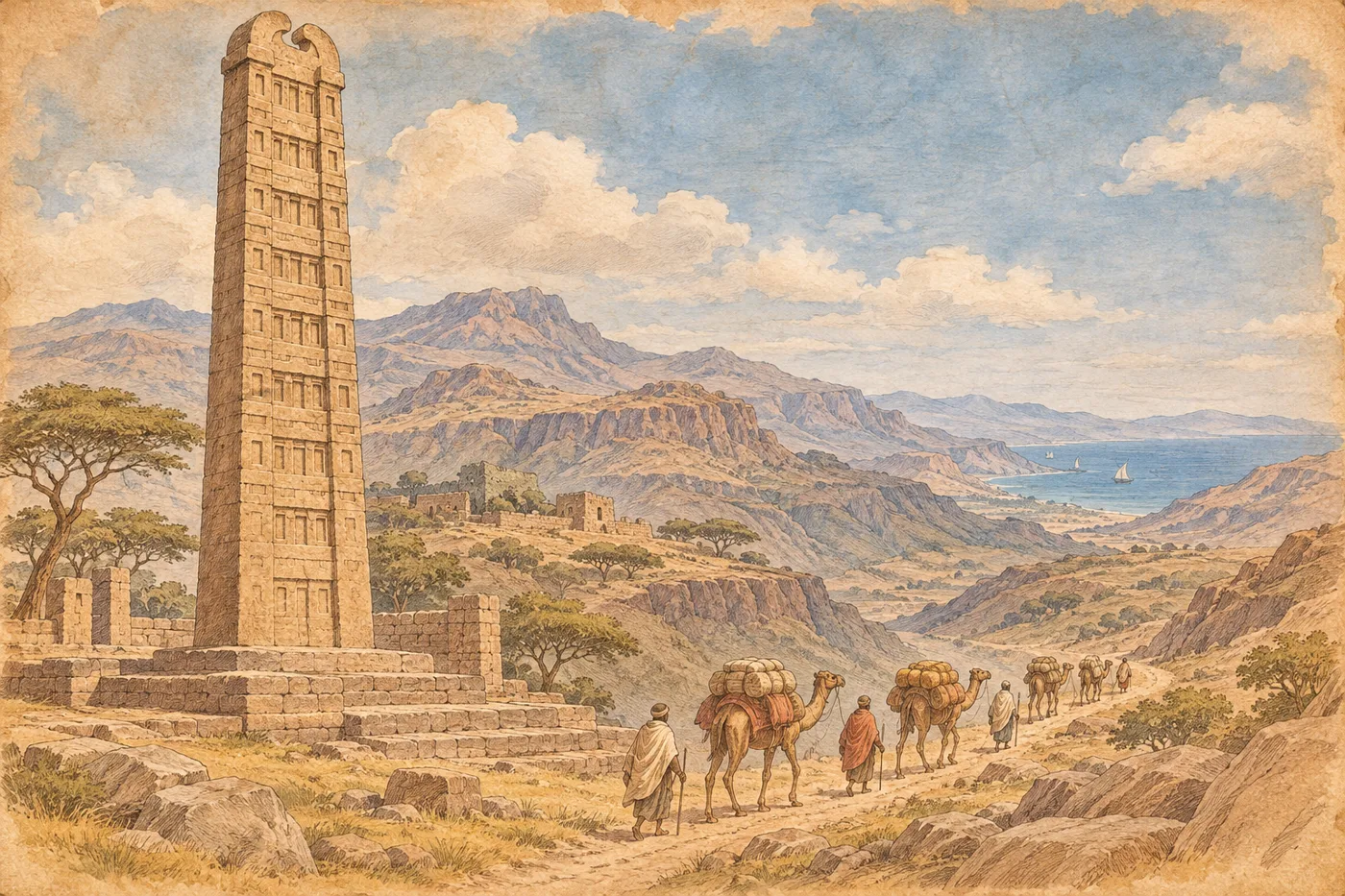
Why was a highland country in Africa able to wield power comparable to Rome and Persia?
In the highlands of northeastern Africa, from what is now northern Ethiopia into Eritrea, a kingdom flourished from around the 1st century AD: the Kingdom of Aksum. The plateau, over 2,000 meters above sea level, was cool and well-watered, growing wheat and millet.
The kingdom's strength came from maritime trade. Through the Red Sea port of Adulis, ivory, gold, and frankincense were shipped to Egypt, the Arabian Peninsula, and even India. The 1st-century sailing guide the Periplus of the Erythraean Sea mentions this port.
From the late 3rd century, Aksum minted its own gold and silver coins. Few states in the world at that time issued currency. Kings erected massive stone stelae in the capital, some over 20 meters tall, thought to mark royal and noble tombs.
In the early 4th century (around the 330s to 340), King Ezana adopted Christianity, nearly contemporary with the Roman Empire beginning to accept the faith. Aksum's Christianity later became the Ethiopian Orthodox Church, which continues today.
In the early 6th century, King Kaleb is said to have crossed the Red Sea to campaign in southern Arabia (the Himyarite Kingdom). Aksum maintained ties with both the Roman (Byzantine) Empire and Persia.
From around the 7th century, Aksum gradually declined. Several reasons are suggested, including shifts in Red Sea trade routes and the spread of Islamic powers. Still, Aksum's script and faith were long preserved among the highland peoples.
Mini timeline
- Around the 1st centuryThe Periplus of the Erythraean Sea describes the port of Adulis
- Around the late 3rd centuryAksum begins minting its own gold and silver coins
- Early 4th centuryKing Ezana adopts Christianity (around the 330s to 340)
- Early 6th centuryKing Kaleb is said to have campaigned in southern Arabia
- Around the 7th centuryAksum gradually loses power due to changes in Red Sea trade, etc.
People in this chapter
Known for leaving coins and inscriptions and for adopting Christianity. His inscriptions are written in multiple languages.
Said to have campaigned in southern Arabia. During this period, Aksum reached its greatest extent of influence.
Meanwhile, elsewhere
Connection to Japan
This period corresponds to the end of the Yayoi period through the Kofun period in Japan. In the 3rd century, Chinese records note that Himiko, queen of Yamatai, sent an envoy to China.
Why it still matters
The Geʽez script used in Aksum survives in modified form as the writing system for modern Ethiopian Amharic and Eritrean Tigrinya. One of Aksum's stelae, taken by Italy in the 20th century, was returned in 2005 and re-erected in 2008.
Perspectives differ
- Date of the adoption of Christianity
- It is placed in the early 4th century, but scholars differ on whether it was around 330 or in the 340s.
- Tradition of the Ark of the Covenant
- The Ethiopian Orthodox Church holds a tradition that the Ark of the Covenant from the Old Testament is kept in a church in Aksum. The Ark is not publicly displayed, and this cannot be verified.
- Tradition of the Queen of Sheba
- In Ethiopia, a story has long been told that the son of King Solomon and the Queen of Sheba was the ancestor of the Ethiopian royal line. This story was compiled in written form in the 14th century, long after Aksum's time.
- Cause of decline
- Several theories exist—climatic change, soil exhaustion, shifts in trade routes due to the spread of Islam—and no single cause has been determined as decisive.
Facts checked (6, verified by AI on the web)
- Confirmed The port of Adulis appears in the 1st-century Periplus of the Erythraean Sea Foundations of Aksumite Civilization (Metropolitan Museum)
Details of trade based on that work - Corrected & confirmed Independent coinage began in the late 3rd century (King Endubis, around 270) World History Encyclopedia: Kingdom of Axum
Gold and silver coins date from the 3rd century (WHE). Gold coins of King Endubis are dated to around 270–300 (summary of British Museum holdings). Text revised from 'end of the 3rd century' to 'late 3rd century' (timeline adjusted similarly) - Confirmed King Ezana's adoption of Christianity was in the early 4th century Foundations of Aksumite Civilization (Metropolitan Museum)
Dates range from 325–328 to around the 330s–340s (consistent with debates section) - Confirmed King Kaleb's campaign in southern Arabia was around 520–525 British Museum: Historical city travel guide, Aksum 6th century AD
British Museum and WHE give around 525; British Museum display labels say around 520, showing a range. The text's 'early 6th century' is consistent. - Confirmed Stele height over 20 m (obelisk about 24 m, fallen great stele total length approximately 33 m) UNESCO World Heritage Centre: Aksum Obelisk
UNESCO gives the obelisk as 24 m; WHE gives the fallen stele as 33 m. The 21 m stele of King Ezana is unconfirmed in the cited public sources. - Confirmed The stele was returned in 2005 and re-erected in 2008 Aksum Obelisk (UNESCO World Heritage Centre)
The last block was installed on July 31, 2008
Sources
Foundations of Aksumite Civilization (Metropolitan Museum)
World History Encyclopedia: Kingdom of Axum
British Museum: Historical city travel guide, Aksum 6th century AD
UNESCO World Heritage Centre: Aksum Obelisk
* AI-drafted and cross-checked; human review is in progress. Status: