Ethiopia — A Country That Kept Its Independence in Africa
Why is it said that Ethiopia took a different path from other African countries?
Ethiopia is a country on the highlands of northeastern Africa. In ancient times, the Kingdom of Aksum existed, and King Ezana is said to have accepted Christianity in the 4th century. The Aksumite period is covered in another chapter, but the Christianity of this country thereafter became a pillar supporting the people and the royal power. Later kings are explained as having come to think of themselves as connected to the holy city of Jerusalem.
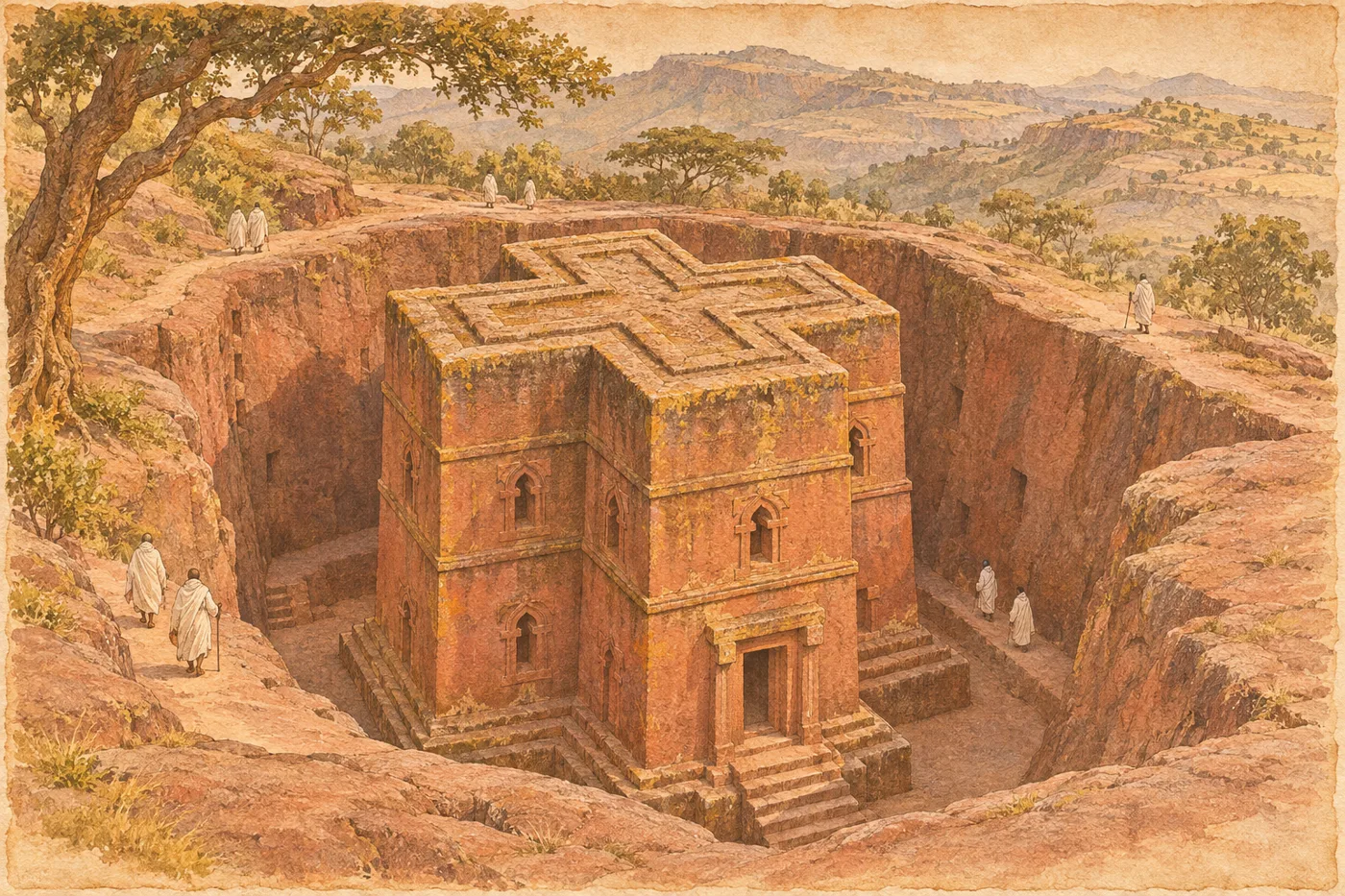
From the late 12th to the early 13th century, during the reign of King Lalibela of the Zagwe dynasty (said to be around 1181–1221), churches carved from rock were built in the town bearing his name. It is an astonishing feat: carving down from the top of a mass of rock to create a structure where both the interior and exterior are one single piece of stone. As a pilgrimage site, it continues to be a place of prayer today. There is scholarly debate about when and by whom it was built.
In 1270, Yekuno Amlak overthrew the last king of the Zagwe dynasty and founded a new dynasty. The kings of this dynasty claimed descent from King Solomon and the Queen of Sheba, and it is called the 'Solomonic dynasty.' The 14th-century book *Kebra Nagast* tells that story. This genealogy was also a story that supported royal authority, and the previous dynasty was considered usurpers. This dynasty is explained to have lasted until the 1970s.
At the end of the 19th century, as European countries were dividing up Africa, Emperor Menelik II signed the Treaty of Wuchale in 1889. The interpretation of the treaty's wording differed from Italy's, leading later to war. In March 1896, at Adwa, the Ethiopian army defeated the Italian army. The detailed circumstances are summarized in another chapter. The victory is still celebrated every March.
Independence did not continue uninterrupted. In October 1935, Mussolini's Italy invaded again, and in May 1936, Addis Ababa was occupied. Emperor Haile Selassie appealed to the League of Nations, asking whether a precedent of yielding to force should be set, but received no effective help. There are estimates that the number of people who died during the occupation amounted to several percent of the population.
In 1941, British and Ethiopian patriot forces drove out the Italian army, and on May 5, the Emperor returned to Addis Ababa. It was exactly five years after the capital had been occupied. Sovereignty was thus restored. The day of his return to the capital became a national holiday that rewrote the memory. In the phrase 'a country that kept its independence,' it is necessary to also consider the harsh occupation of 1936–41.
Mini timeline
- Around the 4th centuryKing Ezana of Aksum is said to have accepted Christianity
- Late 12th – early 13th centuryRock-hewn churches are said to have been built during the reign of King Lalibela of the Zagwe dynasty
- 1270Yekuno Amlak overthrows the Zagwe dynasty and founds the Solomonic dynasty
- March 1896Ethiopia defeats Italy at the Battle of Adwa
- May 1936Italian forces occupy Addis Ababa
- May 5, 1941Emperor Haile Selassie returns to the capital
People in this chapter
Emperor crowned in 1889 who defeated the Italian army at Adwa. He held the title 'Conquering Lion of the Tribe of Judah.'
Emperor who appealed against the invasion to the League of Nations in 1936 and returned to the capital on May 5, 1941.
Meanwhile, elsewhere
Connection to Japan
When the churches of Lalibela were built, Japan was at the end of the Heian period and the beginning of the Kamakura period. The Battle of Adwa in 1896 was the 29th year of the Meiji era, the year after the First Sino-Japanese War.
Why it still matters
The victory at Adwa is still celebrated every March. At the churches of Lalibela, pilgrims offer their prayers.
Perspectives differ
- Dating of the Lalibela church complex
- While a tradition holds that all the churches date from the time of King Lalibela alone, there is also the view that they were built in several stages, with construction continuing in later periods; opinions among researchers are divided.
- The meaning of 'New Jerusalem'
- There is a theory, based on the names of the churches and places, that it was a town modeled after Jerusalem, and another theory that it was less a substitute for the holy city and more a symbol of being chosen by God; there are various views.
- The Solomonic dynasty's genealogy and 'usurpation'
- The Solomonic dynasty called the Zagwe dynasty usurpers. On the other hand, there is research suggesting the Zagwe were actually closer to the Aksumite kings, and views are divided.
- The phrase 'kept its independence'
- Because of the occupation from 1936–41, how to understand the expression 'never colonized' is a matter of differing opinions among researchers and depending on one's standpoint. Estimates of the scale of casualties during the occupation also vary.
Facts checked (7, verified by AI on the web)
- Corrected & confirmed King Lalibela reigned around 1181–1221, and the rock-hewn churches were built EBSCO Research Starters: Lalibela Founds Christian Capital of Ethiopia
EBSCO gives his reign as around 1181–1221, but African History Extra cites land charters from 1204 and 1225 and a later theory of accession in 1185, mentioning the possibility that construction occurred in multiple stages and continued later. The main text uses 'is said to' and 'there is debate.' - Confirmed In 1270, Yekuno Amlak overthrew the last king of the Zagwe dynasty and founded the Solomonic dynasty EBSCO Research Starters: Lalibela Founds Christian Capital of Ethiopia
Both EBSCO and African History Extra record the dynastic change in 1270. The latter argues that viewing the Zagwe as usurpers is a later perspective, and that the Zagwe were actually closer to Aksum. - Confirmed Menelik II was crowned in 1889 and defeated Italy at Adwa Library of Congress blog: Emperor Menelik II of Ethiopia and the Battle of Adwa: A Pictorial History
The US Library of Congress blog confirms his coronation on November 3, 1889, negotiations at Wuchale in May 1889, the victory at Adwa, and the annual celebration in March. The date of the battle (March 1) and the discrepancy over Article 17 of the treaty are not detailed on this page. - Confirmed Italy invaded in October 1935, occupied the capital on May 5, 1936; Haile Selassie returned on May 5, 1941 Ohio State University, Origins: Emperor Haile Selassie I Returns Triumphant to Ethiopia
Confirmed by Ohio State University's Origins. It also mentions the League of Nations speech in June 1936 and support from British forces, including the Orde Wingate (Gideon) Force. - Corrected & confirmed 4–5% of the population died during the occupation Ohio State University, Origins: Emperor Haile Selassie I Returns Triumphant to Ethiopia
Origins estimates 4–5% of a population of about 12 million, but this is an estimate; other estimates exist, so the main text uses 'several percent are estimated.' - Confirmed Article 17 of the 1889 Treaty of Wuchale differed in the Amharic and Italian versions Journal of African History: The Protectorate Paragraph of the Wichale Treaty (Cambridge Core)
An academic journal abstract states there were significant discrepancies in Article 17 between the Amharic and Italian versions, and the Italian government claimed it established a protectorate (the World History Encyclopedia also notes a difference in interpretation). - Corrected & confirmed King Ezana accepted Christianity in the 4th century / later kings emphasized a connection to Jerusalem World History Encyclopedia: Kingdom of Axum(事典)
The encyclopedia states that King Ezana adopted Christianity in the mid-4th century, and that later Solomonic kings claimed descent from Solomon and the Queen of Sheba (the connection to Jerusalem is confirmed through this genealogical claim).
Sources
Library of Congress blog: Emperor Menelik II of Ethiopia and the Battle of Adwa: A Pictorial History
Ohio State University, Origins: Emperor Haile Selassie I Returns Triumphant to Ethiopia
EBSCO Research Starters: Lalibela Founds Christian Capital of Ethiopia
African History Extra: Constructing a global monument in Lalibela(研究者による解説)
Journal of African History: The Protectorate Paragraph of the Wichale Treaty (Cambridge Core)
World History Encyclopedia: Italo-Ethiopian Wars(事典)
World History Encyclopedia: Kingdom of Axum(事典)
* AI-drafted and cross-checked; human review is in progress. Status: