The Swahili Coast and Great Zimbabwe — Ports on the Sea and a City of Stone
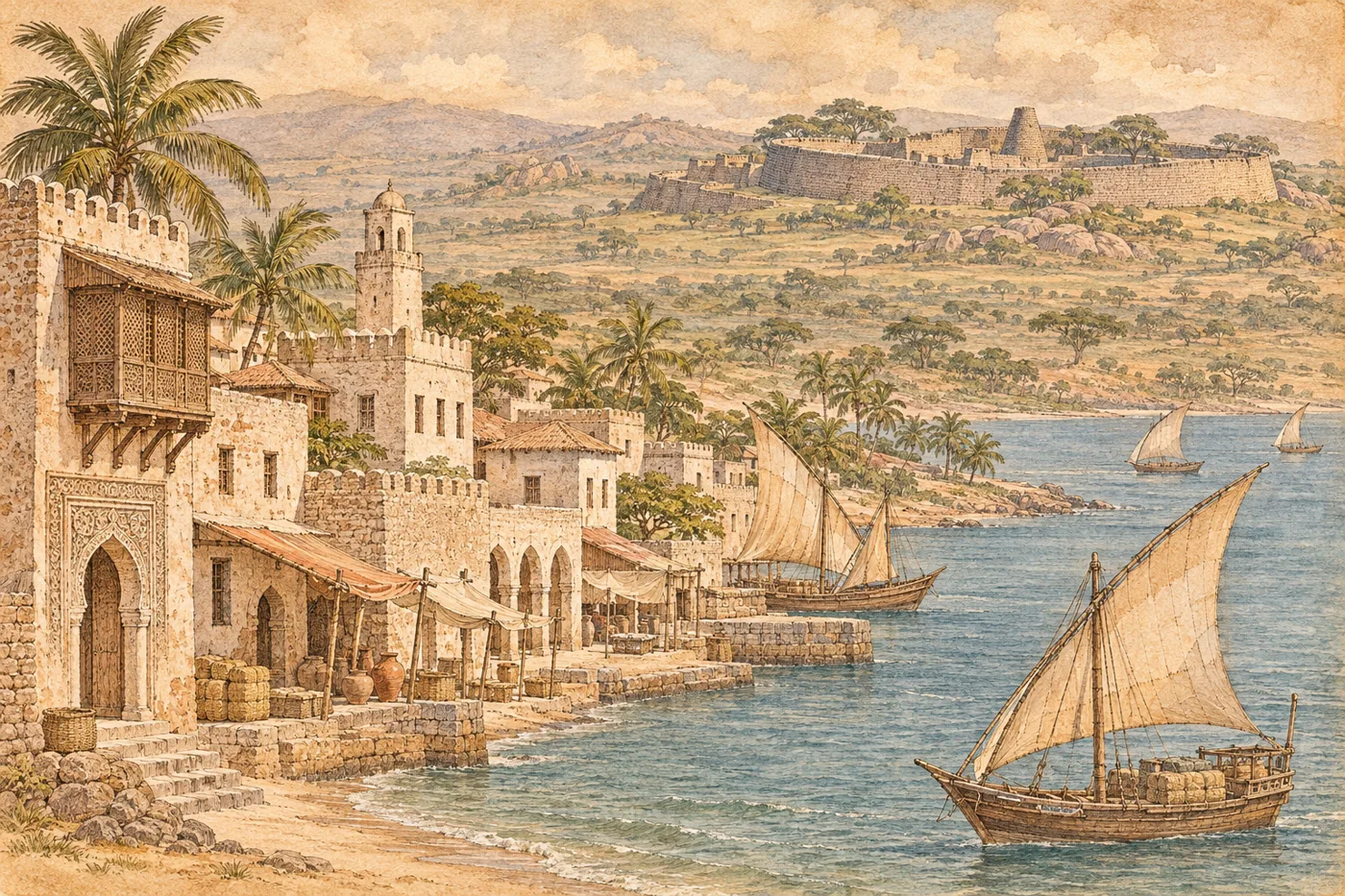
Why were the African coastal towns and the inland stone city connected to the Indian Ocean world?
The Indian Ocean has monsoon winds that change direction every six months, so ships could ride the northeast wind to Africa in winter and return to Arabia or India on the southwest wind in summer. Using these winds, ships from Arabia, Persia, and India visited the East African coast.
From around the 8th century, port towns such as Kilwa, Mombasa, Malindi, and Zanzibar grew along the East African coast. Swahili is thought to have formed from Bantu languages mixed with Arabic and other languages. 'Swahili' is said to come from an Arabic word meaning 'people of the coast.'
Around 1331, the Moroccan traveler Ibn Battuta visited Kilwa and wrote that it was one of the most beautiful cities in the world. Ivory, gold, slaves, and products from the African interior were shipped from here across the sea. The slave trade was a dark side of this commerce. Chinese ceramics also reached here.
Meanwhile, in inland southern Africa, there was a huge city built of stone: Great Zimbabwe in present-day Zimbabwe. It flourished from the 11th to 15th centuries, and its walls, stacked without mortar, reach about 11 meters at their highest. 'Zimbabwe' is said to come from a Shona word meaning 'stone houses.'
This city prospered on a foundation of gold and cattle. Gold from the interior is thought to have been carried through coastal ports to the Indian Ocean world. On the hilltop stood a palace, and in the valley was built the Great Enclosure, where people likely prayed and lived.
At the end of the 15th century, Portuguese ships arrived in the Indian Ocean for the first time (Vasco da Gama, 1498). Portugal attacked the port towns of East Africa and built a fortress at Kilwa in 1505. The patterns of Indian Ocean trade began to change dramatically.
Mini timeline
- c. 8th centuryIslamic merchant port towns begin to develop on the East African coast
- 11th–15th centuriesGreat Zimbabwe flourishes
- c. 1331Ibn Battuta visits Kilwa
- 1498Vasco da Gama passes along the East African coast on his way to India
- 1505Portugal builds a fortress at Kilwa
People in this chapter
He traveled across Africa and Asia for about 30 years, recording his observations in his 'Travels' (Rihla).
She conducted excavations in 1929 and scientifically demonstrated that Great Zimbabwe was built by African peoples.
Meanwhile, elsewhere
Connection to Japan
This corresponds to Japan's Muromachi period. In the early 15th century, Zheng He's fleet is said to have reached East Africa, and it is known that a giraffe was brought from East Africa to the Ming court.
Why it still matters
Swahili is still spoken today in Tanzania, Kenya, and elsewhere, by tens of millions of people. The name Great Zimbabwe became the name of a country that gained independence in 1980. The 'Zimbabwe Bird' statues found at the ruins are also depicted on the national flag.
Perspectives differ
- The builders of Great Zimbabwe
- 19th-century Europeans did not accept that it was built by Africans, believing it was the work of ancient Phoenicians or the city of the Queen of Sheba. This was due to racial prejudice at the time. Today it is recognized as a site built by African peoples (Shona-speaking peoples).
- Origins of Swahili culture
- The old view that it was founded by Arab or Persian immigrants has been reconsidered. The prevailing view now is that African peoples developed the culture through contact with foreign merchants.
- Etymology of 'Zimbabwe'
- Besides the 'stone houses' theory, there is also a theory that it means 'venerable house,' but this is not confirmed.
- Reasons for the city's decline
- There are multiple theories, including resource depletion, climate change, and shifts in trade routes.
Facts checked (5, verified by AI on the web)
- Confirmed Ibn Battuta visited Kilwa around 1331 and described it as one of the most beautiful cities Kilwa Kisiwani nomination (UNESCO)
Some sources say 1331–1332. Not verified against the original text of the 'Travels.' - Confirmed Great Zimbabwe dates from the 11th–15th centuries, with walls about 11 m high Great Zimbabwe (Metropolitan Museum)
Some sources give the wall height as about 9.75 m. - Confirmed Caton-Thompson surveyed the site in 1929 and showed it was an African-built site Caton-Thompson, Gertrude (AIM25)
Some sources give the excavation year as 1928–29. - Corrected & confirmed Portugal built a fortress at Kilwa in 1505 Universitat Politècnica de València: Kilwa, the first European overseas' fortification built in the East
Confirmed in an abstract of a paper from the Polytechnic University of Valencia that a fortress was built at Kilwa during Almeida's voyage from July 23 to August 9, 1505 (17 days). The abstract does not mention an 'attack,' so the text has been corrected to 'built a fortress.' - Confirmed Vasco da Gama reached the Indian Ocean in 1498 World History Encyclopedia(事典): Vasco da Gama / The Portuguese Conquest of India
The text states that Gama set out from Malindi for India in April 1498 and arrived in Calicut in less than a month.
Sources
Kilwa Kisiwani nomination (UNESCO)
Great Zimbabwe (Metropolitan Museum)
Caton-Thompson, Gertrude (AIM25)
Universitat Politècnica de València: Kilwa, the first European overseas' fortification built in the East
World History Encyclopedia(事典): Vasco da Gama / The Portuguese Conquest of India
* AI-drafted and cross-checked; human review is in progress. Status: