The Cape and the Zulu — From Supply Base to Land of Conflict
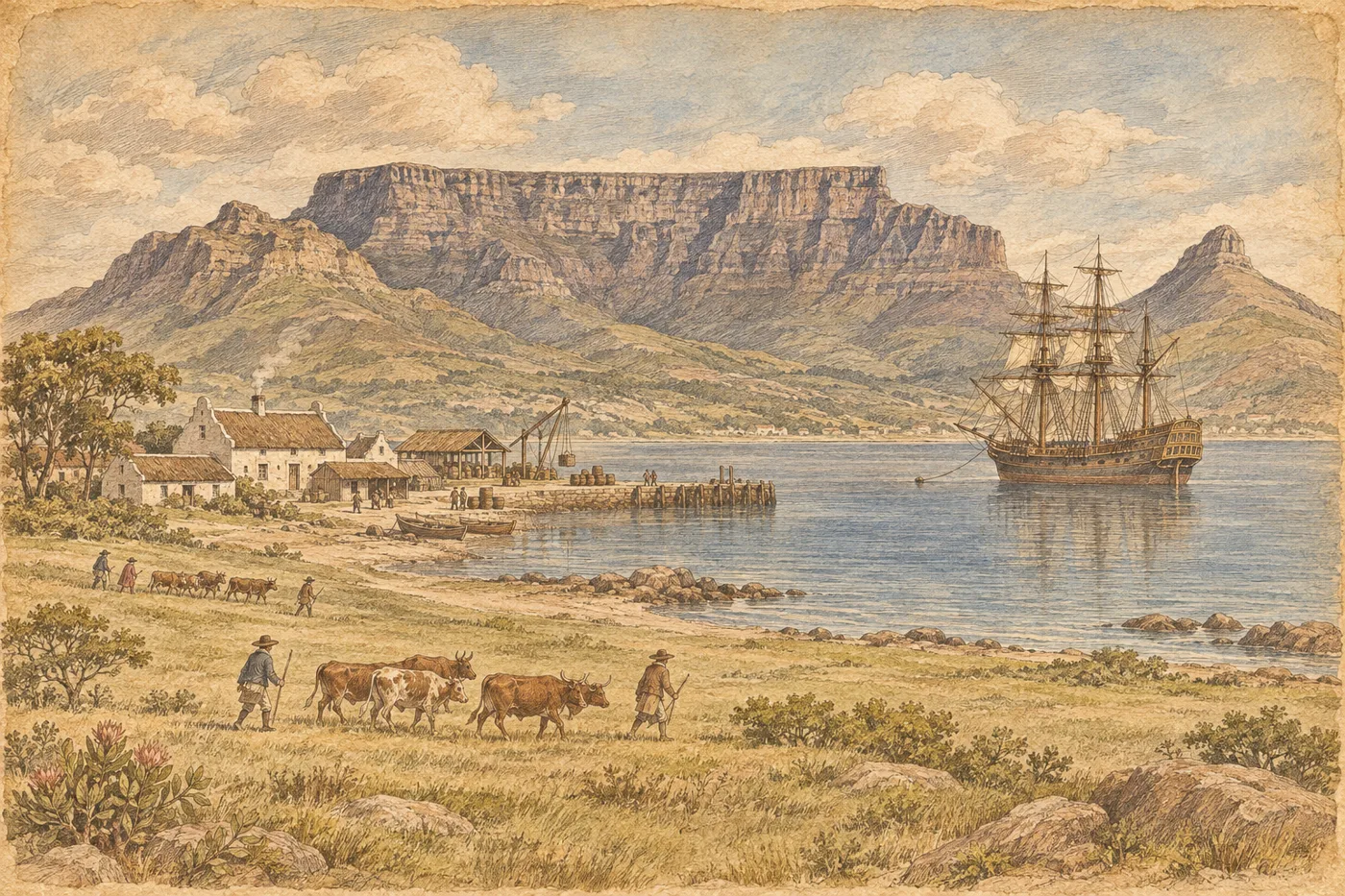
Why did a European country come to exist at the southern tip of South Africa?
In 1652, a party led by Jan van Riebeeck, an employee of the Dutch East India Company, established a supply station at the Cape on the southwestern tip of Africa. This was to obtain fresh water and food at a midpoint on the sea route between Europe and Asia. Around the same time, the Company was also trading at Dejima in Nagasaki, Japan.
This land was already home to indigenous peoples such as the Khoikhoi and San. Dutch settlers gradually expanded their farms, taking the land and livestock of the indigenous peoples. The descendants of the settlers later came to be called 'Boers' (Afrikaners).
When Britain occupied the Cape in 1806, the Boers resisted. The British abolition of slavery (1834) and differences in law were among the reasons for their discontent. From the mid-1830s, the Boers loaded their belongings onto ox-wagons and headed inland. This was the 'Great Trek'.
Inland at that time, the Zulu kingdom was growing in power. King Shaka (reigned c. 1816–1828) reformed the military organization and united surrounding groups. In 1838, the battle between the Boers and the Zulu army at 'Blood River' remained etched in each side's memory for generations.
In the latter half of the 19th century, the situation changed dramatically. Diamonds (1867) and gold (1886) were discovered, and people flocked from around the world. Britain fought the Zulu kingdom; though defeated at the Battle of Isandlwana in 1879, it crushed the Zulu kingdom later that same year.
After the Boer Wars starting in 1899, the Boer republics also came under British control. In 1910, the British Union of South Africa was established. However, it was mainly white people who were allowed to participate in the country's politics. This choice leads into the story of the next chapter.
Mini timeline
- 1652Dutch East India Company establishes a supply station at the Cape
- 1806Britain occupies the Cape
- 1838Battle of Blood River
- 1886Gold discovered near Johannesburg
- 1910Union of South Africa established
People in this chapter
He reformed military organization and tactics, greatly expanding Zulu power.
He led the Zulu army in the 1879 war against the British.
Meanwhile, elsewhere
Connection to Japan
The Dutch East India Company, which established the Cape, also traded with Japan during the Edo period at Dejima in Nagasaki.
Why it still matters
South Africa has many official languages (11 under the 1996 constitution, later joined by sign language to make 12). The term 'Rainbow Nation' evokes an image of a country where diverse ethnic groups and languages live together. But behind it lies the long and complex history seen in this chapter.
Perspectives differ
- Portrayal of Shaka
- Since European records make up much of the source material, it has been pointed out that depictions are biased toward a 'cruel king' image. The full picture is being reassessed, including Zulu oral traditions.
- The concept of 'Mfecane'
- The idea that a period of great upheaval and migration occurred across large parts of southern Africa in the 1820s (Mfecane) is widely known, but many researchers are now re-evaluating it, arguing that attributing the cause solely to the Zulu kingdom is too simplistic.
- The claim of 'empty land'
- Some among the settlers claimed that the land they moved into was uninhabited. In reality, indigenous peoples lived there, and this claim has been criticized.
- Death toll in Boer War camps
- During the war, the British army placed Boer women and children in camps. More than 20,000 deaths are said to have occurred on the Boer side, and many deaths also reportedly occurred in camps for Africans. Figures vary by estimate.
Facts checked (5, verified by AI on the web)
- Confirmed Cape supply station in 1652, British occupation in 1806, abolition of slavery in 1834 History of slavery and early colonisation in SA, timeline 1602-1841 (SAHO)
The 1806 occupation followed the Battle of Blaauwberg (a separate first occupation occurred from 1795–1802). - Confirmed Battle of Blood River in 1838 Battle of Blood River (Britannica)
Zulu losses are said to exceed 3,000, but figures vary by source. - Confirmed Cetshwayo reigned 1872–79, British defeated at Isandlwana (1879), defeated at Ulundi the same year Cetshwayo (Britannica)
The Battle of Ulundi took place on July 4, 1879. - Confirmed Shaka reigned c. 1816–1828 South African History Online: Shaka Zulu
SAHO records that Shaka led the Zulu as king from 1816 and was killed on September 22, 1828. - Confirmed Sign language became the 12th official language in 2023 (today section) President Ramaphosa: signing of SASL Bill (gov.za)
Signed on July 19, 2023.
Sources
History of slavery and early colonisation in SA, timeline 1602-1841 (SAHO)
Battle of Blood River (Britannica)
Cetshwayo (Britannica)
President Ramaphosa: signing of SASL Bill (gov.za)
South African History Online: Shaka Zulu
* AI-drafted and cross-checked; human review is in progress. Status: