The Battle of Adwa — Ethiopia, the African Nation That Defended Its Independence
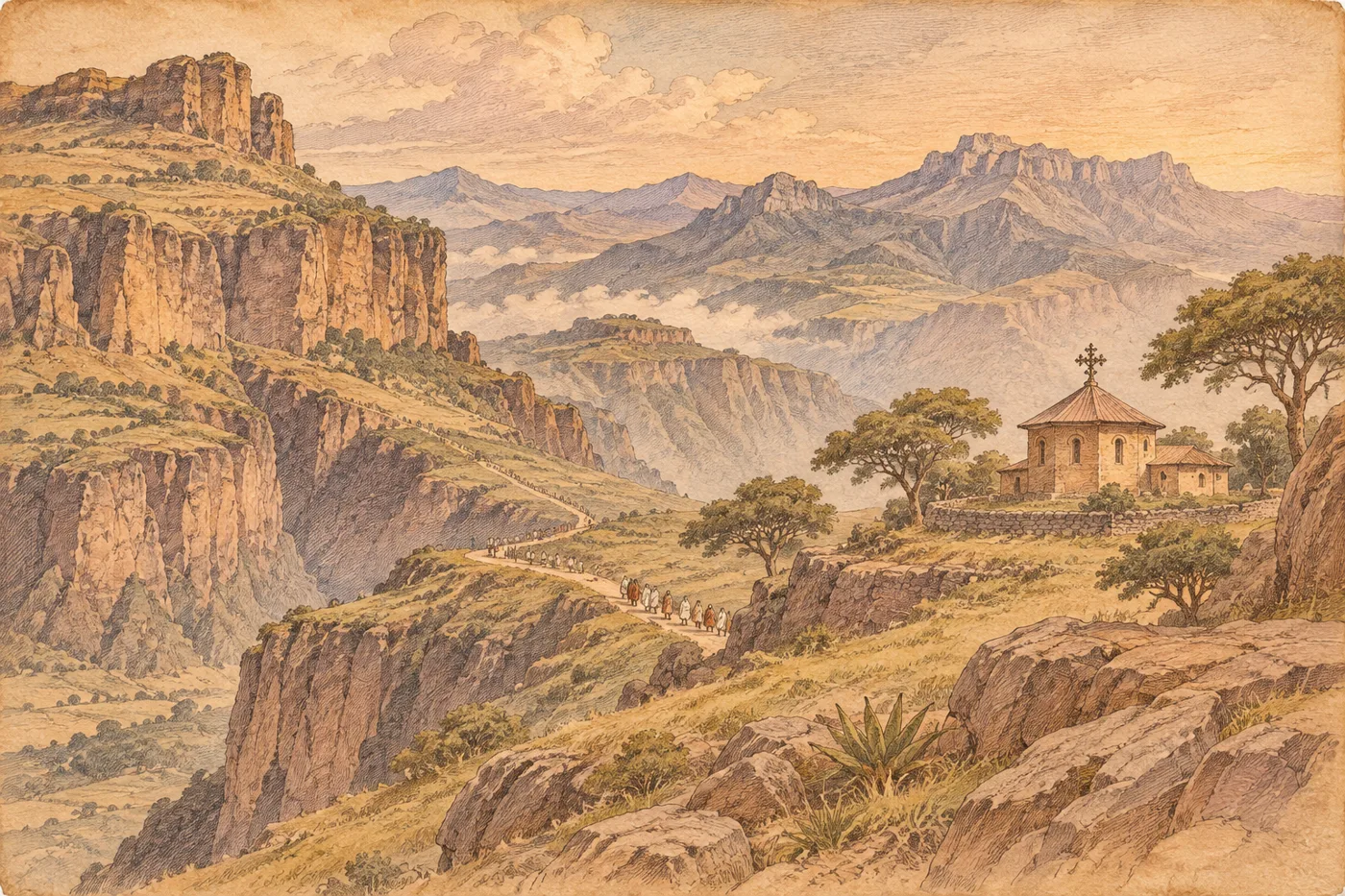
While most of Africa was colonized, why was Ethiopia able to defend its independence?
In the latter half of the 19th century, European nations competed to carve up Africa. This scramble accelerated around the Berlin Conference of 1884–85. Among them, Ethiopia, located on the highlands of East Africa, was one of the few countries that maintained its independence. At its core was an ancient Christian highland kingdom.
Behind this was a movement toward national unification. Emperor Tewodros II, who ascended the throne in 1855, tried to unite the fragmented regions. John IV, and then Menelik II (reigned 1889–1913), continued this effort. Menelik also expanded territory southward, and a new capital, Addis Ababa, emerged around the late 1880s. People of various languages and religions lived in the southern regions. It's also known that he purchased weapons such as firearms from abroad to prepare.
In 1889, around the time he became emperor, Menelik II signed the Treaty of Wuchale with Italy. The treaty existed in Amharic and Italian versions, and Article 17 differed in meaning between the two. The Italian version could be read as giving Italy control over Ethiopia's foreign affairs, and Italy tried to treat Ethiopia as a protectorate. Menelik did not accept this.
Negotiations broke down, and minor clashes began around late 1894, escalating into full-scale war in 1895. On March 1, 1896, near Adwa in the north, Menelik's army clashed head-on with the Italian army. The Ethiopian army outnumbered the Italians, and the Italian forces suffered heavy losses and were defeated. About 6,000 Italian soldiers were killed, and over 3,000 taken prisoner, according to some accounts (figures vary by source). The role of Empress Taytu is also remembered.
In October of the same year, the Treaty of Addis Ababa recognized the abrogation of the Treaty of Wuchale and acknowledged Ethiopia's independence. The Battle of Adwa became known worldwide as an instance where a European army was decisively defeated by an African nation, and it was etched into the memory of those who later resisted colonial rule.
But the story does not end there. In 1935, Mussolini's Italy invaded again, and in May 1936, Addis Ababa was occupied. Emperor Haile Selassie fled abroad and appealed to the League of Nations. In 1941, with the help of British forces and local resistance, the Italians were driven out, and the emperor returned to the capital on May 5.
Mini timeline
- 1855Tewodros II ascends the throne, aiming to unify the country
- 1889Treaty of Wuchale signed; Menelik II becomes emperor
- March 1, 1896Italian army defeated at the Battle of Adwa
- October 1896Independence recognized by the Treaty of Addis Ababa
- 1936–41Italian occupation and its end
People in this chapter
He unified the country and repelled the Italians at the Battle of Adwa.
He continued to appeal from abroad during the occupation and returned to the capital in 1941.
Meanwhile, elsewhere
Connection to Japan
The Battle of Adwa took place in 1896, the 29th year of the Meiji era, the year after the First Sino-Japanese War. Japan had just won a war and was rapidly building its position in the international community.
Why it still matters
The victory at Adwa is commemorated in Ethiopia as 'Victory of Adwa Day,' celebrated around March 2 each year. The African Union's headquarters is in Addis Ababa.
Perspectives differ
- Number of casualties at Adwa
- Many accounts say Italian dead numbered over 6,000, but figures range from about 5,000 to higher, depending on the source. Ethiopian casualties are also said to be in the thousands, but the exact number is unclear.
- Discrepancy in Article 17
- Whether the difference between the Amharic and Italian versions was a mistranslation or intentional is debated among researchers. Menelik is said to have rejected Article 17 in 1890 and abrogated the entire treaty in 1893.
- The phrase 'only independent nation'
- Ethiopia is a prime example of maintaining independence, but Liberia also survived as an independent state. How many are counted as 'exceptions' depends on how one views the nature of their independence.
- Evaluation of Menelik II's territorial expansion
- While some highly value the unification and maintenance of independence, others point out that the expansion into the south amounted to domination for the people of those regions, and debate continues today.
Facts checked (10, verified by AI on the web)
- Confirmed The Battle of Adwa was fought on March 1, 1896, between Menelik II's forces and the Italian army under Baratieri, with Ethiopia winning. World History Encyclopedia(事典): Italo-Ethiopian Wars
The text states that the Battle of Adwa (March 1, 1896) saw the attacking Italian army under Baratieri suffer heavy losses inflicted by Menelik II's side. - Corrected & confirmed About 6,000 Italian dead and about 3,800 prisoners of war. World History Encyclopedia(事典): Italo-Ethiopian Wars
The text notes 'about 6,000 Italian soldiers killed, and over 3,000 taken prisoner' (figures vary by source). Revised segments to 'about 6,000 killed in action, over 3,000 taken prisoner'. - Confirmed Article 17 of the Treaty of Wuchale differed in Italian and Amharic, leading Italy to claim a protectorate. World History Encyclopedia(事典): Italo-Ethiopian Wars
The text describes the interpretational difference in Article 17 of the 1889 Treaty of Wuchale, Italy's claim of a protectorate, and Menelik's rejection of the protectorate claim in 1893. - Confirmed The Treaty of Addis Ababa on October 26, 1896 voided the Treaty of Wuchale and recognized independence. World History Encyclopedia: Italo-Ethiopian Wars
The text states that on October 26, 1896, Italy agreed to the abrogation of the Treaty of Wuchale and recognized Ethiopia's sovereignty and independence (Britannica: Treaty of Wichale). - Confirmed Italian forces entered Addis Ababa on May 5, 1936, and Haile Selassie returned on May 5, 1941. Origins (Ohio State): Haile Selassie I Returns Triumphant to Ethiopia
Sources distinguish between the start of the invasion in 1935 and the establishment of occupation in 1936. - Confirmed Tewodros II ascended the throne in 1855. Britannica: Emergence of modern Ethiopia (1855–1916)
Britannica's chronology gives Tewodros II's reign as 1855–68. The coronation date varies by source (one gives 11 February). - Confirmed Addis Ababa was founded in the late 1880s. Addis Ababa City Administration: FAQs
City official FAQ states: 'Founded by Menelik II and Empress Taytu in 1887.' Some sources cite 1886, so 'late 1880s' is reasonable. - Confirmed Menelik became emperor in 1889, and the treaty was signed around that time. Britannica: Menilek II
Britannica gives the emperor's reign as 1889–1913 and the Treaty of Wuchale as 2 May. Some sources give 3 November for the coronation. - Unverified Liberia also maintained its independence. Office of the Historian: Liberia
Text covers the 1847 declaration of independence and 1862 US recognition, but does not mention maintaining independence during the partition. No official source specifying independence during partition could be accessed (Britannica returns 403). - Confirmed Victory of Adwa Day is commemorated on March 2. Embassy of Ethiopia (Belgium): 127th Adwa Victory Day
エチオピア大使館などが3月2日に記念行事を行う。戦闘日を3月1日とする資料もあり、本文は「3月2日ごろ」。
Sources
World History Encyclopedia(事典): Italo-Ethiopian Wars
Origins (Ohio State): Haile Selassie I Returns Triumphant to Ethiopia
Britannica: Emergence of modern Ethiopia (1855–1916)
Britannica: Menilek II
Embassy of Ethiopia (Belgium): 127th Adwa Victory Day
* AI-drafted and cross-checked; human review is in progress. Status: