Maya — Stone Cities and the People Who Read the Stars
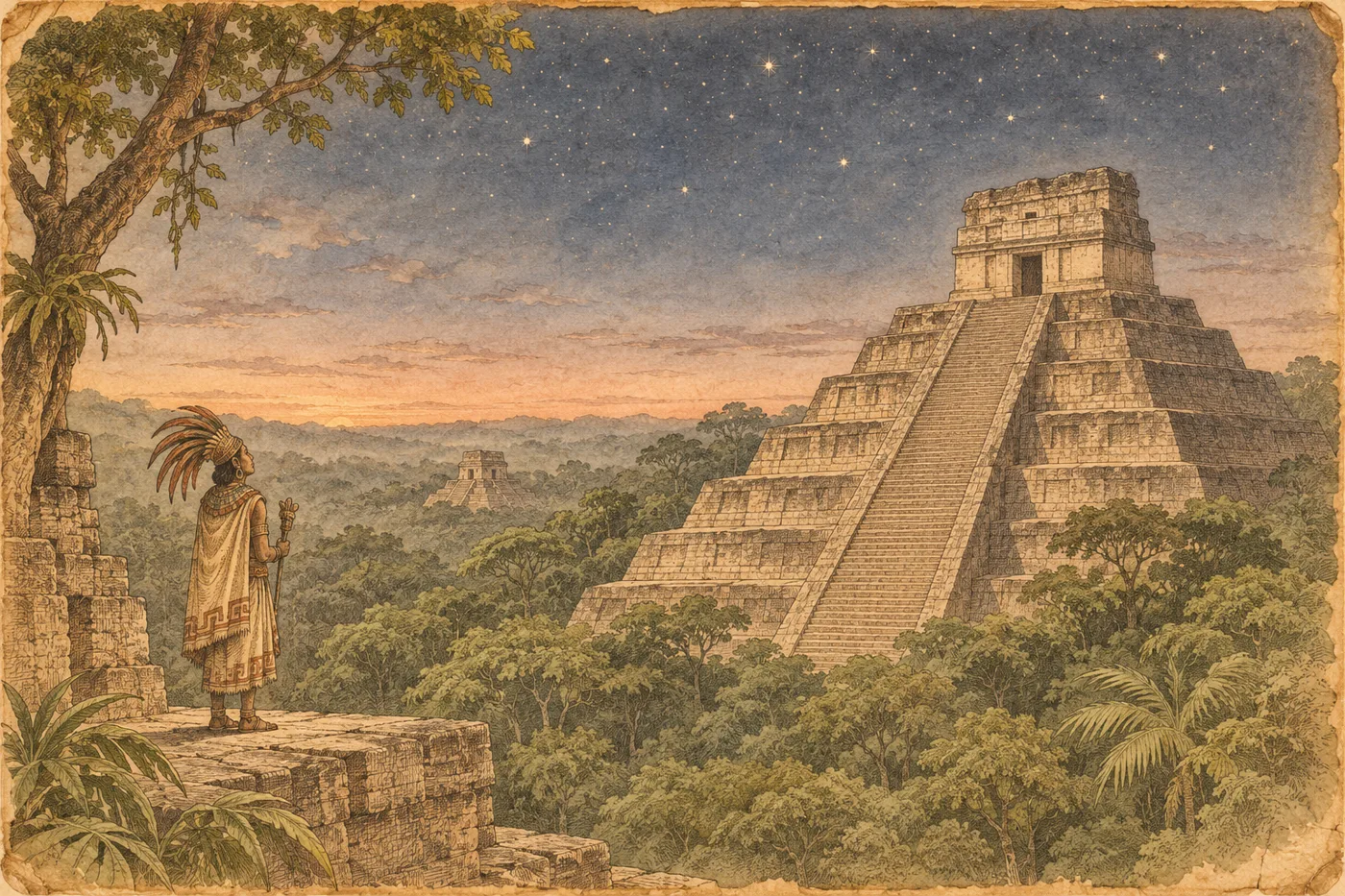
Why were such huge stone cities built in the middle of the jungle?
In what is now southeastern Mexico, Guatemala, Belize, and Honduras, farming and settled life began to spread around 4,000 years ago, and the Maya people have lived there ever since. Their staple food was maize. Farming spread early in this region, and by around 1000 BC villages began to develop, and cities later emerged.
The period from around 250 to 900 AD is called the Classic Period. During this time, many cities flourished, such as Tikal, Palenque, Copán, and Calakmul. However, the Maya were not a single empire. Each city had its own king, and they were a collection of city-states that sometimes allied and sometimes fought. Their pyramid-shaped stone temples still rise within the dense jungle.
The Maya had a writing system. It combined picture-like glyphs with symbols representing sounds, and they carved the names of kings and events onto stelae and walls. For a long time it could not be read, but since the late 20th century, decipherment has advanced greatly, and now much of the content can be understood.
Their calendar and astronomy were also highly advanced. They combined a 260-day calendar and a 365-day calendar, and also created a 'Long Count' calendar for very long periods. They meticulously observed the movements of Venus, and used a symbol for zero in their numbers. Reading the stars was also practical wisdom for everyday life, used to determine the days for farming and rituals.
However, from around the 9th century, cities in the southern lowlands declined one after another (the Classic Period collapse). The causes are thought to include prolonged drought, warfare between cities, overpopulation, and other factors, but no single explanation has been settled. After that, in the northern Yucatán Peninsula, cities like Chichén Itzá flourished.
So, was the Maya a 'lost civilization'? No. Today, millions of Maya people live in Mexico, Guatemala, and other countries, and more than twenty Mayan languages are spoken. When the Spanish arrived in the 16th century, many of their books were burned, but the few surviving codices, the texts carved in stone, and the oral traditions of the people have passed Maya history down to the present.
Mini timeline
- around 1000 BCVillages develop, forming the foundation of later cities
- around 250 ADThe Classic Period begins (the division is by convention)
- 683 ADKing Pakal of Palenque dies
- around the 9th centuryCities in the southern lowlands decline one after another
- 1697 ADNojpeten (Tayasal), the last independent Maya stronghold, is conquered by Spain
People in this chapter
He is said to have become king at age 12 and ruled for over 60 years. His tomb was discovered beneath a temple in the mid-20th century.
She advocated for Indigenous rights and received the Nobel Peace Prize in 1992. She is one figure showing that Maya people are still protagonists in history today.
Meanwhile, elsewhere
Connection to Japan
Japan moved from the Kofun period into the Asuka and Nara periods. This was almost the same time as the Maya Classic Period.
Why it still matters
In Guatemala and elsewhere, there are still people who follow ceremonies based on the Maya calendar. Around tourist sites like Tikal and Chichén Itzá, Maya communities live and maintain their traditions.
Perspectives differ
- Causes of the Classic Period collapse
- Various theories exist: drought, warfare, overpopulation, environmental degradation, changes in trade routes, etc. The causes likely varied by region, and no definitive theory has been established.
- The image of 'peaceful astronomers'
- The Maya were once thought of as a peaceful people of stargazers, but as the writing system was deciphered, it became clear that warfare between city-states was common. Views are divided on the actual practice of ritual sacrifice.
- Population size
- Estimates of Classic Period populations—for example, of Tikal—vary greatly depending on the survey methods used at the sites.
- Use of zero
- The Maya are said to have used a symbol for zero independently of India. It is considered an independent invention, but research continues on the usage and meaning of the symbol.
- The 2012 'apocalypse' theory
- Because a cycle of the Maya Long Count calendar ended in 2012, it caused a stir as 'the end of the world.' However, no Maya text is known to contain such a prophecy of doom. It was simply a calendar transition.
Facts checked (5, verified by AI on the web)
- Confirmed King Pakal reigned in Palenque from 615–683 AD Palenque (National Geographic)
Some sources give his birth year as 603 AD - Confirmed The Classic Period is roughly 250–900 AD Maya art (VIVA Pressbooks)
Causes of the collapse are debated, involving climate, population, and politics - Confirmed They combined a 260-day and 365-day calendar, and also had a Long Count The Ancient Future: Maya timekeeping (Dumbarton Oaks)
The 260-day calendar is still used in the Guatemalan highlands today - Confirmed Rigoberta Menchú received the 1992 Nobel Peace Prize (K'iche' heritage) Rigoberta Menchú (Britannica)
There has been controversy over details in her autobiography, but the Nobel committee stated that the award was not based solely on that book - Confirmed Today there are over 20 Mayan languages, spoken by millions Bennett et al. (2016) Introduction to Mayan linguistics(Language and Linguistics Compass、著者公開PDF)
PDF confirms: 'Mayan languages are spoken by over 6 million people,' 'about 30 languages,' 'about 21 of these are in Guatemala.' Consistent with the text's 'over 20' and 'millions.'
Sources
Palenque (National Geographic)
Maya art (VIVA Pressbooks)
The Ancient Future: Maya timekeeping (Dumbarton Oaks)
Rigoberta Menchú (Britannica)
Bennett et al. (2016) Introduction to Mayan linguistics(Language and Linguistics Compass)
* AI-drafted and cross-checked; human review is in progress. Status: