The Aztecs and the Inca — The Lake City and the Mountain Empire
How could they build a vast empire without wheels or iron?
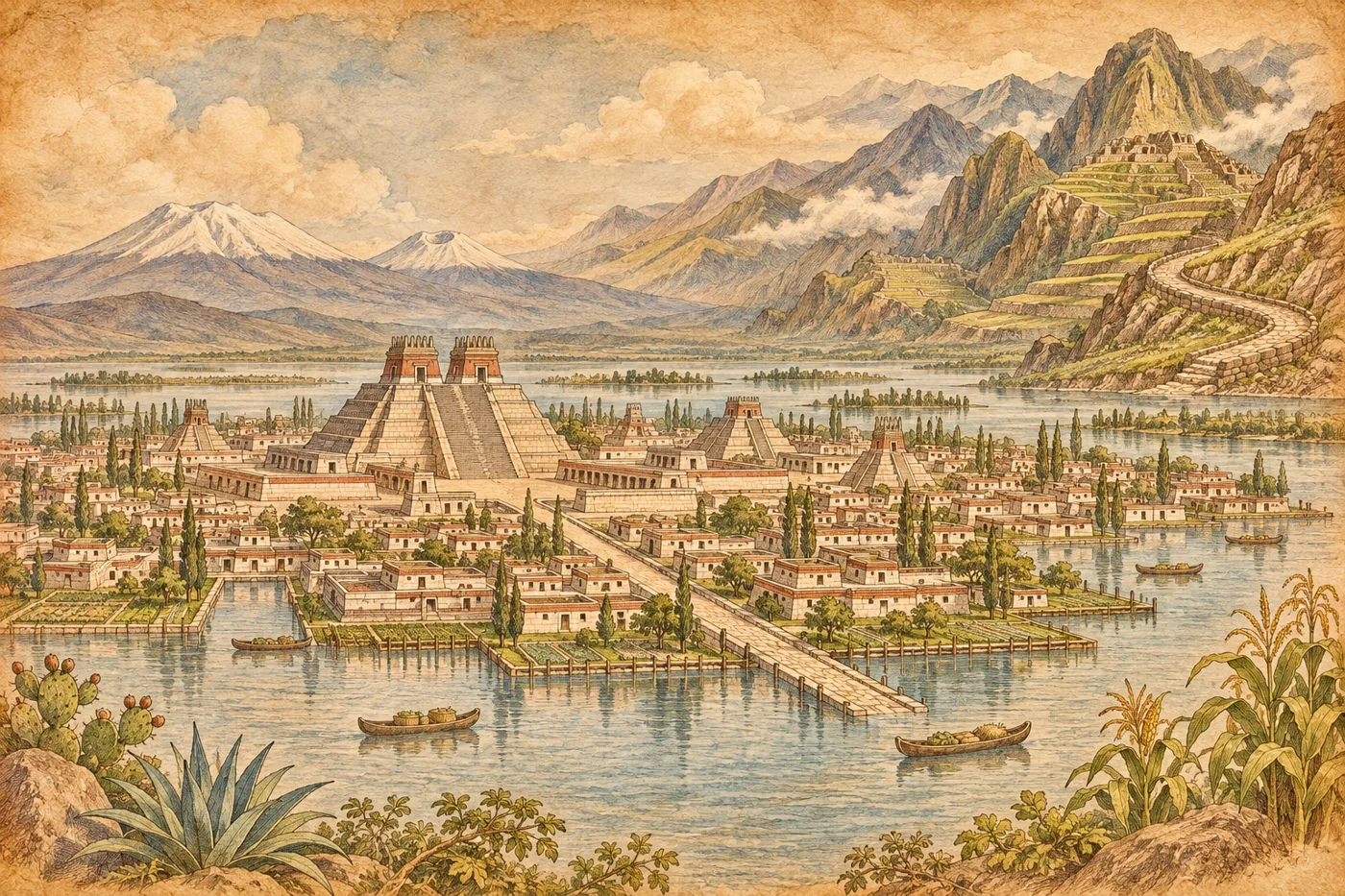
After the Maya era, the Mexica (Aztecs) rose to power in central Mexico. According to tradition, around 1325 they founded their capital, Tenochtitlan, on an island in Lake Texcoco. In the shallow parts of the lake, they built artificial agricultural plots called chinampas from water plants and mud to grow maize and other crops.
Around 1428, the Mexica formed an alliance with neighboring city-states and subdued surrounding regions, becoming a major power. Tenochtitlan's population is said to have been between 100,000 and 250,000. In the great market, cacao beans (also used as currency), cotton cloth, and feather ornaments were traded.
The Aztecs believed that to keep the sun moving the world, offerings to the gods were necessary. Human sacrifice was practiced, though its scale is debated among researchers. At the same time, there were schools, and poetry and song were highly valued.
In the Andes of South America, from the 15th century onward, the Inca Empire expanded. With Cusco as its capital, Emperor Pachacuti (reigned c. 1438–c. 1471) expanded the territory, and the population is said to have been around 10 million. In Quechua, it was called Tawantinsuyu (the Four Regions).
The Inca did not use writing; they recorded numbers and information using knotted cords called quipu. Their road network extended over 30,000 km, connecting high mountains and valleys, with runners relaying messages. They cultivated potatoes and maize on terraced fields on mountain slopes. Machu Picchu is also said to have been built around this time.
Both empires imposed taxes and labor on conquered peoples, built temples, and constructed roads and canals. They were powerful states, but there were many discontented people within them. In 1492, a new encounter from Europe approached across the sea.
Mini timeline
- c. 1325The Mexica are said to have founded Tenochtitlan on a lake island
- c. 1428The Aztec Triple Alliance is formed
- c. 1438Pachacuti ascends the throne; the Inca expand greatly
- mid-15th centuryMachu Picchu is believed to have been built
- 1502Moctezuma II becomes Aztec ruler
People in this chapter
He is considered the ruler who expanded the Inca from a small kingdom into a great empire, and also advanced the urban development of Cusco.
He ruled during the Aztecs' greatest territorial extent. He would later encounter the Spanish.
Meanwhile, elsewhere
Connection to Japan
Japan was in the Muromachi period. The Ōnin War began in 1467.
Why it still matters
The names for tomatoes, avocados, chocolate, and more are said to come from the Aztec language (Nahuatl). Potatoes and maize are crops that have been cultivated in the Andes and Central America. Quechua is still spoken by over 8 million people in South America today.
Perspectives differ
- Founding date of Tenochtitlan
- 1325 is a traditional date from later records; scholars differ on when the city was actually founded.
- Scale of human sacrifice
- Accounts by the conquerors are thought to contain exaggerations; the number and frequency of victims are unclear. Archaeological evidence confirms the practice occurred, but its scale remains debated.
- Population of Tenochtitlan
- Estimates range from under 100,000 to over 250,000.
- Population and extent of the Inca Empire
- An estimate of around 10 million is commonly used, but estimates range from about 6 million to 14 million.
Facts checked (4, verified by AI on the web)
- Confirmed Tenochtitlan was founded c. 1325; the Triple Alliance was formed in 1428 Tenochtitlán (Britannica)
The founding date is based on tradition - Confirmed Tenochtitlan's population was 100,000–250,000 World History Encyclopedia: Aztec Civilization
Source says 'at least 200,000 in the early 16th century.' Estimates range from under 100,000 to over 250,000 - Confirmed The Inca road network was over 30,000 km long Qhapaq Ñan, Andean Road System (UNESCO)
UNESCO says 'over 30,000 km'; some sources give 23,000 km - Confirmed Pachacuti reigned c. 1438–1471; Inca population about 10 million World History Encyclopedia: Inca Civilization
Pachacuti's reign is given as 1438–1471; the empire's subjects are said to exceed 10 million. Population estimates range from 6 million to 14 million
Sources
Tenochtitlán (Britannica)
World History Encyclopedia: Aztec Civilization
Qhapaq Ñan, Andean Road System (UNESCO)
World History Encyclopedia: Inca Civilization
* AI-drafted and cross-checked; human review is in progress. Status: