Mesopotamia — Writing Was Born from the Ledger
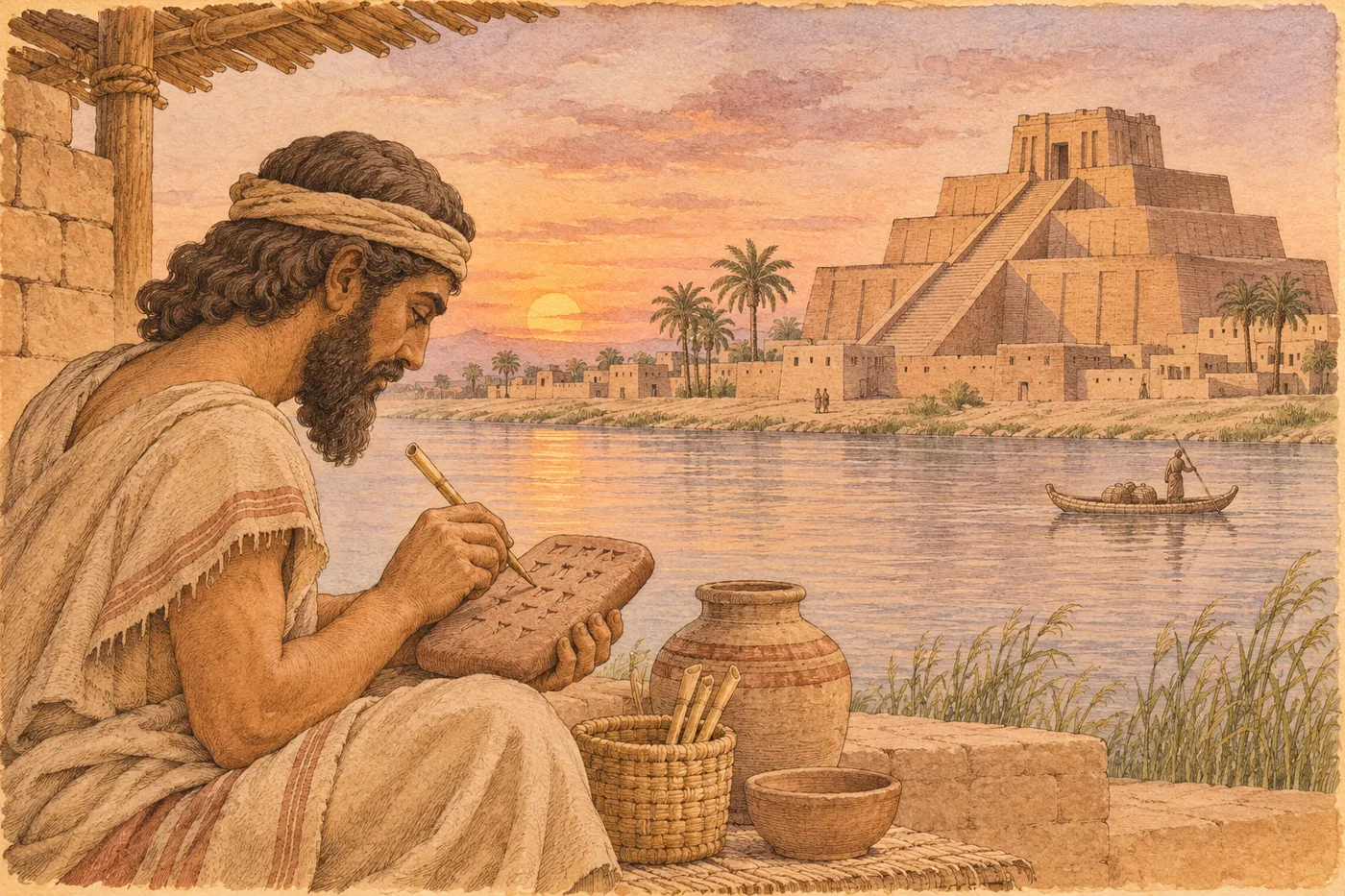
Why did humans invent writing on the banks of a river?
The land between the Tigris and Euphrates rivers, in what is now Iraq, was called 'Mesopotamia' (land between the rivers) in Greek. It was a region with little rain, but drawing water from the rivers allowed wheat to grow well. As harvests increased, food surpluses arose, people gathered, and cities were born. That was about 5,000 years ago.
It was the Sumerians who built cities in this land. Among them, Uruk is said to have grown into a large city with tens of thousands of people. The center of the city was a temple, and wheat, sheep, and beer were gathered there. 'Who deposited how much?' As numbers grew, it became impossible to keep track by memory alone.
So people began to carve marks on damp clay tablets. At first, they drew picture-like symbols with a reed pen, but later they pressed the tip of the pen to carve wedge-shaped lines, which developed into cuneiform writing. Some of the oldest known clay tablets were written around 3200 BC. The first writing was not poetry or prayer, but a ledger.
As the number of cities increased, conflicts between them also grew. Around 2300 BC, King Sargon of Akkad is said to have unified Mesopotamia and created the first 'empire.' Then, in the 18th century BC, King Hammurabi of Babylon inscribed a set of 282 laws on a stone pillar: the 'Code of Hammurabi.' It was meant to show that the king was 'one who governs the country fairly' and to set a standard for unifying the realm.
This land also left behind stories. The 'Epic of Gilgamesh' tells of the king of Uruk, Gilgamesh, who, after the death of his close friend, sets out on a journey to find a way to avoid death. The story includes a great flood scene, very similar to Noah's flood in the Old Testament. One of humanity's earliest works of literature can still be read on clay tablets today.
Eventually, Mesopotamia was ruled by a succession of powerful states: Assyria, then the Neo-Babylonian Empire. Around 586 BC (some sources say 587 BC), the Neo-Babylonian Empire attacked Jerusalem and took many Jews captive to Babylon (the Babylonian Captivity). That Neo-Babylonian Empire was itself overthrown by Persia, which came from the east, in 539 BC. The story continues in the next chapter.
Mini timeline
- c. 3500 BCSumerian cities such as Uruk grow large
- c. 3200 BCSome of the earliest known clay tablets with writing (cuneiform)
- c. 2300 BCKing Sargon of Akkad creates the first empire
- 18th century BCKing Hammurabi inscribes his law code
- c. 586 BCNeo-Babylonian Empire captures Jerusalem (Babylonian Captivity)
People in this chapter
He had his laws inscribed on a stone pillar and made public, showing that 'the king judges by law.'
A legendary hero, but some believe he was based on an actual king.
Meanwhile, elsewhere
Connection to Japan
The Japanese archipelago was in the Jōmon period. While cuneiform was being used in Mesopotamia, writing had not yet appeared in Japan.
Why it still matters
An hour has 60 minutes, a circle 360 degrees. This base-60 counting system is said to be a remnant of the Sumerian and Babylonian sexagesimal system. In Iraq, where the ruins are located, excavations and decipherment of clay tablets continue to this day.
Perspectives differ
- Where was writing 'first' invented?
- Cuneiform in Mesopotamia is considered among the oldest, but there is debate among researchers about whether it predates or followed Egyptian writing, and whether they influenced each other or developed independently.
- The meaning of 'an eye for an eye'
- The principle of exact retribution in the Code of Hammurabi ('an eye for an eye') is interpreted by some not as permission to retaliate, but as a limit to prevent retaliation beyond the original injury.
- Chronology
- The reign of King Hammurabi is widely dated to c. 1792–1750 BC (the Middle Chronology), but other chronologies shift this by several decades. Treat all ancient dates as approximations.
- Cause of the decline of Sumerian civilization
- One theory holds that salinization from irrigation caused wheat harvests to decline, but the strength of the evidence is debated.
- Was the Code of Hammurabi an actual law code?
- A prevailing view is that it was not used directly in court like modern law, but was a monument (or a collection of exemplary verdicts) to show the gods and posterity how justly the king ruled. Note also that penalties differed by social class.
Facts checked (7, verified by AI on the web)
- Corrected & confirmed The earliest known clay tablets (proto-cuneiform) date to c. 3200 BC in Uruk World History Encyclopedia: Cuneiform
Sources place the beginnings of cuneiform around 3600/3500 BC, with its development at Uruk around 3200 BC. Dates for the earliest tablets vary; c. 3350–3200 BC is also given, consistent with the text's 'approx.' - Confirmed Early writing was used for ledgers (administrative records) Englund, Proto-Cuneiform / CDLI (PDF)
The majority of documents from Uruk are administrative records. - Confirmed The Code of Hammurabi has 282 articles The Code of Hammurabi (Louvre)
The Louvre states that 282 articles survive, and also notes its character as a collection of exemplary judgments. The date of inscription varies: c. 1750 BC (Britannica gives c. 1758 BC; World History Encyclopedia gives c. 1722 BC). - Confirmed King Hammurabi's reign was c. 1792–1750 BC (Middle Chronology) Cuneiform law (Britannica)
Reign dates vary by chronology (already noted in the debates section). - Confirmed The Epic of Gilgamesh includes a great flood story (Utnapishtim) Epic of Gilgamesh (Britannica)
The flood story appears on Tablet XI. - Confirmed King Sargon of Akkad created the first empire around 2300 BC World History Encyclopedia: Sargon of Akkad
Sargon's reign (c. 2334–2279 BC) and the Akkadian Empire are described as 'the first multinational empire.' The phrase 'first empire' depends on definition. - Corrected & confirmed The Babylonian Captivity began in 586 BC World History Encyclopedia: Nebuchadnezzar II
The fall of Jerusalem is dated to 587/586 BC; the deportation of Jews took place from 597 to 587 BC. The text has been revised to 'c. 586 BC (some sources say 587 BC).'
Sources
Louvre: The Code of Hammurabi
Britannica: Cuneiform law
Britannica: Epic of Gilgamesh
World History Encyclopedia: Cuneiform
Englund 2011 (CDLI)
World History Encyclopedia: Sargon of Akkad
World History Encyclopedia: Nebuchadnezzar II
* AI-drafted and cross-checked; human review is in progress. Status: