The History of Calendars and Time — The Moon, the Sun, and the Wisdom to Correct the Drift
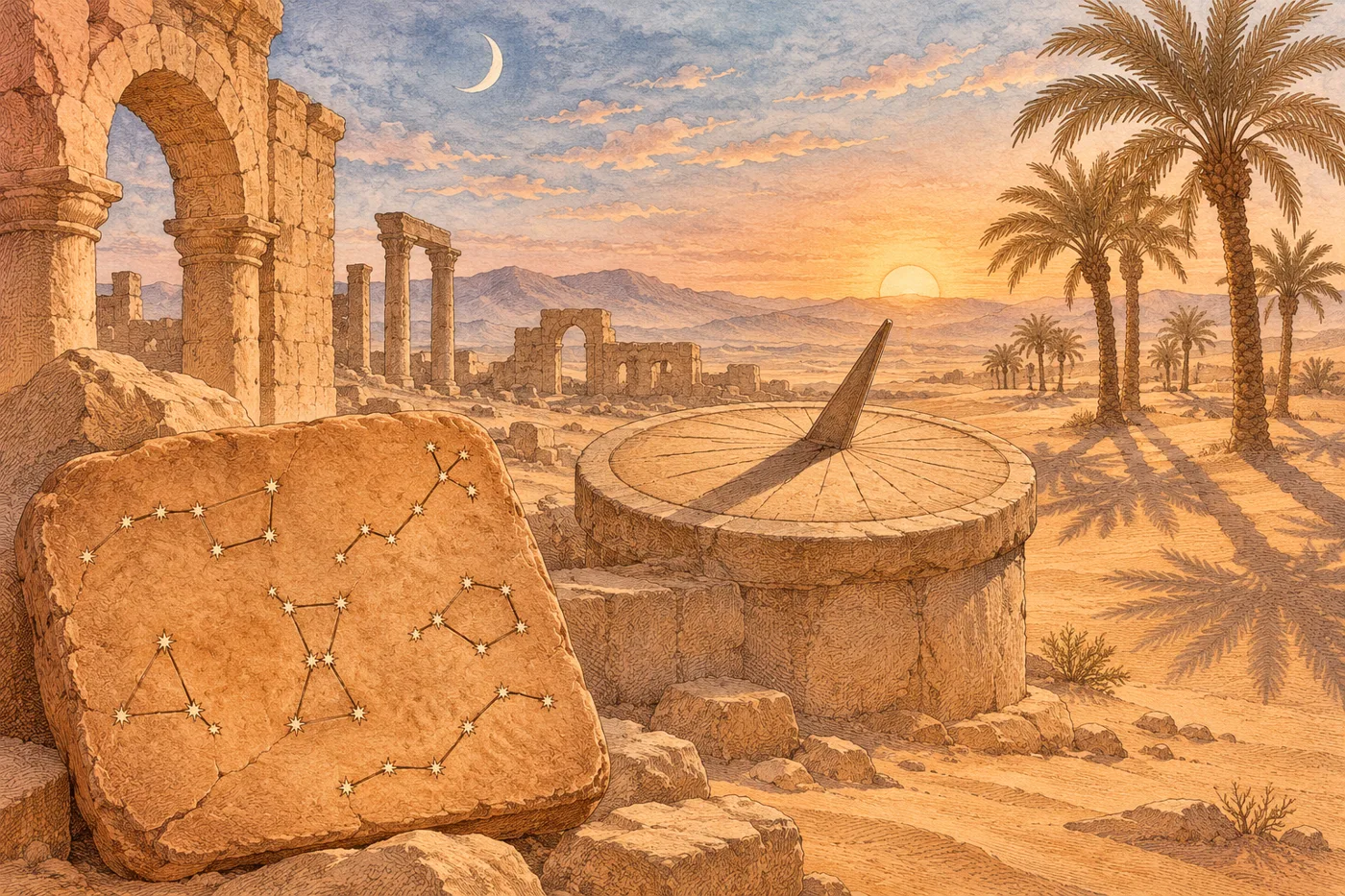
The phases of the moon and the sun's year. How have people fixed the gap between these two rhythms?
A calendar is a way to reconcile two clocks: the moon and the sun. In Mesopotamia, a lunisolar calendar was used that began the month with the sighting of a crescent moon; when it fell out of step with the seasons, an 'intercalary month' was inserted to correct it. At first this was done irregularly, but from around the 6th to 5th centuries BC, it is said that a fixed pattern of seven intercalary months every 19 years was established. In Egypt, there is said to have been a 365-day calendar, with no leap days added.
Rome's Julius Caesar, advised by the astronomer Sosigenes, realigned the calendar with the sun. He stopped using the moon as a seasonal guide, set the year at 365 days, and added a leap day every four years to average 365.25 days. The year 46 BC is called the 'last year of confusion' and had 445 days. The new calendar is said to have been used from January 1, 45 BC. This later became known as the Julian calendar.
However, the true solar year is about 365.2422 days, slightly shorter than the Julian average. This drift is about 0.0078 days per year, which accumulates significantly. By the 16th century, the vernal equinox is said to have shifted to around March 11. In 1582, Pope Gregory XIII skipped 10 days, making the day after October 4 into October 15. He also ruled that leap years would be skipped in years divisible by 100 but not by 400.
But the year that countries adopted the new calendar varied. Most Catholic countries followed in 1582 or within a few years, while Protestant countries lagged far behind. England switched in 1752 (the day after September 2 was September 14). Even in what is now Belgium, the timing differed by region. Flanders made January 1, 1583 the day after December 21, 1582, while Liège introduced the new calendar the following February. Neighboring regions had different dates.
Russia used the Julian calendar until 1918. The Soviet government decreed on January 24, 1918 (old style; February 6 new style) that January 31 (old style) would be followed by February 14 (new style). The gap then was 13 days, not the 10 of 1582. This was because the difference in how century leap years were handled had accumulated in the years 1700, 1800, and 1900. Greece is said to have made the switch in 1923. Even the same 'calendar date' could refer to different days, depending on the country and era.
The Islamic calendar (Hijri calendar) is a pure lunar calendar where all 12 months are determined by the moon's phases, with 354 or 355 days per year. Its epoch is the year 622, when the Prophet Muhammad migrated from Mecca to Medina. There are no intercalary months to align with the seasons, so the calendar drifts about 11 days earlier each year, and the new year cycles through the seasons about every 33 years. In Japan, December 3, 1872 (Meiji 5) became January 1, 1873 (Meiji 6). The calendar changed overnight from the old system to the new one.
Mini timeline
- From the 3rd millennium BCA calendar based on moon observations is used in Mesopotamia, with intercalary months correcting seasonal drift.
- 45 BCThe Julian calendar begins (with its introduction extending from 46 BC).
- 622The epoch year of the Hijri calendar.
- 1582The Gregorian calendar is established; October 4 is followed by October 15.
- 1872–73In Japan, December 3 of the old calendar (Meiji 5) becomes January 1 of the new calendar (Meiji 6).
- 1918Russia switches to the Gregorian calendar; January 31 is followed by February 14.
- 1923Greece switches to the Gregorian calendar.
People in this chapter
He is said to have aligned the calendar with the sun's motion, advised by the astronomer Sosigenes.
He ordered the calendar reform in 1582. The actual calculations are said to have been carried out by a commission including Clavius.
Meanwhile, elsewhere
Connection to Japan
In Japan, an edict on November 9 of the old calendar (Meiji 5; December 9, 1872 in the Gregorian calendar) declared that December 3 of the old calendar would become January 1, 1873 (Meiji 6). There was less than a month between the announcement and its implementation. The Meiji 6 calendar listed the old calendar alongside the new one, and this dual notation is said to have continued until around the end of the Meiji era.
Why it still matters
Most countries today use the Gregorian calendar in daily life. Meanwhile, Islamic religious observances are still determined by the Hijri calendar. The difference between the Julian and Gregorian calendars is 13 days from March 1900 to February 2100. The phrasing 'such-and-such day of the old calendar,' born from calendar discrepancies, lingers in Japanese New Year observances and other events.
Perspectives differ
- Whether the Julian calendar began in 46 BC or 45 BC
- Caesar is said to have ordered the calendar reform in 46 BC, and the new calendar is often described as having been used from January 1, 45 BC. However, some sources refer to 46 BC as the first Julian year. The year depends on which point is called the 'beginning.' This book mentions both.
- When and by whom the switch to the Gregorian calendar was decided
- Even though the Pope established the calendar, it was each country's or region's sovereign who made it law. Therefore, Catholic countries adopted it quickly, while Protestant and Orthodox countries delayed, partly due to religious conflicts. The reasons are thought to have included not only religion but also each country's circumstances.
- The reasons for Japan's calendar change
- The common explanation is that it was done to align with Western calendars. Another theory holds that it was to avoid an extra month's salary payment in 1873, which would have had an intercalary month. Which was the main reason is debated among researchers; this book takes no side.
- Whether Russia's switch year was 1917 or 1918
- Some sources write 1917, others 1918. Here, because the calendar actually changed in February 1918 (new style), we have used '1918'.
Facts checked (13, verified by AI on the web)
- Corrected & confirmed The Mesopotamian calendar had 12 months starting with the crescent moon observation, with intercalary months added to match the seasons. At first irregular, from around 590 BC a regular system of seven intercalary months in 19 years emerged. ISAW (New York University): AWOL Index, The Babylonian Calendar(大学資料)
Confirmed in ISAW sources (regular system from around 590 BC). Rice University page states the regularization began in 499 BC and was strictly followed from 384 BC. Since sources vary, the main text uses the broader '6th to 5th centuries BC.' - Confirmed 19 solar years equal about 235 lunar months, with seven intercalary months in 19 years (Metonic cycle). Rice University, The Galileo Project: The Gregorian Calendar
Confirmed on Rice University page (19 years = 235 months, 7 intercalary months). The main text omits precise numbers and simply says 'seven times in 19 years.' - Unverified Egypt had a 365-day calendar with no leap days, consisting of 12 months (30 days each) plus 5 extra days at the end. Rice University, The Galileo Project: The Gregorian Calendar
No official sources with accessible text found this trial (WHE Egyptian calendar page, Britannica, Rice University pages return 403 or mismatch; Belgian Royal Observatory page on Gregorian reform has no mention of the 13-day discrepancy). - Corrected & confirmed The Julian calendar was introduced by Caesar on the advice of Sosigenes, averaging 365.25 days with a leap day every four years. 46 BC was the 445-day 'last year of confusion.' Rice University, The Galileo Project: The Gregorian Calendar
Confirmed on Rice University page. That page sets the first Julian year as January 1, 46 BC, but the common explanation is from January 1, 45 BC, hence the debate section presents both views. - Confirmed The solar year is about 365.2422 days, the Julian calendar drifts about 0.0078 days per year, and by the 16th century the vernal equinox was around March 11. In 1582, October 4 was followed by October 15. Royal Observatory of Belgium: What is the Gregorian Calendar Reform?
Confirmed on Royal Observatory of Belgium page. That the Pope set the leap-year rule (skipping years divisible by 100 but not 400), and the commission including Clavius, is confirmed on Rice University page. - Corrected & confirmed Catholic countries adopted the calendar soon after 1582, Protestant countries delayed, and England adopted it in the mid-18th century (1752). Rice University, The Galileo Project: The Gregorian Calendar
Rice University page confirms Catholic areas adopted quickly, Protestant areas delayed, and Britain and its colonies adopted 'mid-18th century.' The year 1752 is not on that page and is from unverified search summaries; the main text uses 'said to be around.' - Confirmed In Belgium (Flanders), December 21, 1582 was followed by January 1, 1583; Liège adopted it in February 1583. Royal Observatory of Belgium: What is the Gregorian Calendar Reform?
Confirmed on Royal Observatory of Belgium page (Brabant and Zeeland were even earlier, December 14–25). - Confirmed Russia, by decree of February (new style 6th) 1918, made January 31 followed by February 14. The gap was 13 days. Greece switched in 1923. Michigan State University, Soviet History Archive: Introduction of a New Calendar(1918年の布告)
Confirmed on MSU page about the decree: dated February 6, 1918, making January 31 followed by February 14. The 13-day gap matches calculation from leap-year rules (1700, 1800, 1900 not leap years). Greece 1923 confirmed on Royal Observatory of Belgium page (year only, exact date unverified). That page writes Russia as 1917, but actual change was February 1918, explained in debates. - Corrected & confirmed The Hijri calendar is a pure lunar calendar with 354 or 355 days per year, epoch 622. It drifts from the seasons, cycling through them about every 33 years. Emory University Libraries: Calendars (Nowruz research guide)
Emory University page confirms it is lunar, 12 months, 354 or 355 days, epoch 622. The drift of about 11 days per year and 33-year cycle are calculated from solar year length (about 365.24 days - 354 days); not in the page itself. - Unverified Islamic religious months begin with the observation of the new moon / Islamic religious observances are still determined by the Hijri calendar. Emory University Libraries: Calendars (Nowruz research guide)
Al Jazeera article states 'the Islamic lunar month begins with the sighting of the crescent moon,' but as a news outlet it is not a standard source, so not treated as confirmed. - Confirmed In Japan, December 3, 1872 (Meiji 5) became January 1, 1873 (Meiji 6). The edict was on November 9, Meiji 5, by Dajokan Fukoku No. 337. The Meiji 6 calendar included the old calendar alongside the new one. 国立天文台 暦Wiki: 改暦(旧暦から新暦へ)に関する項
Confirmed on National Astronomical Observatory of Japan page (partly garbled, some from context). The number of years the dual calendar continued varies (Meiji 42 or 43 per sources); the main text says 'until the end of the Meiji era.' - Unverified One theory for Japan's calendar change is that it was to avoid a year with an intercalary month, which would have required an extra monthly salary payment. 国立天文台 暦Wiki: 改暦(旧暦から新暦へ)に関する項
No official sources with accessible text found this trial (WHE Egyptian calendar page, Britannica, Rice University pages return 403 or mismatch; Belgian Royal Observatory page on Gregorian reform has no mention of the 13-day discrepancy). - Unverified Rome, Mesoamerica, and world events (meanwhile section); the 13-day gap from 1900 to 2100. Royal Observatory of Belgium: What is the Gregorian Calendar Reform?
No official sources with accessible text found this trial (WHE Egyptian calendar page, Britannica, Rice University pages return 403 or mismatch; Belgian Royal Observatory page on Gregorian reform has no mention of the 13-day discrepancy).
Sources
ISAW (New York University): AWOL Index, The Babylonian Calendar(大学資料)
Rice University, The Galileo Project: The Gregorian Calendar
Royal Observatory of Belgium: What is the Gregorian Calendar Reform?
Michigan State University, Soviet History Archive: Introduction of a New Calendar(1918年の布告)
Emory University Libraries: Calendars (Nowruz research guide)
国立天文台 暦Wiki: 改暦(旧暦から新暦へ)に関する項
* AI-drafted and cross-checked; human review is in progress. Status: