Oil and the Modern World — Black Water Beneath the Sand That Drove the World
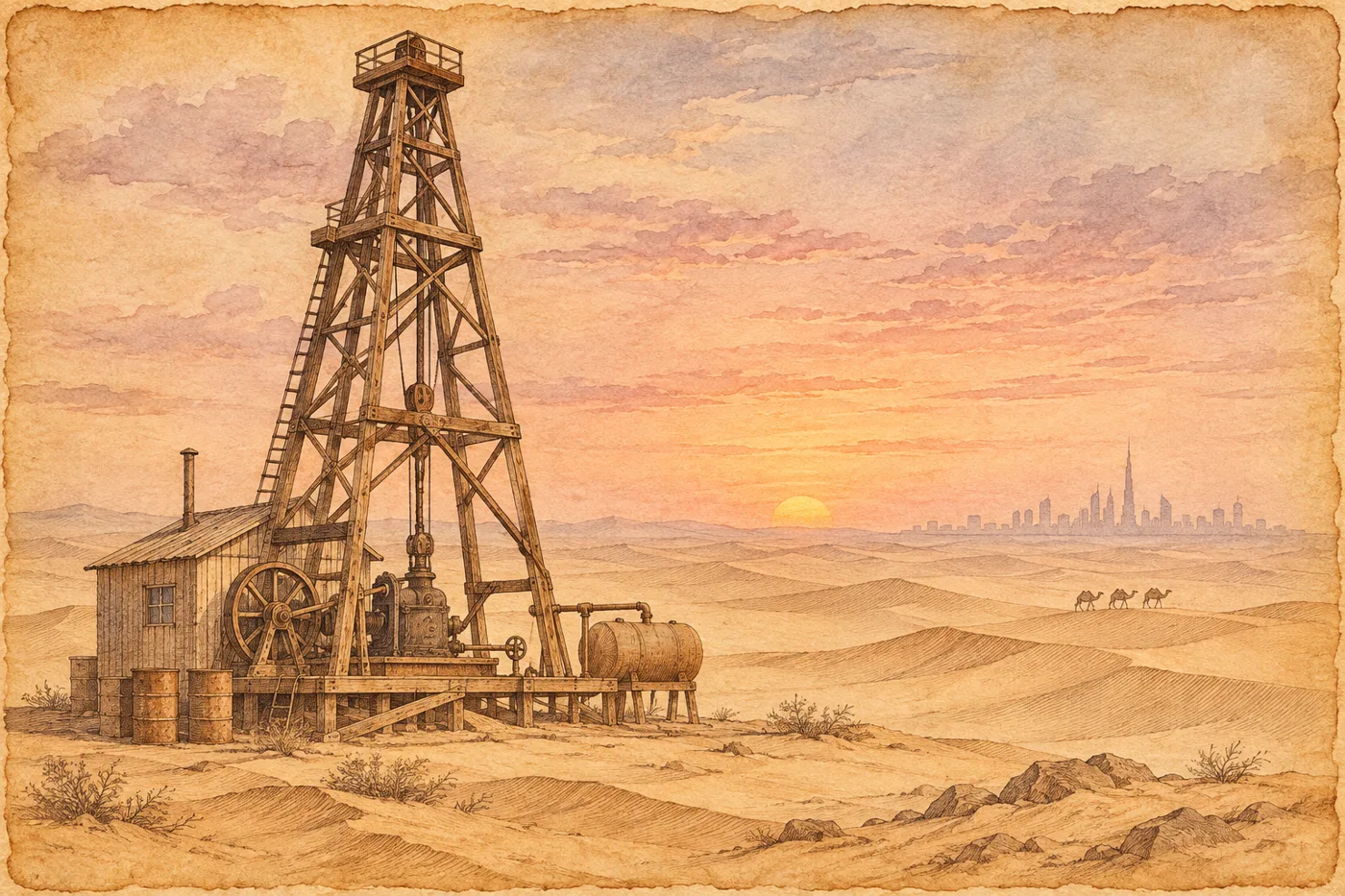
How did the 'black water' beneath the desert change the world?
In 1908, the first commercially significant large oil field in the Middle East was discovered in Persia (the Qajar dynasty, in present-day Iran). In 1938, oil fields were also found in Saudi Arabia. Cars, airplanes, warships — the 20th-century world came to run on oil, and the Middle East became the heart of the world's energy.
At the same time, conflict between Jews and Arabs was deepening in Palestine. In 1948, Israel declared independence, sparking a war (the First Arab-Israeli War) with neighboring Arab states. Many Palestinians left their homes during this war. Palestinians call this event the 'Nakba' (Catastrophe).
Movements surrounding oil also intensified. In 1951, Iranian Prime Minister Mosaddegh pushed for the nationalization of oil, but was ousted in a coup in 1953. The US government later acknowledged that US and British intelligence agencies were deeply involved in planning and executing this coup. People in oil-producing countries began to think, 'We want to decide the fate of our own resources.'
In 1960, oil-producing countries cooperated to form the Organization of the Petroleum Exporting Countries (OPEC). Then, triggered by the Fourth Arab-Israeli War in 1973, Arab oil-producing states restricted oil exports, and OPEC also sharply raised crude oil prices, plunging the world into the First Oil Crisis. Oil prices rose several times over, dealing a heavy blow to the global economy.
In 1979, revolution broke out in Iran, toppling the monarchy and establishing the Islamic Republic. The Iran-Iraq War (1980–88), the Gulf War (1990–91), and the Iraq War (2003) followed. Major wars continued in the Middle East. In 2011, the pro-democracy movement 'Arab Spring,' which began in Tunisia, spread across a wide region.
The history so far may give the impression that 'the Middle East is a land of conflict.' However, most people study, work, and live their daily lives there. There are also cities like Dubai that have rapidly grown by diversifying into tourism, logistics, and finance. The story of this region is still unfolding.
Mini timeline
- 1908First commercial oil field in the Middle East discovered in Iran
- 1948Establishment of Israel; First Arab-Israeli War
- 1960OPEC founded
- 1973Fourth Arab-Israeli War; First Oil Crisis
- 1979Iranian Revolution
- 2011Arab Spring
People in this chapter
He promoted the nationalization of oil but was ousted in a coup in 1953.
After the revolution, he established a system where Islamic jurists guide politics.
Meanwhile, elsewhere
Connection to Japan
The 1973 oil crisis had a major impact on Japan (the 'oil shock'). It triggered a toilet paper panic and is said to have ended the high-growth era. Japan still relies on the Middle East for about 90% of its crude oil.
Why it still matters
The Middle East has a young population, with many young people enjoying soccer and anime. The Middle East seen in Japanese news is actually just one part of it. Look beyond the lines on the map and turn your eyes to the daily lives of the people living there.
Perspectives differ
- Names and assessments of the conflict
- The 1948 war is called the 'War of Independence' in Israel, and the 'Nakba' (Catastrophe) by the Palestinian people. Both perspectives are part of history. This site does not declare either side as 'correct'.
- The 1953 coup in Iran
- The US government has officially acknowledged involvement by the US and UK, but scholars disagree on how decisive that involvement was.
- Assessment of the Arab Spring
- Some countries achieved democratization, while others fell into civil war or chaos. Whether it was a 'success' or 'failure' varies by country, and assessments remain unsettled.
- Recent events
- This chapter covers events up to around 2011. For developments after that, please check reliable news reports elsewhere, as the situation changes rapidly.
- Reasons for the emergence of Palestinian refugees
- The reasons why many Palestinians left their homes in the 1948 war have long been debated between those who cite 'calls from Arab leaders' and those who cite 'expulsion by Israeli forces.' Since the 1980s, as more official documents have been declassified, studies suggesting that expulsion by the military and fear were major factors have emerged, but the debate continues.
Facts checked (5, verified by AI on the web)
- Confirmed 1908 discovery of the first major commercial oil field in the Middle East at Masjed Soleyman Masjed Soleymān (Britannica)
The gusher occurred on May 26, 1908. Described as the 'first commercially significant discovery' in the Middle East. - Confirmed US government acknowledged involvement in the 1953 coup CIA Confirms Role in 1953 Iran Coup (National Security Archive)
In 2013, the CIA officially released documents acknowledging its involvement in the coup. - Confirmed 1960 founding of OPEC (Baghdad Conference) OPEC: Brief History
Member states: Iran, Iraq, Kuwait, Saudi Arabia, and Venezuela (5 countries). - Confirmed In 1973, Arab oil-producing states imposed an embargo and production cuts (OAPEC); OPEC raised prices Federal Reserve History: Oil Shock of 1973-74
According to the text of the US Federal Reserve's explanation, OAPEC began its embargo on the US on October 19, 1973, continued production cuts, and lifted the embargo in March 1974, with crude oil prices rising about fourfold. - Confirmed Numerous Palestinian refugees emerged from the 1948 war ('Nakba') 1948 Arab-Israeli War (Britannica)
Estimates range from around 700,000 (from over 600,000 to over 900,000). The text does not specify a number; the debate on causes is already noted in the 'debates' section.
Sources
Britannica: Masjed Soleymān
Britannica: 1953 coup in Iran
National Security Archive: CIA Confirms Role in 1953 Iran Coup
OPEC: Brief History
Britannica: 1948 Arab-Israeli War
Federal Reserve History: Oil Shock of 1973-74
* AI-drafted and cross-checked; human review is in progress. Status: