The Kingdom of the Nile and the Pyramids — A River That Raised a Kingdom of Kings
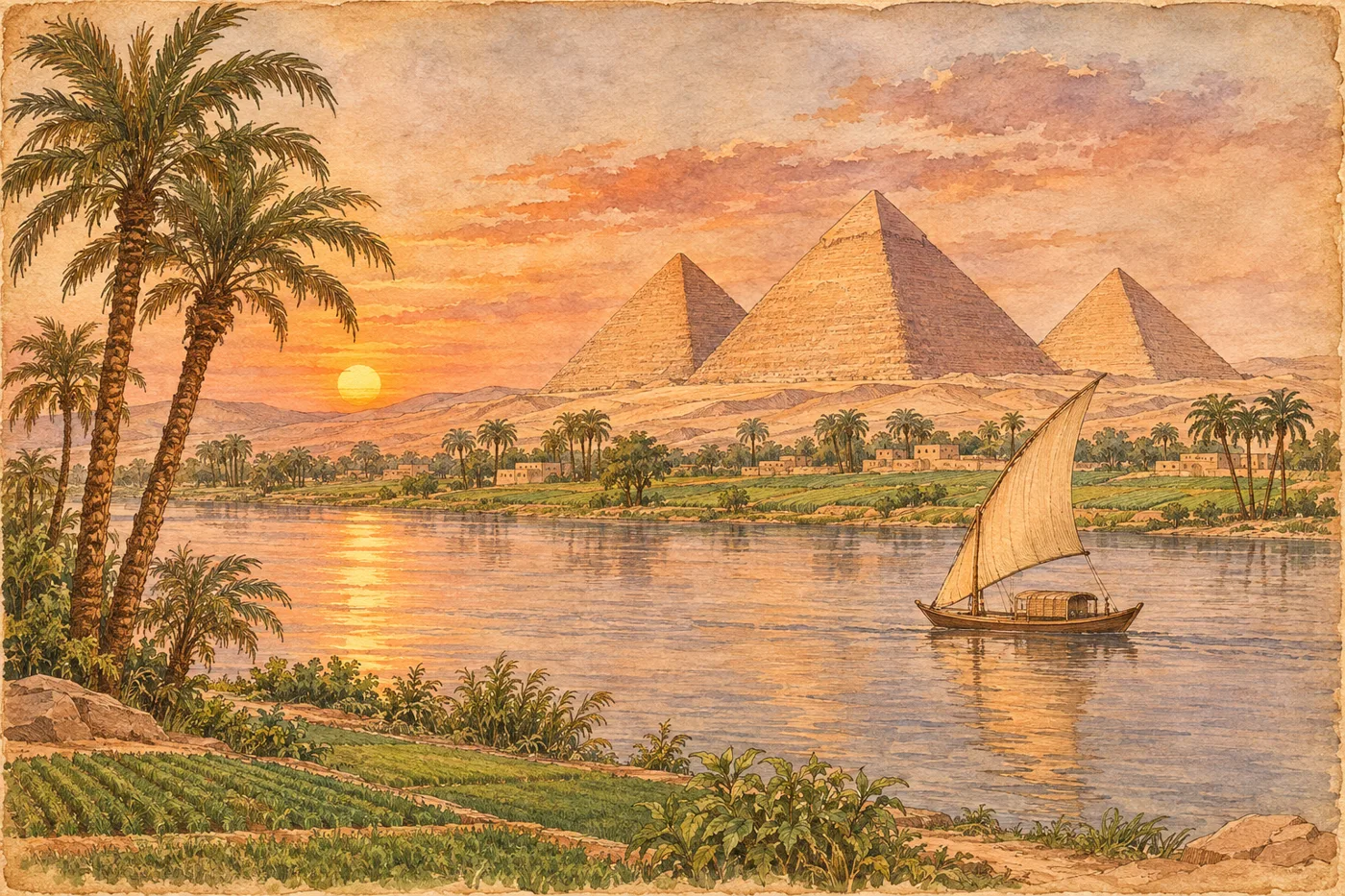
Why were such enormous pyramids built along the Nile?
Most of Egypt is desert. Yet people have lived there since ancient times because of the Nile. Until modern dams were built, the river flooded every summer, and when the waters receded, they left behind rich black silt. Sowing wheat in that soil brought abundant harvests. The ancient Greek historian Herodotus is known for describing 'Egypt as the gift of the Nile.'
Egypt stretched as a long, narrow strip along the river, and there were once many small states. Around 3100 BC, the upstream region (Upper Egypt) and downstream region (Lower Egypt) are said to have been unified. The king is spoken of as Narmer or Menes (there are various theories about who unified it and how). The king ruled the land as a god-like figure (the word 'pharaoh' for the king came later, in the New Kingdom, but today we often call even ancient kings pharaohs).
Around the 27th century BC, the vizier Imhotep is said to have built a step pyramid for King Djoser. Later, the Great Pyramid of Khufu was built at Giza around the 26th century BC. Its original height was about 146 meters. For thousands of years, it was one of the tallest buildings in the world.
It is often thought that slaves built the pyramids, but recent excavations at Giza show that workers were given food and housing and were properly buried. One explanation is that farmers joined the state project during the season when fields were flooded and there was no farm work.
Ancient Egyptians used hieroglyphs and made a paper-like material from papyrus, a plant that grew along the Nile. They believed in an afterlife and developed mummification to preserve the body. Hieroglyphs, which had long been unreadable, were deciphered by Champollion in 1822, using the Rosetta Stone discovered in 1799.
In the later New Kingdom, Ramesses II ruled for about 66 years and built great temples. The tomb of the boy king Tutankhamun was found in 1922, almost untouched. However, after Alexander the Great took control in 332 BC, and following the Ptolemaic dynasty that succeeded him, Egypt became a Roman territory in 30 BC with the death of Queen Cleopatra VII.
Mini timeline
- c. 3100 BCUpper and Lower Egypt are said to have been unified.
- c. 27th century BCThe Step Pyramid of King Djoser is built.
- c. 26th century BCThe Great Pyramid of Khufu is built at Giza.
- 13th century BCThe reign of Ramesses II.
- 30 BCThe Ptolemaic dynasty falls, and Egypt becomes Roman territory.
People in this chapter
He is said to have had the Great Pyramid of Giza built.
He ruled the land for a long time and left many enormous temples and statues.
Meanwhile, elsewhere
Connection to Japan
The Japanese archipelago was in the Jōmon period. When the Great Pyramid was built, writing was not yet used in Japan.
Why it still matters
The Great Pyramid of Giza is said to be the only one of the Seven Wonders of the ancient world still standing. In Egypt, the excavation and preservation of ruins continue, and people from all over the world visit.
Perspectives differ
- Who unified Egypt
- There is debate among researchers over whether Narmer and Menes are the same person or different kings, and whether unification happened at once or gradually.
- How the Great Pyramid was built
- The shape of the ramps used to move stones and the exact number of stones (often said to be about 2.3 million, but this is an estimate) are not certain, with many theories.
- Purpose of the pyramids
- The most common explanation is that they were royal tombs, but some emphasize their role as ritual sites or as large-scale projects that unified the country.
- The builders
- The old image of slaves whipped into labor is not well supported by current research. However, there are still unknowns about the workers' status and the full picture of how the work was organized.
- Chronology
- There are several competing chronologies for ancient Egypt, with differences of decades or sometimes over a century. On this site, we use widely accepted dates with 'c.' (circa).
- Builders of the pyramids
- Excavations at Giza have uncovered workers' towns and graves, leading scholars to believe the builders were Egyptians, not slaves. However, debate continues over whether those towns housed only construction workers, or also soldiers and sailors.
Facts checked (6, verified by AI on the web)
- Confirmed The Great Pyramid originally about 146.6 m tall, from the time of Khufu Encyclopaedia Britannica: Great Pyramid of Giza
Construction dates vary between sources from around 2600 BC to the 2500s BC, so the text uses 'c. 26th century BC'. - Confirmed The Step Pyramid of Djoser dates to c. 27th century BC (c. 2667–2648 BC), designer said to be vizier Imhotep Encyclopaedia Britannica: Step Pyramid of Djoser
Britannica gives the 26th century BC. The text uses 'said to be'. - Corrected & confirmed Unification of Egypt c. 3150–3090 BC, Narmer (= Menes) World History Encyclopedia: Narmer
WHE gives Narmer's reign as c. 3150–3100 BC (Britannica says the identification of Menes with Narmer or Aha is 'not certain'). Text changed from 'c. 3000 BC' to 'c. 3100 BC' (timeline also updated). There is also a view that unification was gradual; the text uses 'various theories' to stay neutral. - Confirmed Pyramid builders were not slaves but Egyptian workers (based on graves and workers' town excavations) Giza Plateau Mapping Project (Harvard): Lehner
Debate section added: the nature of the town's inhabitants is still debated. - Confirmed Rosetta Stone discovered in 1799, deciphered by Champollion in 1822 Encyclopaedia Britannica: Hieroglyphic writing
- Confirmed Ramesses II reigned about 66 years; Tutankhamun's tomb found almost intact in 1922 Encyclopaedia Britannica: Ramses II
Tutankhamun's tomb: Britannica 'Valley of the Kings'. Some papers give a 67-year reign.
Sources
Encyclopaedia Britannica: Great Pyramid of Giza
Encyclopaedia Britannica: Step Pyramid of Djoser
World History Encyclopedia: Narmer
Giza Plateau Mapping Project (Harvard): Lehner
Encyclopaedia Britannica: Hieroglyphic writing
Encyclopaedia Britannica: Ramses II
* AI-drafted and cross-checked; human review is in progress. Status: