The Maghreb and the Amazigh (Berber) People – Another North Africa, of Mountains and Desert
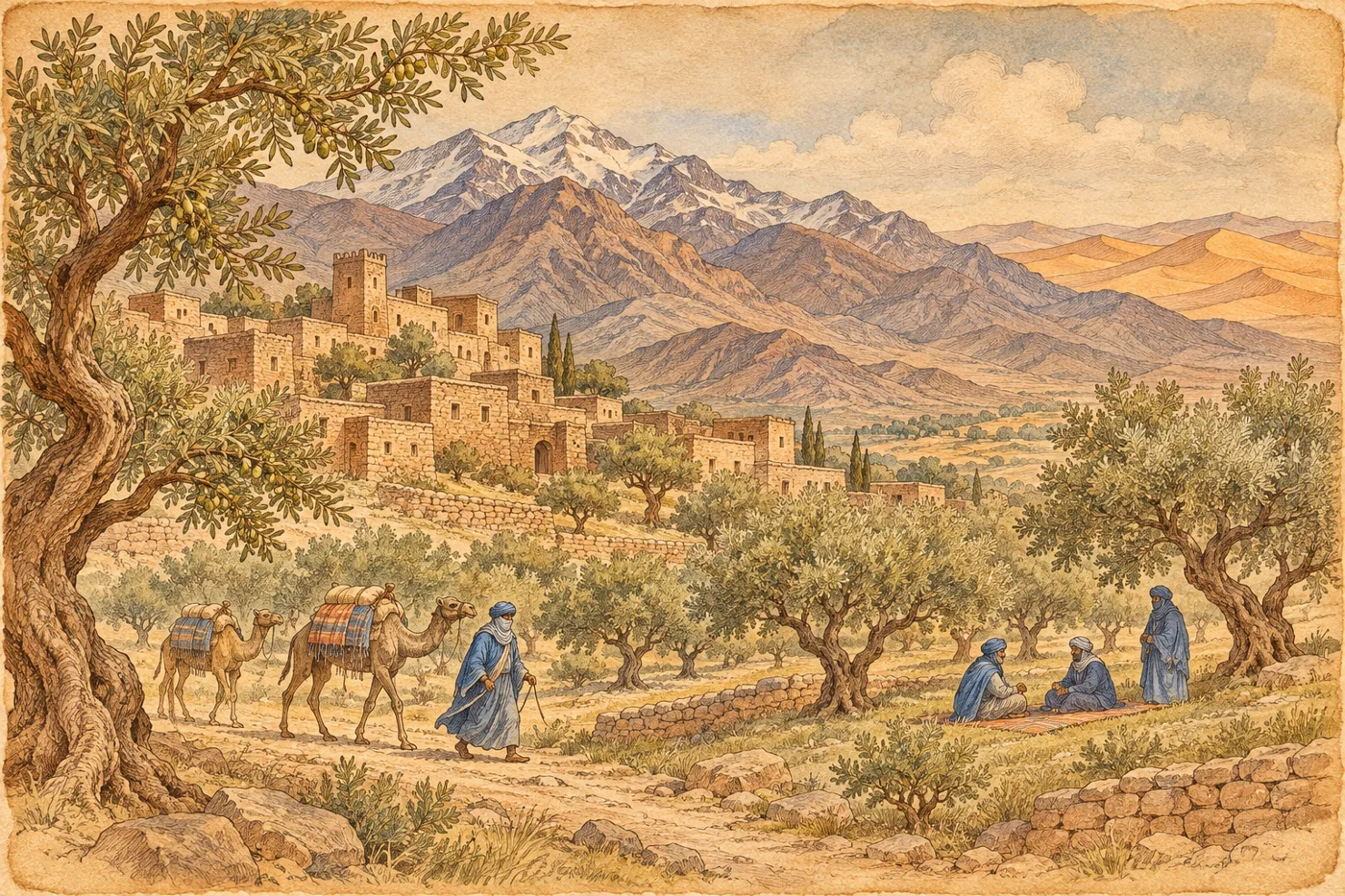
In North Africa, where Arabic is widely spoken, what languages have the people who have lived there much longer spoken?
Morocco, Algeria, Tunisia, and other parts of western North Africa are called the Maghreb (meaning 'place of sunset'). In a wide area centered on the Maghreb and stretching from western Egypt to the Sahara Desert, people called the Amazigh (Berbers) lived long before the Arabs arrived. 'Amazigh' is often said to mean 'free people', but there are various theories about its etymology.
The name 'Berber' is said to come from the Greek and Roman term 'barbaroi' for outsiders. Today, the self-name 'Amazigh' is increasingly used. The Amazigh language is a collection of several distinct languages and dialects that vary by region. Among the Tuareg people of the Sahara, the Tifinagh script, said to derive from an ancient script, has also been passed down.
In ancient times, several Amazigh kingdoms emerged, such as Numidia and Mauretania. Massinissa, who lived from the late 3rd to the 2nd century BC, is known as a king who allied with Rome, fought Carthage, and united Numidia. These areas later came under Roman rule, but it is thought that people in the mountains and deserts continued their traditional ways of life.
From the mid-7th to the early 8th century, Arab armies advanced into North Africa. Among those who resisted, the name of the female leader al-Kahina (Dihya) is recorded, but many later traditions surround her, and the detailed historical facts are unclear. Eventually, many people accepted Islam. The army that crossed into the Iberian Peninsula in 711 is said to have been centered on Amazigh people, including its commander Tariq.
Arabization was not a simple matter of 'inhabitants being replaced by Arabs', but rather a gradual process that took centuries. Even after accepting Islam, many people continued to speak Amazigh. In the 11th-century Almoravid dynasty and the 12th-century Almohad dynasty, Amazigh people founded large states spanning North Africa and the Iberian Peninsula. The Tuareg of the Sahara, the Kabyles of Algeria, and the Rif and Atlas peoples of Morocco each have distinct cultures.
From the late 20th century, movements to value Amazigh language and culture spread. Algeria recognized it as a national language in 2002 and as an official language in 2016. Morocco made it an official language in its 2011 constitution. In recent years, both countries have made the Amazigh New Year (Yennayer, around January 12) a national holiday. The number of speakers varies depending on the survey method and is not clear.
Mini timeline
- 3rd–2nd century BCEra of Massinissa of the Numidian kingdom
- mid-7th – early 8th centuryArab armies advance into North Africa
- 711Tariq's army crosses into the Iberian Peninsula
- 11th–12th centuryAlmoravid and Almohad dynasties flourish
- 2011Morocco makes Amazigh an official language
People in this chapter
He allied with Rome, fought Carthage, and is known for uniting Numidia and expanding the kingdom.
She is said to have resisted the Arab armies, but the detailed facts about her remain unclear.
Meanwhile, elsewhere
Connection to Japan
From the late 11th century, when the Almoravid dynasty gained power, through the 12th century of the Almohads, Japan was in the late Heian period (era of cloistered rule) to the early Kamakura period.
Why it still matters
In Morocco and Algeria, Amazigh is recognized as an official language and is spreading in schools and media. In Morocco, you can see signboards in Tifinagh script alongside Arabic and Latin scripts.
Perspectives differ
- Etymology of 'Amazigh'
- The explanation 'free people' is widely known, but some linguists argue that this is not necessarily the case.
- Historical reality of al-Kahina
- Much of what is known about her name and deeds was passed down by later historians, and scholars debate how much of it is factual.
- Number of speakers
- The number of speakers in Morocco and Algeria varies greatly depending on surveys and definitions, and figures are inconsistent.
- Standardization and script
- Opinions remain divided on a unified standard for the Amazigh language and on whether to use Tifinagh, Latin, or Arabic script.
Facts checked (7, verified by AI on the web)
- Confirmed Algeria recognized Amazigh as a national language in 2002 and as an official language in 2016 Constitute Project: Algeria 2016 Constitution
Recognized as a national language in 2002 (UNPO). The 2016 constitutional amendment, Article 4, makes Tamazight a national and official language. However, the wording pushes the full implementation toward the 'future', and it can be read as still incomplete. - Confirmed Morocco made Amazigh an official language in its 2011 constitution Morocco Adopts Tamazight as Official Language Alongside Arabic (UNPO)
Implementation laws were delayed, and operational challenges are noted. - Corrected & confirmed Massinissa allied with Rome, fought Carthage, and united Numidia World History Encyclopedia: Masinissa
Reigned c. 202–148 BC. Corrected from 'founded a kingdom' to 'united'. - Corrected & confirmed al-Kahina was a female leader who resisted the Arab armies, and her historical reality is largely unclear Georgetown University in Qatar, ISMAHA: Dihya (al-Kahina)
Georgetown University's Qatar page records al-Kahina (Dihya) as resisting Arab armies and gives her death as either 698 or 702 AD. The point 'her historical reality is largely unclear' is not solely supported by this page; the original text's phrasing 'is said' is maintained. - Confirmed The commander Tariq of the 711 crossing army was of Amazigh origin, and the army was centered on Amazigh people Cleveland State University: The Early Arab Conquests
Cleveland State University's teaching material describes Tariq as a 'Berber convert' and notes the army crossing the Strait of Gibraltar in 711 as mainly Berber. - Confirmed Yennayer became a national holiday in Algeria in 2018 and in Morocco in 2023 Al Jazeera: Morocco recognises Berber New Year as official holiday
Algeria decided on the holiday in 2017, implemented from January 2018 (US State Department human rights report). Morocco announced it in May 2023, implemented from January 2024 (Al Jazeera). - Confirmed The Almoravid (11th c.) and Almohad (12th c.) dynasties were Amazigh-ruled and controlled North Africa and Iberia New World Encyclopedia: Almoravid dynasty
Corrected 'Spain' to 'Iberian Peninsula'.
Sources
Constitute Project: Algeria 2016 Constitution
Georgetown University in Qatar, ISMAHA: Dihya (al-Kahina)
Cleveland State University: The Early Arab Conquests
Al Jazeera: Morocco recognises Berber New Year as official holiday
World History Encyclopedia: Masinissa
UNPO: Morocco Adopts Tamazight as Official Language Alongside Arabic
* AI-drafted and cross-checked; human review is in progress. Status: