Carthage and Rome — Two Powers That Divided the Mediterranean
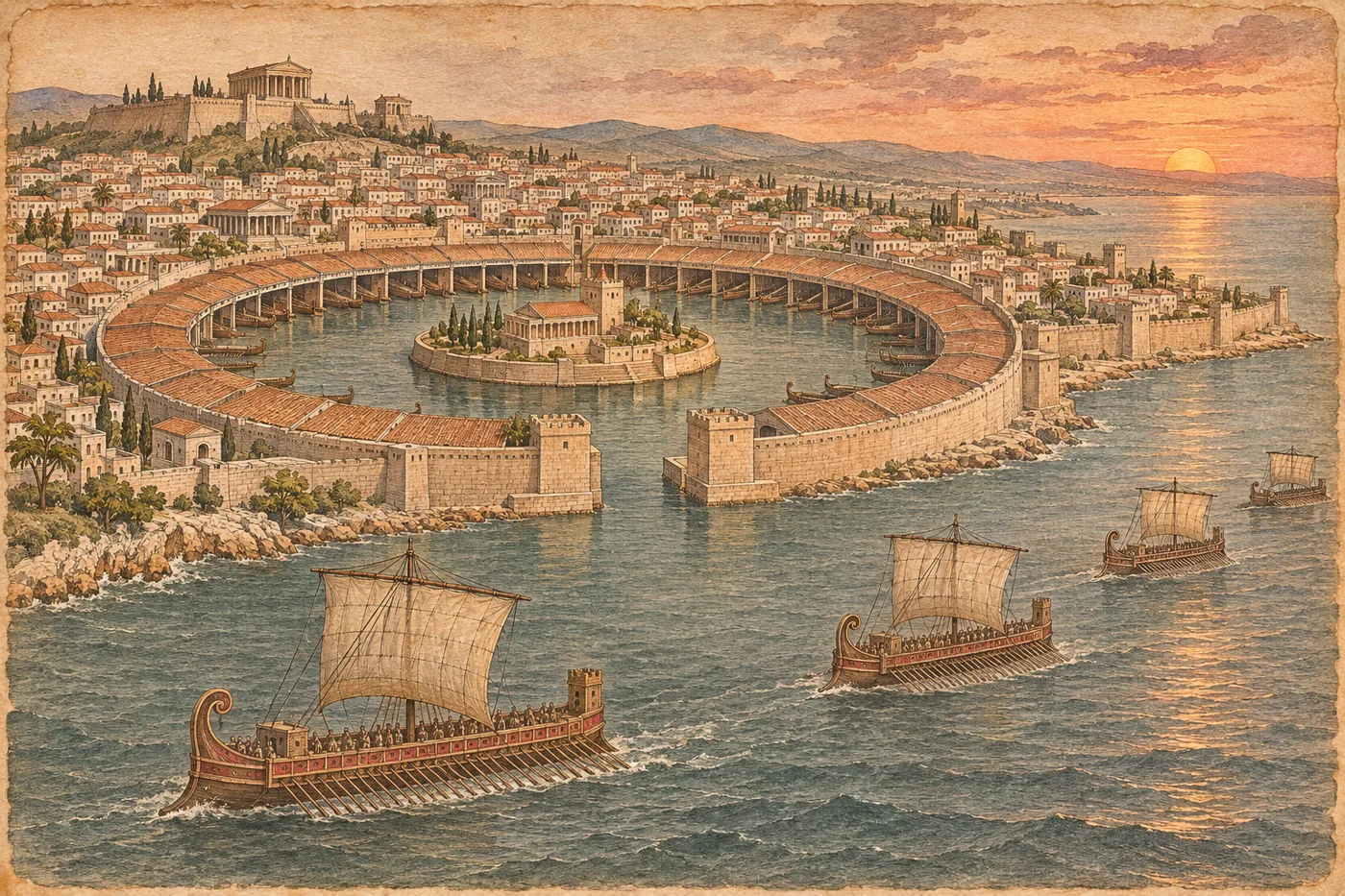
Why did Carthage, a city of merchants, fight Rome for over a hundred years?
West of Egypt, on the southern coast of the Mediterranean, lay a city of sea merchants. It was a port town founded by the Phoenicians (from the area of modern Lebanon). Among these, Carthage (in modern Tunisia) flourished; tradition says it was founded around 814 BC by Dido, a princess of Tyre.
Carthage prospered as a transit point for ships crossing the Mediterranean. It had an excellent harbor and expanded its outposts to the Iberian Peninsula (modern Spain, etc.), Sicily, and Sardinia. Around it lived the people of North Africa, later called Berbers (Amazigh), who were involved in Carthage's military and agriculture.
Then a rival appeared: Rome, which was unifying the Italian peninsula. The two clashed over Sicily. The Romans called the Carthaginians 'Poeni,' so these conflicts are called the Punic Wars. The First Punic War was 264–241 BC, and Rome won.
In the Second Punic War (218–201 BC), the Carthaginian general Hannibal crossed the Alps with elephants and invaded Italy. At the Battle of Cannae in 216 BC, he won a great victory over the Roman army. But Rome's Scipio crossed to North Africa and attacked, and Hannibal was defeated at the Battle of Zama in 202 BC.
In the Third Punic War (149–146 BC), Carthage was thoroughly attacked and destroyed. The Roman statesman Cato the Elder is said to have ended every speech with 'Carthage must be destroyed.' North Africa became the Roman province of 'Africa' and, as a major producer of wheat and olive oil, supported Rome's food supply.
Roman North Africa also produced notable figures. Septimius Severus, from Leptis Magna, became emperor in 193 AD. The Christian thinker Augustine was bishop of Hippo (in modern northeastern Algeria). In 439, the Germanic Vandals seized Carthage, and in 534 the Eastern Roman Empire (Byzantium) recovered it. In the next chapter, a new power from the Arabian Peninsula will transform this land.
Mini timeline
- c. 814 BCCarthage is said to have been founded.
- 218–201 BCSecond Punic War. Hannibal invades Italy.
- 146 BCCarthage is destroyed.
- 193 ADSeptimius Severus, born in North Africa, becomes emperor.
- 439 ADThe Vandals occupy Carthage.
People in this chapter
Famous for his crossing of the Alps, a general long feared by the Romans.
Bishop of Hippo. His works 'Confessions' and 'City of God' had a great influence on later European thought.
Meanwhile, elsewhere
Connection to Japan
Japan was in the Yayoi period. Around the time of the Punic Wars, rice cultivation was spreading across the Japanese archipelago.
Why it still matters
The ruins of Carthage remain near Tunis and were registered as a World Heritage Site in 1979. Berber (Amazigh) is still spoken in North Africa and was recognized as an official language in Morocco in 2011 and in Algeria in 2016.
Perspectives differ
- The founding legend of Carthage
- The date 814 BC comes from ancient writers; archaeological evidence suggests a date around the 8th century BC. The story of Princess Dido is also thought to contain strong legendary elements.
- The story of 'sowing the fields with salt'
- The famous story that salt was sown on Carthage's land so nothing would grow is widely considered a later fabrication.
- The truth about child sacrifice
- Roman sources describe child sacrifice to the gods in Carthage. Children's bones have been found at the site, but debate continues over whether they were sacrifices or from a cemetery. It has also been noted that Roman accounts may have intended to portray their enemies negatively.
- Hannibal's route
- The exact route across the Alps and the number of elephants he brought are not well understood.
- The founding date of Carthage
- 'c. 814 BC' is the traditional date based on ancient Greek historians. The oldest structures confirmed by excavation date to the late 8th century BC, about a century later than the traditional date.
Facts checked (5, verified by AI on the web)
- Confirmed Carthage's founding is traditionally c. 814 BC, involving Queen Dido. Encyclopaedia Britannica: Carthage
Archaeologically, the oldest structures are from the late 8th century BC. See the debates section. - Corrected & confirmed The Punic Wars: First 264–241 BC, Second 218–201 BC, Third 149–146 BC. The Latin Library: The Punic Wars (264-241, 218-202, 149-146 B.C.)
The Latin Library notes the First as 264–241 BC and the Third as 149–146 BC. For the Second, sources differ on whether the end is the Battle of Zama (202 BC) or the peace treaty (201 BC). - Confirmed Scipio defeated Hannibal at the Battle of Zama in 202 BC. Encyclopaedia Britannica: Battle of Zama
- Confirmed The Vandals occupied Carthage in 439; the Eastern Roman Empire recaptured it in 533–534. University of Chicago (Penelope): Hodgkin, Italy and Her Invaders, Book III ch. 2
Hodgkin's 'Italy and Her Invaders' (via the University of Chicago) records Gaiseric's surprise attack on Carthage on October 19, 439, and Belisarius's overthrow of the Vandal Kingdom (533–534). - Confirmed Septimius Severus (from Leptis Magna) became emperor in 193; Augustine (354–430) was bishop of Hippo. Stanford Encyclopedia of Philosophy: Augustine of Hippo
The Stanford Encyclopedia of Philosophy records Augustine as 354–430, born in Thagaste, becoming bishop of Hippo around 396. Severus's Leptis origin and reign as emperor 193–211 are confirmed by Yale University's open lecture (oyc.yale.edu HSAR 252, Lecture 18).
Sources
Encyclopaedia Britannica: Carthage
The Latin Library: The Punic Wars (264-241, 218-202, 149-146 B.C.)
Encyclopaedia Britannica: Battle of Zama
University of Chicago (Penelope): Hodgkin, Italy and Her Invaders, Book III ch. 2
Stanford Encyclopedia of Philosophy: Augustine of Hippo
Britannica: Saint Augustine
Yale Open Courses: HSAR 252 Lecture 18 (Kleiner)
* AI-drafted and cross-checked; human review is in progress. Status: