The Rosetta Stone — The Stone That Unlocked a Lost Script
How did ancient Egyptian writing, unreadable for centuries, become readable again?
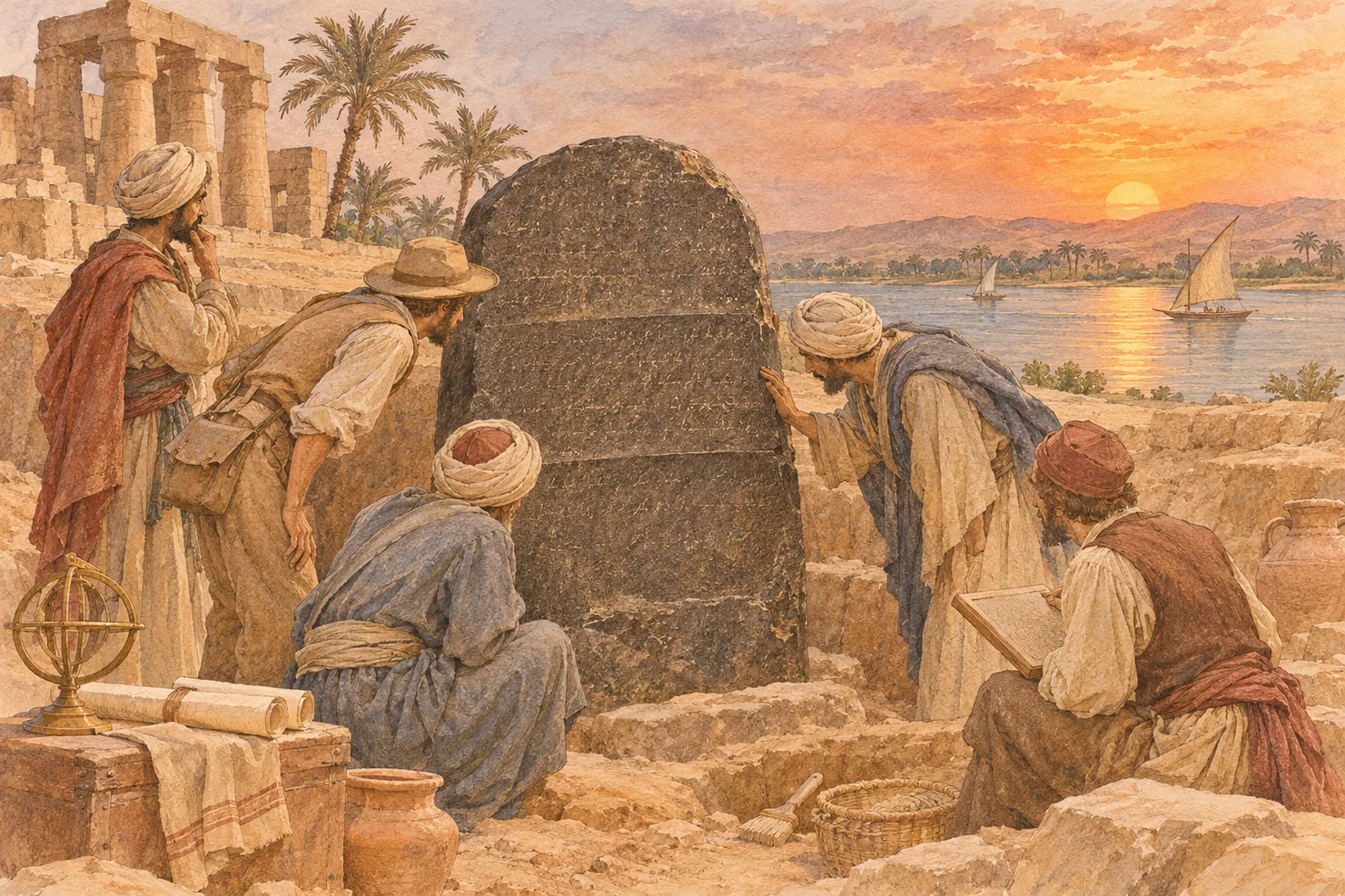
In July 1799, French soldiers were rebuilding an old fort in Rashid (called Rosetta in Europe), a port town near the mouth of the Nile. In the rubble of its foundation, they found a large broken stone slab densely carved with three scripts. The officer who found it is said to have been named Bouchard, and the stone was soon recognized as important.
The stone recorded a decree issued by Egyptian priests at Memphis on March 27, 196 BC. It praised King Ptolemy V and listed honors the priestly council granted him. The form of the decree is said to have been adopted from Greek culture, not native Egyptian, since Egypt was under Greek rule.
The same text was carved in Egyptian hieroglyphs, Egyptian demotic script, and Greek script (ancient Greek). The surviving lines number 14 for hieroglyphs, 32 for demotic, and 54 for Greek. Since Greek could be read, European scholars hoped the other two scripts could be deciphered as well. The story of hieroglyphs themselves also appears in the 'Nile Kingdom and Pyramids' chapter.
When the French army surrendered at Alexandria in 1801, Article 16 of the agreement left the collected ancient artifacts at the disposal of the allied generals. As a result, 22 items including the stone are said to have passed into British hands. The stone was brought to England around February 1802 and has been housed in the British Museum ever since. For the full picture of Napoleon's expedition, see the 'Napoleon and the Suez Canal' chapter.
The decipherment is mainly associated with the names of two scholars. Thomas Young (1773–1829) of Britain joined the study of the stone in July 1814 and worked especially on reading the demotic script. Jean-François Champollion (1790–1832) of France learned Coptic, using it as a clue to understanding ancient Egyptian. Using the reading of royal names as a clue, he determined that the characters represented sounds, and summarized his results in a letter to Dacier in September 1822.
The stone remains in the British Museum. In 2022, former Egyptian Minister of Antiquities Zahi Hawass and others were reported to be collecting signatures for its return. The museum is said to have explained that the 1801 surrender document was signed by an Ottoman admiral who represented Egypt, and that no formal request for return had been made by the Egyptian government. Legal, historical, and ethical perspectives overlap, and no conclusion has been reached.
Mini timeline
- March 27, 196 BCPriests at Memphis issue a decree in praise of Ptolemy V
- July 1799French soldiers find the stone at Rashid
- 1801French army surrenders at Alexandria; the stone passes to British hands
- July 1814Thomas Young begins studying the stone
- September 1822Champollion summarizes his decipherment in a letter to Dacier
- 2022Egyptian experts collect signatures calling for the stone's return
People in this chapter
Familiar with ancient languages from childhood, he studied Coptic and showed that hieroglyphs also represented sounds.
Made contributions across medicine, physics, and other fields; greatly advanced the reading of the demotic script on the stone.
Meanwhile, elsewhere
Connection to Japan
Around 196 BC, Japan was in the Yayoi period. When Champollion compiled the key to decipherment in 1822, Japan was in the late Edo period, and Dutch studies scholars were learning Western knowledge through Dutch books.
Why it still matters
The stone is on display as part of the British Museum's collection. Some other stelae inscribed with the same decree have also been found in part, echoing the decree's final line ordering that it be placed in temples across Egypt. Thanks to the decipherment, we can now read the records that ancient Egyptians left in their own words.
Perspectives differ
- Who deserves credit for the decipherment
- Young opened the way to reading the demotic script and royal names, but is said not to have reached an understanding of ancient Egyptian grammar. While Young sought recognition for his pioneering role, Champollion emphasized his own achievement and barely acknowledged Young's contribution, sparking a dispute between Britain and France over the credit.
- The date and discoverer of the stone
- Most accounts say it was found on July 15, 1799, by an officer named Bouchard, but sources differ on his rank and the exact date. The main text here simply says 'July' and 'officer'.
- Debate over repatriation
- Some in Egypt argue that the stone was taken as 'spoils of war' and should be returned. The British Museum cites the 1801 surrender document signed by an Ottoman admiral. Both views have supporting arguments; there are various opinions and no conclusion has been reached.
- Alternative dating of the decree
- The decree is generally dated to 196 BC, but some sources give a different year depending on how the inscribed date is converted. This text follows 196 BC.
Facts checked (9, verified by AI on the web)
- Confirmed The decree was issued by priests at Memphis on March 27, 196 BC, praising Ptolemy V British Museum: Hieroglyphs: unlocking ancient Egypt, large print guide (PDF)
Confirmed in the British Museum guide. The guide also notes that the decree's form was adopted from Greek culture. - Confirmed In July 1799, the stone was found at Rashid while French soldiers were rebuilding a fort British Museum: Hieroglyphs: unlocking ancient Egypt, large print guide (PDF)
Confirmed in the same guide. MacTutor gives July 15 and Captain Bouchard; World History Encyclopedia says lieutenant. The main text does not specify the date or rank. - Confirmed 14 lines of hieroglyphs, 32 lines of demotic, 54 lines of Greek World History Encyclopedia(事典): Rosetta Stone
Confirmed in the World History Encyclopedia. - Confirmed By Article 16 of the 1801 surrender document, the stone and 21 other items passed to British hands, reaching England around February 1802 British Museum: Hieroglyphs: unlocking ancient Egypt, large print guide (PDF)
Confirmed in the British Museum display guide. MacTutor also states it has been displayed at the British Museum since 1802. - Confirmed Young began studying the stone in July 1814 and contributed to reading the demotic script British Museum: Hieroglyphs: unlocking ancient Egypt, large print guide (PDF)
Confirmed in the same guide. - Confirmed In September 1822, Champollion summarized his decipherment in a letter to Dacier (regarded as the decipherment moment) British Museum: Hieroglyphs: unlocking ancient Egypt, large print guide (PDF)
The guide mentions the anecdote of September 14, 1822, and the letter to Dacier. MacTutor says he presented at the Academy on September 27. The main text says only 'September'. - Confirmed 2022 return petition and the museum's response (admiral's signature, no formal request) Al Jazeera(報道): 'Act of plunder': Egyptians want the Rosetta Stone back
Confirmed in an Al Jazeera report. Hawass's side reported over 100,000 signatures; Hanna's side about 4,200. The museum's own official statement was not independently confirmed. - Unverified Alternative reading of the decree's date (197 BC) World History Encyclopedia(事典): Rosetta Stone
WHE text opened but only mentions 196; no reading of 197 found. Cannot confirm. - Confirmed Three other copies of the decree (Memphis Decree) have been found British Museum: Hieroglyphs: unlocking ancient Egypt, large print guide (PDF)
The same guide notes three other fragments, including one on sandstone from another site.
Sources
British Museum: Hieroglyphs: unlocking ancient Egypt, large print guide (PDF)
World History Encyclopedia(事典): Rosetta Stone
University of St Andrews (MacTutor): Cracking the Code - Champollion and the Rosetta Stone
Al Jazeera(報道): 'Act of plunder': Egyptians want the Rosetta Stone back
University of Rochester: The Rosetta Stone
* AI-drafted and cross-checked; human review is in progress. Status: