Arabization and Islamization — The Spread of Language and Faith
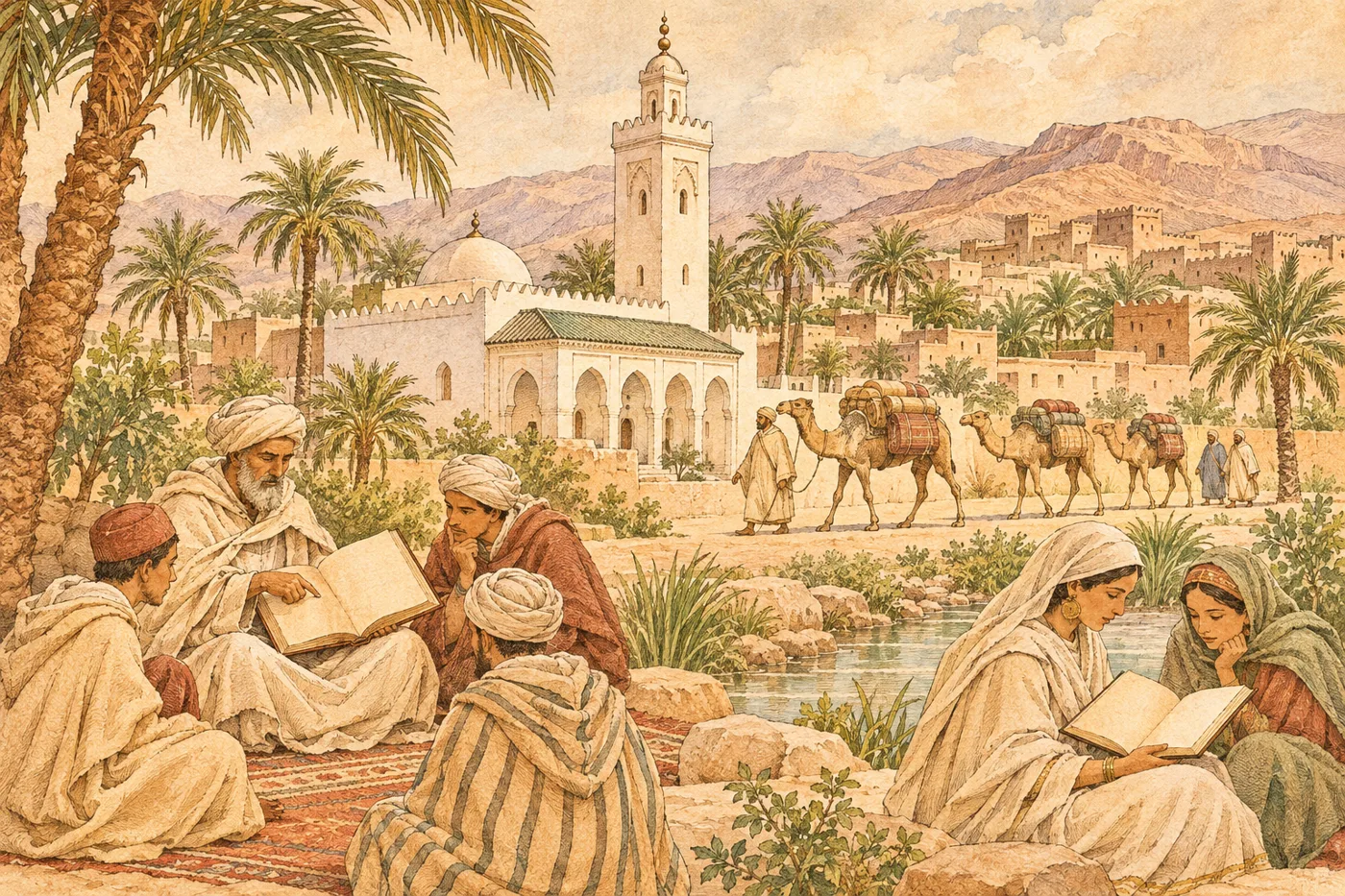
Why did the people of North Africa come to accept Arabic and Islam?
Around 641–642, an Arab army led by Amr ibn al-As conquered Egypt. At the time, Egypt was under the rule of the Eastern Roman (Byzantine) Empire, and there was growing discontent among the people due to sectarian conflict (differences within Christianity). The Arab army built a new military camp city, Fustat, which was the forerunner of later Cairo.
Pushing westward, the Arab army established Kairouan (in present-day Tunisia) as a base around 670, and captured Carthage in 698. The indigenous Berber people of this region initially resisted fiercely. However, later, many of them accepted Islam and joined the army as its main force.
In 711, an army centered on Berbers, led by Tariq ibn Ziyad, crossed the Strait of Gibraltar and advanced into the Iberian Peninsula. Even within the expansion of the Umayyad Caliphate seen in the previous story, the Berbers played a major role.
However, among the Berbers, there was resentment over the preferential treatment of Arabs. Around 740, a major rebellion broke out. Soon after, local dynasties emerged one after another in North Africa. In 789, the Idrisid dynasty was established in Morocco, and Fez was founded.
In the 10th century, the Fatimid Caliphate (a Shi'a dynasty) appeared. It was established in Tunisia in 909, conquered Egypt in 969, began construction that same year of a new capital, Cairo (meaning 'the Victorious City'), in 969, and Caliph al-Mu'izz moved there in 973. Around 970, the Al-Azhar Mosque was built in Cairo, which also became a center of learning.
In the 11th century, Berbers from the Sahara founded the Almoravid dynasty and took control of all of Morocco. Around the same time, Arab nomadic herders are said to have migrated from the east into North Africa, advancing Arabization in terms of language. However, the Berber language still lives on today. Neither faith nor language changed overnight; they spread and blended over a long period of time.
Mini timeline
- around 641–642Arab army conquers Egypt
- around 670Kairouan is founded
- 711An army centered on Berbers advances into the Iberian Peninsula
- 909Fatimid Caliphate is established
- 969–973Fatimids conquer Egypt and build the new capital Cairo
People in this chapter
It is said that he led the expedition to the Iberian Peninsula in 711. The place name Gibraltar is said to derive from his name.
After the conquest of Egypt, he moved the capital to Cairo in 973, laying the foundations for the future center of the Islamic world.
Meanwhile, elsewhere
Connection to Japan
Japan was moving from the Nara period to the Heian period. Cairo was founded in 973, around the middle of the Heian period.
Why it still matters
Cairo's Al-Azhar University, founded around 970, continues as a place of learning to this day. The Great Mosque of Kairouan was registered as a World Heritage Site in 1988. In North Africa, alongside Arabic, there are also people who speak Berber languages.
Perspectives differ
- Speed of Arabization and Islamization
- Although conquest was swift, the prevailing view is that it took several centuries for most of the population to convert and for Arabic to spread. The simple view of 'conversion by the sword' is now being re-evaluated.
- Impact of Arab nomadic migration
- Against the theory that the 11th-century nomadic migration greatly accelerated Arabization, there is also the view that its impact has been exaggerated.
- Tariq's origin
- There are various theories about whether Tariq was a Berber, with some claiming he was of Persian or Arab origin.
- Legend of the Berber queen Kahina
- The story of Queen Kahina, who resisted the Arab army in the late 7th century, relies on later historical sources, and it is not clear how much is factual.
Facts checked (5, verified by AI on the web)
- Confirmed Arab conquest of Egypt 639–642 (surrender of Alexandria 641–642), founding of Fustat U.S. Library of Congress Country Studies: Egypt (Arab conquest)
Text states Amr invaded on December 12, 639, Babylon fell in 641, the governor of Alexandria signed a surrender treaty in November 641, and the capital moved to the new city of Fustat. The year 642 is not explicitly noted on this page (other sources cite 642). - Confirmed Kairouan founded around 670, Carthage fell in 698 SUNY Open Textbook: Islamic Conquest of the Maghreb
Confirmed in text: Kairouan was established as a base in 670, and the Arab army captured Carthage in 698 (founder's name not given in text). - Confirmed 711: Tariq ibn Ziyad crosses the Strait of Gibraltar (army mainly Berbers) Encyclopaedia Britannica: Ṭāriq ibn Ziyād
- Confirmed Idrisid dynasty founded 789 (some say 788), Fez founded 789 Encyclopaedia Britannica: Idrisid dynasty
- Confirmed Fatimid Caliphate founded 909, conquers Egypt 969, begins building Cairo 969, Caliph moves 973, Al-Azhar around 970 EBSCO Research Starters: The Reign of the Fatimids
Text states conquest of Tunisia in 909, advance to the Nile valley in July 969, and Mu'izz himself entered Egypt in 973. Al-Azhar founded by Mu'izz. Construction starting in 970 is from Muslim Heritage 'Cairo: A Millennial' (built 970-972), which is not an official source.
Sources
Britannica: ʿAmr ibn al-ʿĀṣ
SUNY Open Textbook: Islamic Conquest of the Maghreb
Britannica: Ḥassān ibn al-Nuʿmān
Encyclopaedia Britannica: Ṭāriq ibn Ziyād
Encyclopaedia Britannica: Idrisid dynasty
Britannica: Fatimid dynasty
* AI-drafted and cross-checked; human review is in progress. Status: