The Mamluks and the Ottomans — A purchased boy becomes sultan
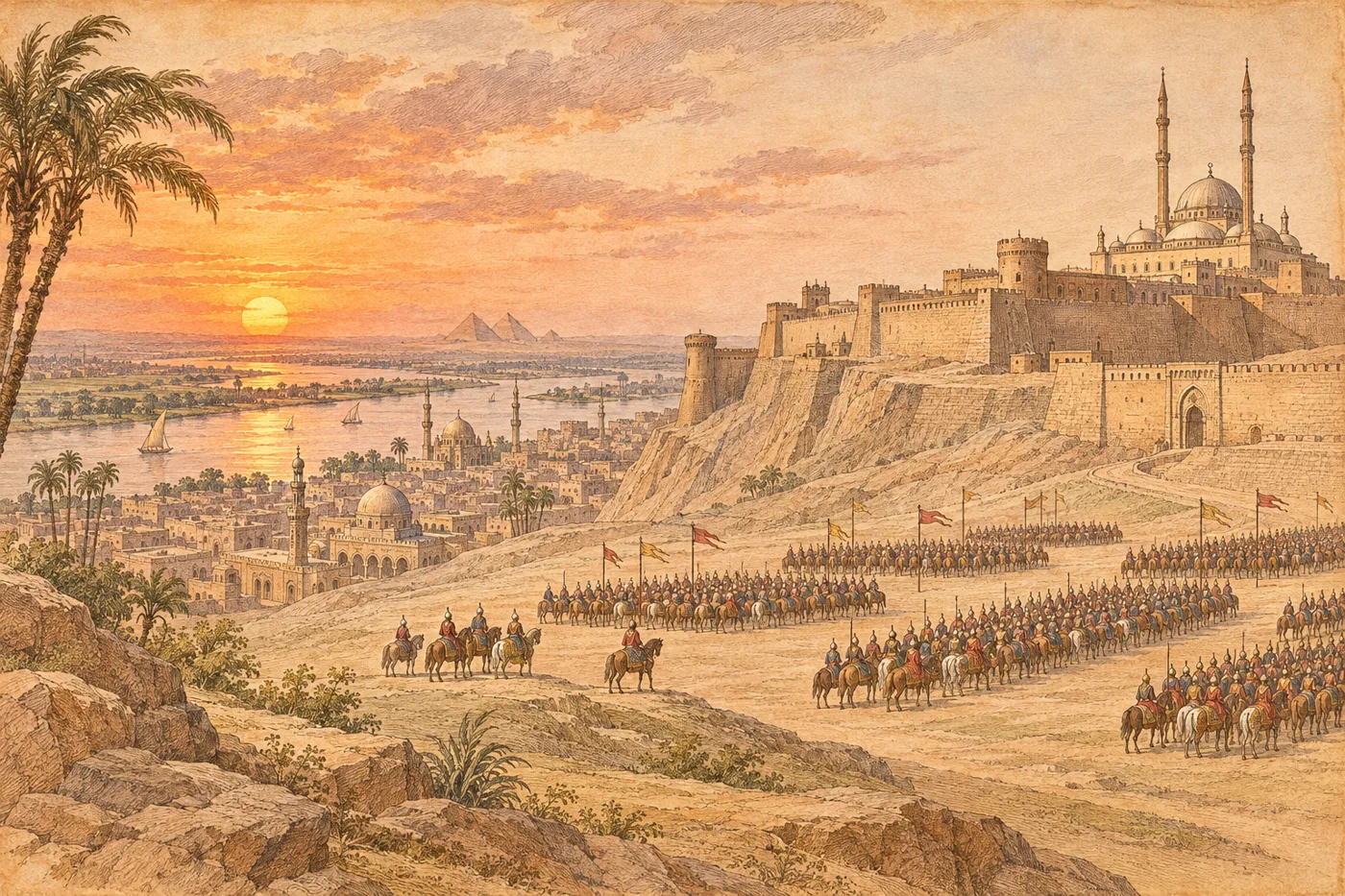
Why could soldiers who were “purchased slaves” become rulers of Egypt?
In 1171, Saladin ended the Fatimid Caliphate and founded the Ayyubid dynasty. The armies of this era included soldiers called Mamluks. Young boys of Turkic or Caucasian origin were purchased, given military training, and then freed to serve as soldiers. Although their status was “slave,” they could later rise to become military commanders.
In 1250, when the Ayyubid dynasty fell into chaos, Mamluk commanders seized power, establishing the Mamluk Sultanate (1250–1517). One of its first sultans was a woman, Shajar al-Durr. In 1260, at the Battle of Ain Jalut, they defeated the Mongol army. Baybars then captured Crusader strongholds one after another, and in 1291 Acre fell, ending the Crusader era.
After the destruction of Baghdad, Cairo became one of the intellectual and cultural centers of the Islamic world. The thinker Ibn Khaldun, who wrote the Muqaddimah, was born in Tunis and spent his later years in Cairo. In 1324, Mansa Musa, the king of Mali in West Africa, is said to have stopped in Cairo on his pilgrimage, astonishing people with his vast quantities of gold.
But the Black Death (plague) of 1347–49 dealt a heavy blow to Cairo as well. The spice routes that supported trade also began to change in the 15th century as the Portuguese opened new sea routes.
In 1517, Selim I of the Ottoman Empire defeated the Mamluk Sultanate, and Egypt became a province of the empire. Yet powerful Mamluks continued to hold power as local rulers. In the west, Algiers, Tunis, and Tripoli came under Ottoman influence in the 16th century. Morocco remained independent, and from the 17th century the Alawi dynasty, still ruling today, became the royal house.
In the Mediterranean, piracy (privateering) and warfare continued, and the trading of captives and slaves was practiced by both sides. 18th-century North Africa is often described in terms of Ottoman “decline,” but regional powers were surprisingly strong and pursued their own development. Then, in 1798, an unexpected visitor arrived across the Mediterranean.
Mini timeline
- 1171Saladin ends the Fatimid Caliphate and founds the Ayyubid dynasty
- 1250The Mamluk Sultanate is established
- 1260The Mamluks defeat the Mongol army at the Battle of Ain Jalut
- 1291The last Crusader stronghold, Acre, falls
- 1517The Ottoman Empire defeats the Mamluk Sultanate and conquers Egypt
People in this chapter
A sultan who fought the Mongols and Crusaders and consolidated the Mamluk Sultanate.
In his Muqaddimah, he sought to explain the rise and fall of states through social cohesion.
Meanwhile, elsewhere
Connection to Japan
The same Mongol forces that swept toward Japan in the east (the Mongol invasions of 1274 and 1281) were halted before reaching Cairo in the west.
Why it still matters
Cairo's old city (Islamic Cairo) retains many buildings from the Mamluk and Ottoman eras and was designated a UNESCO World Heritage site in 1979.
Perspectives differ
- How to translate the Mamluk system
- The word “mamluk” is often translated as “slave,” but because Mamluks were freed to serve as soldiers, the system differed greatly from ordinary slavery. The term “military slavery” is also used, though its appropriateness is debated.
- Casualties from the Black Death
- Cairo's losses are estimated at one-third to half of its population, but records are limited and the figures are uncertain.
- Mediterranean slave trade
- Estimates that over a million Europeans were enslaved in North Africa exist, but scholars disagree.
- Ottoman “decline”
- Once described as an “age of decline,” recent scholarship offers a more nuanced view, looking at local autonomy and economic developments.
Facts checked (4, verified by AI on the web)
- Confirmed The Mamluk Sultanate was established in 1250, with Shajar al-Durr as one of its first sultans World History Encyclopedia: Shajara al-Durr
Shajar al-Durr became sultana in 1250 and is considered a founder of the Mamluk Sultanate. - Confirmed The Mongols were defeated at Ain Jalut in 1260 (by Qutuz and Baybars); Acre fell in 1291 Encyclopaedia Britannica: Mamluk dynasty
The sultan at Acre's fall was al-Ashraf Khalil (Baybars died in 1277). The text separates the subjects, so it is consistent. - Confirmed Selim I of the Ottoman Empire defeated the Mamluk Sultanate in 1517 EBSCO Research Starters: Mamluk-Ottoman Wars
The Mamluk army was defeated at the Battle of Ridaniya on January 22, 1517, and the Mamluk Sultanate was annexed by the Ottoman Empire. - Confirmed Mansa Musa of Mali stopped in Cairo in 1324 Encyclopaedia Britannica: What happened on Mūsā I's pilgrimage?
The extent of his impact on gold prices is debated. The text says 'is said to.'
Sources
Encyclopaedia Britannica: Mamluk dynasty
Encyclopaedia Britannica: What happened on Mūsā I's pilgrimage?
World History Encyclopedia: Shajara al-Durr
EBSCO Research Starters: Mamluk-Ottoman Wars
* AI-drafted and cross-checked; human review is in progress. Status: