The World of Native Peoples — Diverse Ways of Life Spread Across a Continent
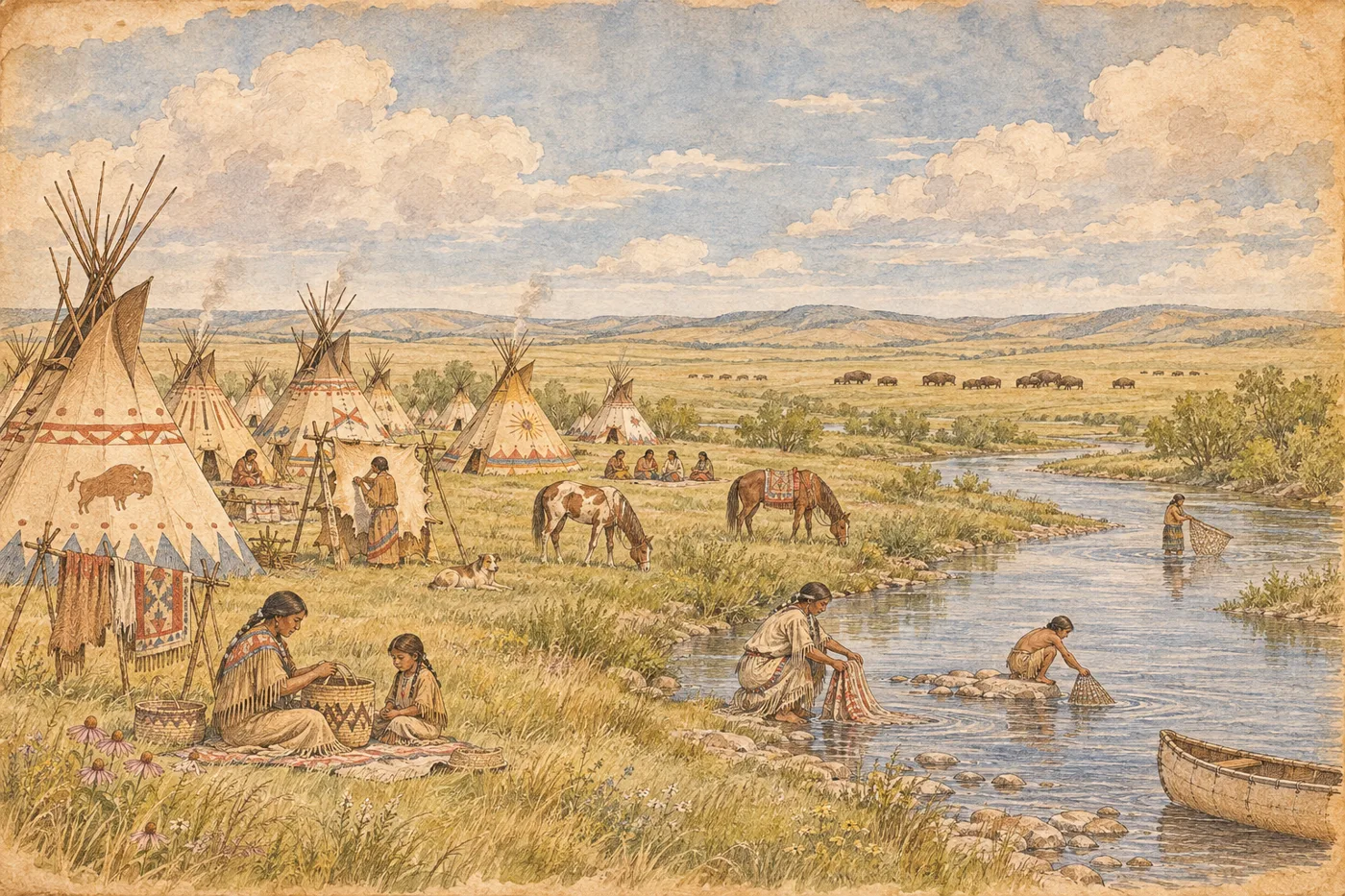
Why were there so many different ways of life in North America?
Around 20,000 years ago, the earth was in an ice age; seawater became ice, and the sea level was much lower than today. As a result, a wide land bridge (Beringia) appeared between Siberia and Alaska. It is thought that people entered North America more than 15,000 years ago, either by following game or by traveling along the coast in boats (there are various theories about the timing and route).
When the ice age ended, people spread across the continent, creating ways of life suited to the natural environment of each region. In the Arctic, the Inuit hunted seals; on the Northwest Coast, a wealthy society centered on salmon fishing developed, known for raising totem poles. On the Great Plains, people hunted bison; in the Southwest, settlements (pueblos) of adobe (sun-dried brick) houses emerged.
In the eastern woodlands, the cultivation of maize, beans, and squash—transmitted from Mesoamerica—spread. Because these three crops grow well together, this wisdom is still passed down today as the 'Three Sisters.' Eventually, cities with huge earthen mounds flourished in the Mississippi River valley.
A prime example is Cahokia, in present-day Illinois. It reached its peak around 1000–1200 AD; its central 'Monks Mound' was a massive earthen structure with an enormous base area. Its population is estimated at several thousand to tens of thousands, making it the largest town in North America at the time.
Political systems were also diverse. Around what is now New York State, the 'Iroquois Confederacy (Haudenosaunee),' an alliance of five nations, created a system of decision-making through discussion. There is a view that this influenced the formation of the later United States, but the extent of that influence is debated. There were hundreds of languages on the continent; there was no single 'Indian' culture.
And this story is not a thing of the past. Even today, there are over 570 federally recognized Indigenous tribes in the United States, and over 600 Indigenous societies (First Nations, Inuit, etc.) in Canada, each preserving and passing on their own languages, ceremonies, and connections to the land. The next chapter moves into the era after 1492, when people came from across the sea.
Mini timeline
- 15000+ years agoPeople enter North America (timing debated)
- About 13000 years ago (c. 11000 BC)Clovis culture. Long considered the oldest culture
- c. 1000 ADMaize farming spreads in the East
- c. 1000–1200 ADCahokia reaches its peak
- c. 15th centuryIroquois Confederacy is said to have been formed (debated)
People in this chapter
He is remembered as the one who united warring nations into a single alliance. He is spoken of as a legendary figure.
He is said to have worked alongside Deganawida to establish the alliance.
Meanwhile, elsewhere
Connection to Japan
Around 15,000 years ago, the Jōmon period was beginning in the Japanese archipelago. Around 1000 AD, when Cahokia flourished, Japan was in the Heian period, around the time The Tale of Genji was written.
Why it still matters
Today, Indigenous peoples still live across North America. Efforts to relearn languages that were nearly lost are also spreading. 'History' is not something that is over; it is a way of life that continues even now.
Perspectives differ
- Timing and Route of Migration
- For a long time, the theory that 'the Clovis culture from about 13,000 years ago is the oldest' was influential, but now, reports of much older sites are appearing one after another. A 2021 study analyzing fossilized footprints found in New Mexico suggested they are over 20,000 years old, and debate continues. Regarding the route, there are two main theories: an inland path (an ice-free corridor) and a coastal path.
- Population before 1492
- The Indigenous population of North America is said to have been in the millions or even higher, but estimates vary widely and are not definitive.
- Cause of Cahokia's Decline
- There are several theories, including flooding, overuse of forests, social unrest, and climate change; no single cause has been determined.
- Founding Date and Influence of the Iroquois Confederacy
- Theories for its founding range from the 12th century to the 16th century. Regarding its influence on the U.S. Constitution, there are both views that it was 'significant' and that it is 'overstated.'
- Terms of Address
- Preferences for terms like 'Indian,' 'Native American,' or 'Indigenous' vary by country, person, and tribe. This site primarily uses 'Indigenous' and uses specific tribal names where possible.
Facts checked (4, verified by AI on the web)
- Confirmed White Sands footprints are over 20,000 years old (2021 study) Independent age estimates resolve the controversy of ancient human footprints at White Sands (Science)
Approximately 21,000–23,000 years old. The dating is still debated; the main text and debates section are consistent, saying 'debate continues.' - Confirmed Cahokia's peak was c. 1000–1200 AD; population several thousand to tens of thousands Cahokia Mounds State Historic Site (UNESCO)
UNESCO suggests 10,000–20,000 people from 1050–1150. Estimates range widely, from 8,000 to 40,000. - Views differ Founding of the Iroquois Confederacy is c. 15th century (debated) Haudenosaunee Confederacy (Britannica)
Theories range from a 1142 solar eclipse date to archaeologists' views that it dates no earlier than 1450, and even to estimates of 1570–1600. The debates section already lists a range from the 12th to 16th centuries. - Confirmed Clovis culture is about 13,000 years old Northern Arizona University: Southwest Virtual Museum, Paleoindian
An exhibition at Northern Arizona University states that calibrated dates for Clovis are about 13,325–12,975 years ago (about 13,000 years ago).
Sources
Science: White Sands footprints (2023)
Science: Evidence of humans in North America during the LGM (2021)
UNESCO: Cahokia Mounds
Britannica: Cahokia Mounds
Britannica: Haudenosaunee Confederacy
Canadian Encyclopedia: Haudenosaunee (Iroquois)
Northern Arizona University: Southwest Virtual Museum, Paleoindian
* AI-drafted and cross-checked; human review is in progress. Status: