The Arrival of Europeans — The Beginning of Encounters and Conflicts
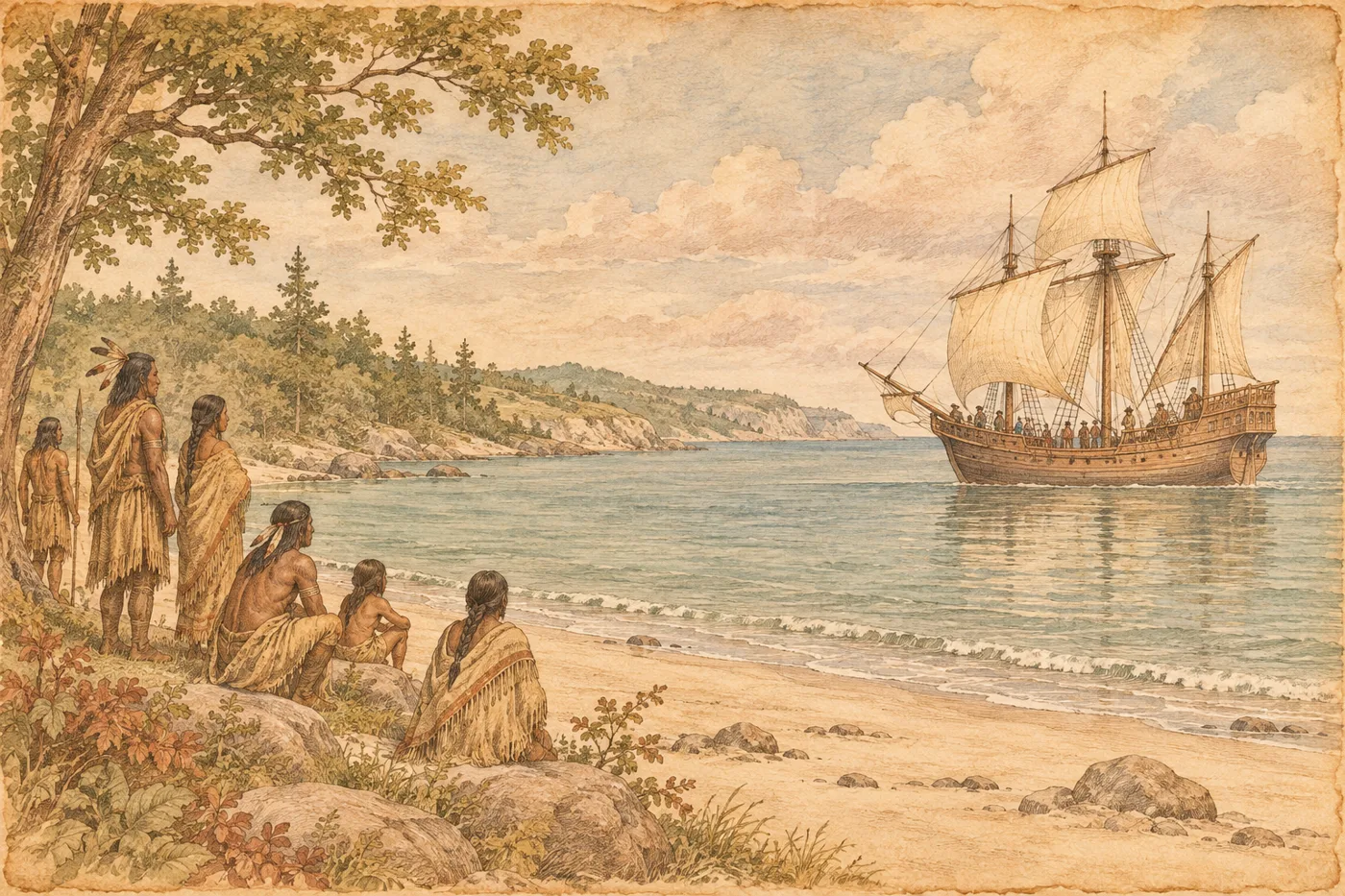
Why did the fate of North America change so dramatically after 1492?
Columbus was not the first European to reach North America. Around the year 1000, Norse people from Scandinavia (the so-called Vikings) built a short-lived settlement at what is now the eastern tip of Canada, on Newfoundland Island. The site (L'Anse aux Meadows) has been found. But this settlement did not last long.
The big turning point was 1492. Columbus, backed by Spain, set out to find a westward route to Asia and landed on an island in the Caribbean. Soon after, John Cabot, employed by the king of England, reached the northeastern coast of North America in 1497, and France's Cartier explored the St. Lawrence River in the 1530s. European countries began competing to send people to North America.
The various nations built settlements in different places. Spain founded St. Augustine in Florida in 1565; England established Jamestown in Virginia in 1607; and France's Champlain built Quebec in 1608. In 1620, the Mayflower, carrying people seeking religious freedom, arrived in what would become Massachusetts. The Dutch also set up a settlement on the site of what later became New York.
However, this was no 'empty new continent.' Indigenous peoples traded furs and food, and sometimes formed alliances, with the newcomers. Massasoit, a leader of the Wampanoag, made a peace agreement with the Plymouth Colony in 1621. On the other hand, conflicts over land increased, and in 1675–76, a war broke out led by Massasoit's son, Metacomet.
What dealt the heaviest blow to indigenous societies was actually disease. Smallpox and measles brought from Europe struck down people with no immunity, and in some regions, the population is said to have been greatly reduced. For this reason, many researchers believe that disease—not just warfare—transformed the very structure of their societies.
Another painful chapter of history began in this era. There is a record from 1619 that more than twenty people brought from Africa arrived in Virginia. Later, the enslavement of African people was codified in colonial law. It should be noted that most destinations of the Atlantic slave trade were the Caribbean and Brazil, and only a few percent of the total arrived on the mainland of North America.
Mini timeline
- c. 1000Norse people build a short-lived settlement on Newfoundland Island
- 1492Columbus reaches an island in the Caribbean
- 1607England founds Jamestown
- 1608France founds Quebec
- 1619Record of African people brought to Virginia
People in this chapter
In 1621, he made a peace agreement with the settlers of Plymouth. Later, during his son's time, the relationship turned to war.
He laid the foundations of New France (Nouvelle-France) based on alliances with indigenous peoples and the fur trade.
Meanwhile, elsewhere
Connection to Japan
In 1607, when Jamestown was founded, Japan was at the beginning of the Edo period. Tokugawa Ieyasu had already passed the title of shōgun to his son Hidetada (1605) and was strengthening the foundations of the Edo shogunate as a retired shōgun.
Why it still matters
In Canada, there is the province of Quebec, where many French-speaking people live, and the country still has two official languages. In the United States, a growing number of states and cities are replacing Columbus Day with 'Indigenous Peoples' Day.' How people remember the same event is itself a present-day issue.
Perspectives differ
- The word 'discovery'
- Calling 1492 the 'discovery of the New World' is disputed on the grounds that 'people were already living there,' and many now use terms like 'arrival' or 'encounter.' Evaluations of Columbus Day and statues of Columbus also vary greatly by region and person.
- Causes and extent of indigenous population decline
- Disease is considered the greatest cause, but researchers differ on how much weight to give warfare, forced labor, and loss of land. The rate of decline also varies by region, with estimates ranging from a few tens of percent to 90 percent; the numbers are uncertain and a matter of debate.
- The year the Norse arrived
- It has traditionally been placed around 1000, but recent research using tree rings has reported the year 1021.
- The status of the Africans in 1619
- Whether the people who arrived were initially 'slaves' or had a status closer to 'indentured servants' is debated among researchers due to limited historical records. What is certain is that slavery was later codified in law.
- The story of Thanksgiving
- The harvest celebration of 1621 is often told as 'the beginning of Thanksgiving,' but there are various views on its connection to actual events and its meaning for indigenous peoples.
Facts checked (4, verified by AI on the web)
- Confirmed The Norse had a settlement on Newfoundland around 1000 (tree-ring study: 1021) Evidence for European presence in the Americas in AD 1021 (Nature)
Identified as 1021 from tree rings and a spike in C14 (993). Radiocarbon alone points to around 990–1050. UNESCO considers it an 11th-century Norse settlement and the oldest European trace in North America. - Confirmed Jamestown founded 1607, Quebec founded 1608 Chronology of Jamestown Events (NPS)
Jamestown was founded in May 1607 (NPS). Quebec was built by Champlain in 1608 (Britannica: Samuel de Champlain). - Confirmed 1619: about twenty Africans arrive in Virginia Jamestown Timeline (Historic Jamestowne)
August 1619, at Point Comfort. Some records identify the ship as the White Lion. - Confirmed 1621: Relationship between Plymouth and the Wampanoag (Massasoit) Plimoth Patuxet Museums: Wampanoag-Pilgrim treaty of 1621
In March 1621, the Plymouth Colony and the Wampanoag sachem Massasoit made a treaty of mutual non-aggression and defense in wartime (Plimoth Patuxet Museums). That autumn, about 90 Wampanoag and about 50 colonists gathered (US National Archives). The interpretation of the treaty may have differed between the two sides.
Sources
Nature: Evidence for European presence in the Americas in AD 1021
NPS: Chronology of Jamestown Events
Historic Jamestowne: Timeline
UNESCO World Heritage Centre: L'Anse aux Meadows National Historic Site
* AI-drafted and cross-checked; human review is in progress. Status: