Civil Rights and the Modern Era —The Promise of 'All People'
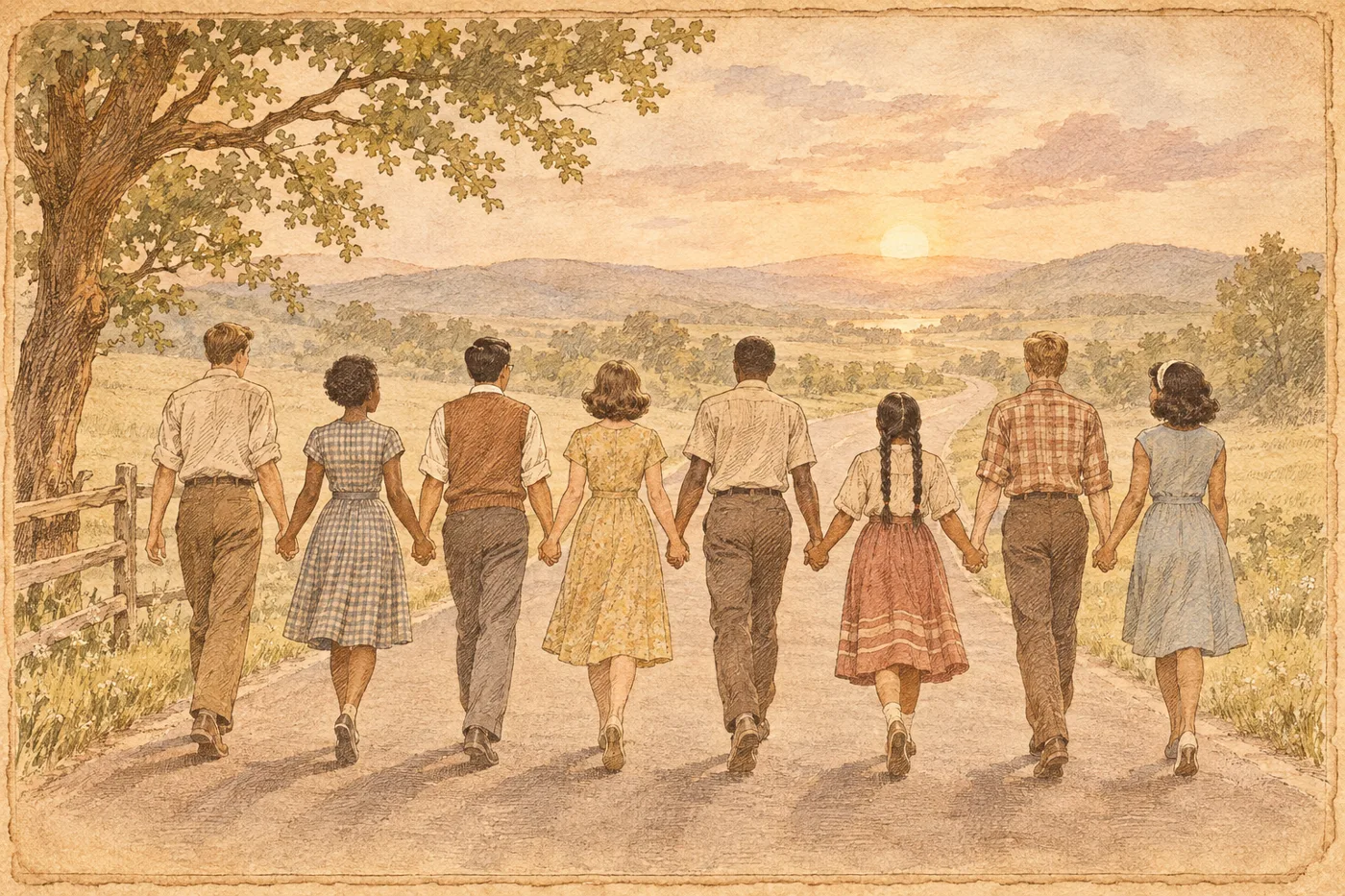
When did the Declaration of Independence's 'all men are created equal' become a reality, and for whom?
After the Civil War, segregation laws known as 'Jim Crow laws' spread across the South. Schools, buses, and even restaurants were separated for whites and Blacks, and Black voting rights were effectively stripped away. The doctrine of 'separate but equal' was upheld by the Supreme Court in 1896. But the actual facilities and funding were clearly unequal.
The turning point came in the 1950s. In 1954, the Supreme Court ruled that racial segregation in public schools was unconstitutional (Brown v. Board of Education). In 1955, Rosa Parks was arrested in Montgomery, Alabama, for refusing to give up her bus seat. Black residents carried out a bus boycott for about a year, and one of its leaders was a young Martin Luther King Jr.
King advocated nonviolent resistance and led the movement. Over 200,000 people gathered for the 1963 March on Washington, where he delivered his 'I Have a Dream' speech. The Civil Rights Act was passed in 1964, and the Voting Rights Act in 1965, broadly prohibiting racial discrimination in law. King was assassinated in 1968, but the movement's momentum spread to other areas.
Women's rights, Indigenous rights, immigration, and the rights of people with disabilities—various groups re-examined the promise of 'all people' as their own cause. The 1965 immigration law abolished country quotas, leading to a surge in immigration from Asia and Latin America, dramatically changing the nation's demographics.
In Canada, coexistence between English-speaking and French-speaking peoples was a key issue. English and French became official languages in 1969, and in 1971 Canada became the first country in the world to adopt multiculturalism as official policy. Additionally, the Truth and Reconciliation Commission, which investigated the harm done to Indigenous children in residential schools, began its work in 2008. The effort to confront the past is reshaping the nation.
In 2001, the September 11 attacks occurred in the United States, followed by wars in Afghanistan and Iraq. A global financial crisis struck in 2008, and in 2009, Barack Obama was inaugurated as the first African American president. Even so, debates over disparities in education and income, as well as discrimination, continue. The promise of 'all people' remains a work in progress.
Mini timeline
- 1954Brown v. Board of Education rules racial segregation in public schools unconstitutional
- 1955Montgomery bus boycott begins
- 1963March on Washington; King's speech
- 1964Civil Rights Act passed
- 2009Obama inaugurated as first African American president
People in this chapter
In 1955, she was arrested for refusing to give up her bus seat, becoming a symbol of the movement. She had been involved in activism before that incident.
He advocated nonviolent resistance and received the Nobel Peace Prize in 1964. He was assassinated in 1968.
Meanwhile, elsewhere
Connection to Japan
Also in the 1960s, Japan was in the midst of rapid economic growth. The Tokyo Olympics were held in 1964. In 1988, the U.S. government apologized for the forced internment of Japanese Americans during World War II.
Why it still matters
Both the United States and Canada have become countries where people from diverse backgrounds live. Debates over race, immigration, inequality, and Indigenous rights continue to this day. 'History' is not only about the past, but also about the present.
Perspectives differ
- Assessment of the Civil Rights Movement's achievements
- There are views that see it as a major achievement in ending legal discrimination, and views that emphasize the remaining economic and educational disparities. Both reflect aspects of the facts.
- Affirmative action
- The pros and cons of affirmative action—preferential treatment for minority groups in university admissions and employment—have long been debated in American society.
- Response to the September 11 attacks
- Regarding the 'war on terror' after 2001, some see it as a necessary response, while others criticize the reasons and consequences; no consensus has been reached.
- How to refer to residential schools
- Canada's Truth and Reconciliation Commission described the assimilation policy of residential schools as 'cultural genocide.' There are various opinions on this term.
- Scope of this chapter
- This chapter covers events up to around 2011. For events after that, please refer to reliable news sources, as changes are rapid.
Facts checked (6, verified by AI on the web)
- Confirmed 1954 Brown v. Board of Education ruled public school segregation unconstitutional Timeline of the American Civil Rights Movement (Britannica)
May 17, 1954; unanimous decision. - Confirmed 1955 Montgomery bus boycott American civil rights movement (Britannica)
December 5, 1955, to about December 1956. - Confirmed Over 200,000 attended the 1963 March on Washington March on Washington (Britannica)
August 28, 1963; estimates range from 200,000 to 300,000. - Confirmed 1964 Civil Rights Act passed Timeline of the American Civil Rights Movement (Britannica)
Signed by President Johnson on July 2, 1964. - Confirmed King received the 1964 Nobel Peace Prize Martin Luther King Jr. (NobelPrize.org)
Announced October 1964; awarded in Oslo on December 10. - Confirmed 2009 Obama inaugurated as first African American president Obama Presidential Library: President Barack Obama
Page states 'Elected as first African American president on November 4, 2008,' 'inaugurated as 44th president on January 20, 2009.' Consistent with the text.
Sources
Britannica: Timeline of the American Civil Rights Movement
Britannica: March on Washington
NobelPrize.org: Martin Luther King Jr.
Britannica: American civil rights movement
Obama Presidential Library(米国立公文書館): President Barack Obama
* AI-drafted and cross-checked; human review is in progress. Status: