The Cold War — Between Two Superpowers
Why did the two great powers, who never exchanged fire, keep facing off for nearly half a century?
When World War II ended in 1945, the United States and the Soviet Union became superpowers that divided the world. The U.S. championed capitalism and free elections, while the Soviet Union advocated socialism; they regarded each other with intense suspicion. Since it never became a direct war, this conflict was called the 'Cold War.' In August 1945, the U.S. dropped atomic bombs on Hiroshima and Nagasaki.
In 1947, the U.S. announced a policy to contain the spread of communism (the Truman Doctrine) and also launched the Marshall Plan to aid Europe's recovery. In 1949, the U.S., Canada, and Western European countries formed the military alliance NATO (North Atlantic Treaty Organization). That same year, the Soviet Union succeeded in testing an atomic bomb, and the nuclear arms race began in earnest.
The conflict also appeared in wars around the world: the Korean War (1950–53) and the Vietnam War. The U.S. became fully involved from the mid-1960s but withdrew its forces in 1973 after a long struggle. During the Cuban Missile Crisis in 1962, the Soviet Union tried to place nuclear missiles in Cuba, bringing the world to the brink of nuclear war for 13 days.
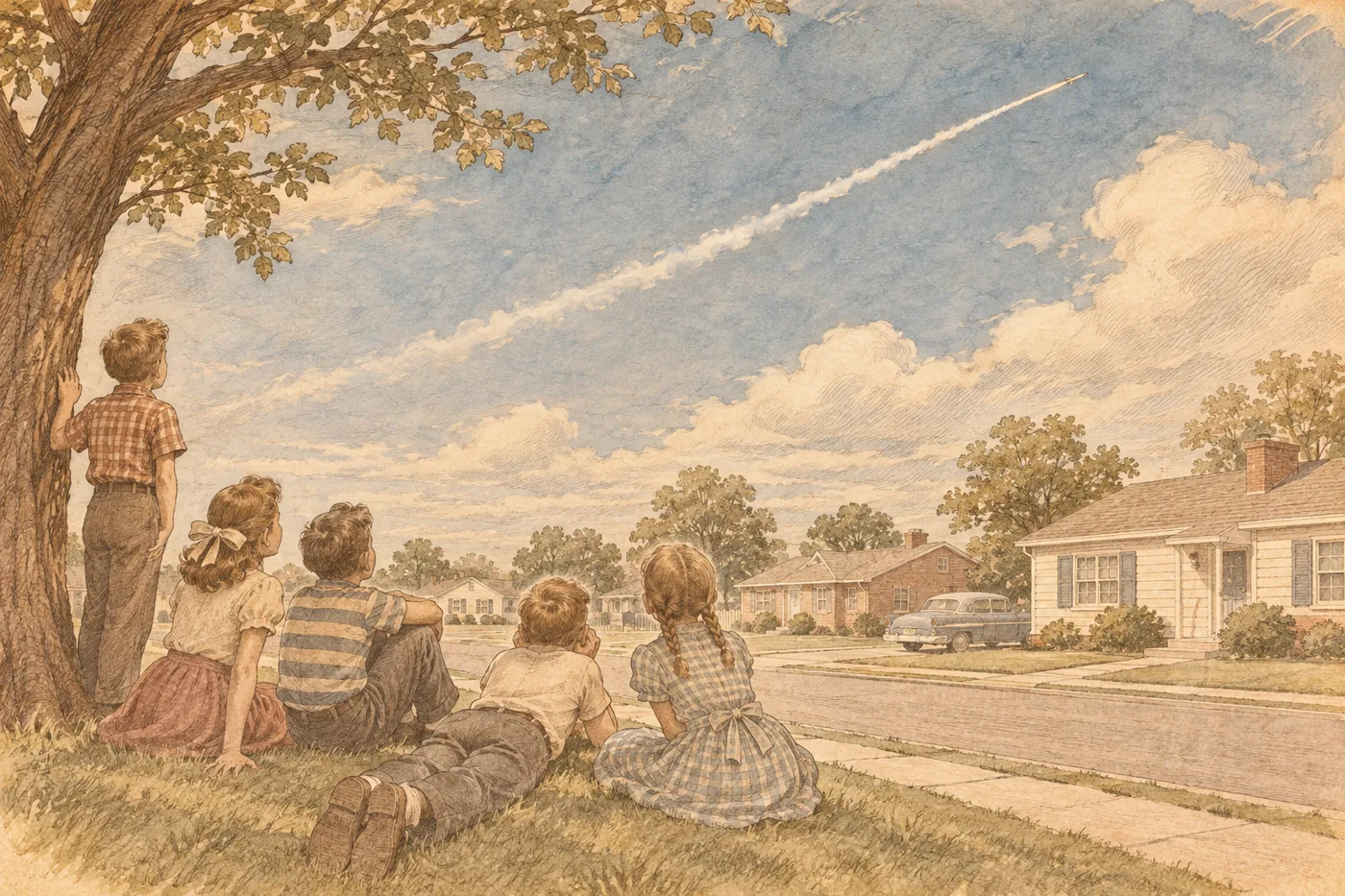
The Cold War cast a shadow within countries as well. In the early 1950s, a 'Red Scare' spread, targeting people suspected of being communists. At the same time, affluent lifestyles expanded: suburban housing, cars, television. When the Soviet Union launched the Sputnik satellite in 1957, the U.S. poured efforts into space development, and in 1969, Apollo 11 sent humans to the moon.
Canada, as a member of NATO, was on the Western side but found its own role. During the Suez Crisis of 1956, Lester Pearson proposed a United Nations peacekeeping force and later received the Nobel Peace Prize. In the 1960s, the 'Quiet Revolution' in Quebec demanded rights for French-speaking people, leading Canada to rethink its national identity.
In the 1970s, tensions eased (détente); in 1972, President Nixon visited China. In 1989, the Berlin Wall fell, and one after another the regimes of Eastern Europe changed. The Soviet Union dissolved in 1991, ending the Cold War.
Mini timeline
- 1947Truman Doctrine, Marshall Plan
- 1949NATO (North Atlantic Treaty Organization) established
- 1962Cuban Missile Crisis
- 1969Apollo 11 takes humans to the moon
- 1989Berlin Wall falls
People in this chapter
He directed the response during the Cuban Missile Crisis. He was assassinated in 1963.
He proposed a UN peacekeeping force during the Suez Crisis and received the Nobel Peace Prize in 1957.
Meanwhile, elsewhere
Connection to Japan
Japan was occupied by the Allied Powers (effectively the United States) from 1945 to 1952. The peace treaty and U.S.-Japan Security Treaty in 1951, the return of Okinawa in 1972, and high economic growth—Japan's postwar path unfolded in connection with the Cold War.
Why it still matters
Nuclear weapons still exist in the world even after the Cold War ended. Canada remains deeply involved in peacekeeping, while Japan considers its security under the U.S.-Japan alliance. The legacy of the Cold War is still close to us today.
Perspectives differ
- Causes and responsibility for the Cold War
- Scholars' views have differed on which country bears more responsibility. There are views favoring the U.S., views favoring the Soviet Union, and views that emphasize the responsibility of both sides; as official documents are released, assessments continue to change.
- Assessment of the atomic bombings
- There is a view that they ended the war quickly and saved many lives, and a view that they were militarily unnecessary and ethically problematic. In Japan, voices stressing the scale of the damage and inhumanity are strong; in the U.S. as well, opinions differ by generation and standpoint.
- Casualties of the Vietnam War
- U.S. military deaths are put at about 58,000, but estimates of Vietnamese casualties—military and civilian combined—range from 1 million to over 3 million, with a wide spread and no firm figure.
- Why the Cold War ended
- There is a view that U.S. military buildup and pressure were crucial, and a view that internal economic and political problems in the Soviet Union were more important.
- Scope of this chapter
- This chapter covers up to around 1991. For international affairs after that, please refer to other chapters or reliable news reports.
Facts checked (5, verified by AI on the web)
- Confirmed Truman Doctrine and Marshall Plan in 1947 The Truman Doctrine and the Marshall Plan (Office of the Historian)
The Truman Doctrine was announced in March 1947; the first expenditures under the Marshall Plan were in April 1948. - Confirmed NATO established in 1949 Office of the Historian: North Atlantic Treaty Organization (NATO), 1949
NATO was founded in 1949 by the United States, Canada, and Western European countries as a collective security arrangement against the Soviet Union (the signing date was April 4; this source does not confirm the 12-country figure). - Corrected & confirmed Cuban Missile Crisis lasted 13 days Cuban missile crisis (Britannica)
The acute phase is commonly described as 13 days. Including the naval quarantine, some accounts give the period from October 22 to November 20, 1962—the count varies. - Confirmed Apollo 11 landed on the moon in 1969 NASA: Apollo 11
Apollo 11 launched on July 16, 1969, and landed on the moon on July 20 (NASA). - Confirmed Pearson won the 1957 Nobel Peace Prize for proposing the UN Emergency Force Lester Bowles Pearson (NobelPrize.org)
The prize was awarded for his contribution to realizing the UN Emergency Force after the Suez Crisis.
Sources
Office of the Historian: Truman Doctrine and Marshall Plan
Office of the Historian: North Atlantic Treaty Organization (NATO), 1949
Britannica: Cuban missile crisis
NASA: Apollo 11
NobelPrize.org: Lester B. Pearson
* AI-drafted and cross-checked; human review is in progress. Status: