The Great Depression and the New Deal — The Day the Market Stopped
Why did something that was just a drop in stock prices turn into a depression that changed people's lives all over the world?
In the 1920s, America was booming. The Dow Jones Industrial Average rose from around 63 in 1921 to about 381 in September 1929, roughly a sixfold increase. It is explained that many people bought stocks by paying only about 10% of the price and borrowing the rest, creating a precarious situation where rising prices attracted new buyers. The Federal Reserve, worried about speculation, raised the discount rate to 6% in August 1929.
Starting around October 24, 1929, stock prices suddenly dropped, and on the 28th and 29th, they fell more than 10% in a single day. By mid-November, nearly half the value had been lost. Stock prices continued to fall after that, and by July 1932, they were about 90% below their peak. It would be 1954 before they returned to their original level. The 24th is called 'Black Thursday,' when about 12.9 million shares are said to have been traded, and on the 29th, 'Black Tuesday,' about 16.4 million shares.
However, the current view is that the crash alone was not the cause of the depression. The economy had already started to decline around August 1929. Bank runs continued from 1930 to 1933, and both the money supply and prices fell by nearly 30%. The weight of debt increased, and business bankruptcies and unemployment spread further. In March 1933, industrial production is said to have fallen to about half of its 1929 level.
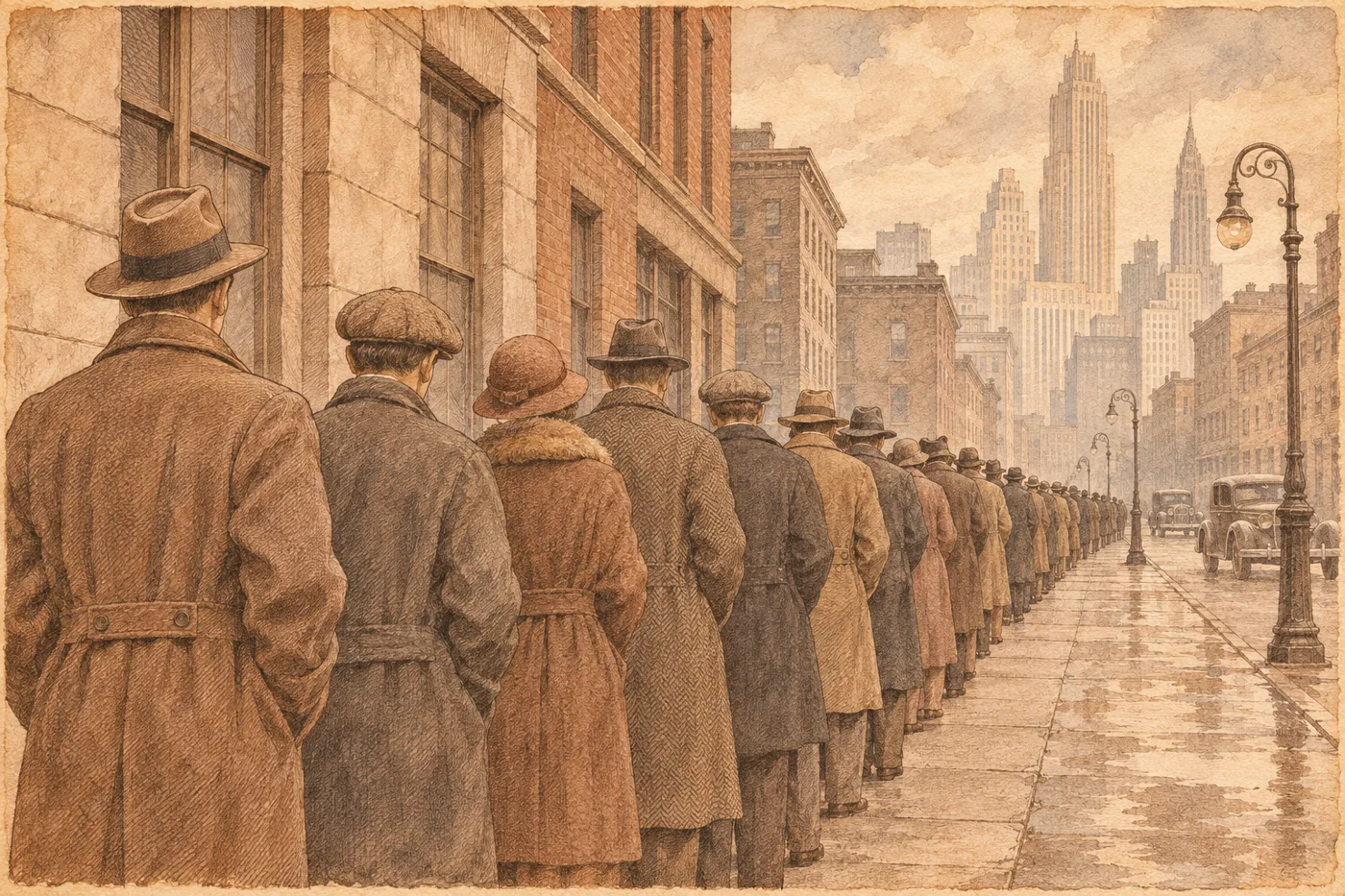
In 1933, about 12.83 million people, roughly a quarter of the workforce, are said to have lost their jobs. Combined with cuts in working hours, nominal weekly wages for those still working and total national wage payments also fell sharply. In rural areas, falling crop prices caused more people to lose their land, and overlapping with drought and dust storms, some families left their homes and headed for California. It is also pointed out that agriculture had already been struggling since the 1920s.
On March 4, 1933, Roosevelt was inaugurated as president. On March 6, all banks nationwide were closed, and on March 9, the Emergency Banking Act was passed. The Banking Act of June of the same year created deposit insurance, which began in January 1934. The initial protection limit was $2,500, which served to calm public anxiety. By March 15, banks holding about 90% of the nation's banking resources had resumed operations, but about 4,000 banks did not reopen.
Roosevelt's 'New Deal' consisted of many policies, such as the Civilian Conservation Corps, which provided young people with jobs in forests and other areas, and public works programs. The Social Security Act of August 14, 1935, created old-age benefits and an unemployment insurance system. However, agricultural and domestic workers, among others, were not included. How effective these policies actually were is still debated among researchers today.
Mini timeline
- October 1929Stock prices crash in New York
- March 1933Roosevelt inaugurated; banks closed
- June 1933Deposit insurance created by the Banking Act
- August 1935Social Security Act passed
- 1937–38The economy worsens again
- Around 1941Wartime production brings a large recovery in employment
People in this chapter
He defeated Hoover in the 1932 election and took office in 1933. He implemented the bank holiday and the New Deal.
He was in charge during the first few years of the Depression, and dissatisfaction with his economic policies is said to have led to his defeat in the 1932 election.
Meanwhile, elsewhere
Connection to Japan
1929 was Showa 4 in Japan. The following year, 1930, Japan lifted the gold embargo, which, combined with the global depression, led to a severe downturn called the Showa Depression.
Why it still matters
Deposit insurance and social security systems continue to this day, albeit in different forms. The deposit insurance limit has been raised from the original $2,500 to the current $250,000.
Perspectives differ
- Effectiveness of the New Deal
- There are views that focus on financial stability and the increase in the money supply as the main force of recovery, views focusing on its significance in changing the relationship between the government and citizens, and views that regulations delayed recovery—evaluations are divided.
- Causes of the Depression
- Many studies are said to place more weight on monetary tightening, the gold standard, and delayed responses to banks than on the stock market crash itself. However, there is a range in how much weight each factor is given.
- Counting the Unemployed
- Unemployment in 1933 is given as about 12.83 million, but depending on whether workers in public works projects are counted as 'unemployed' or 'employed,' it can be about 10.64 million. Estimates also vary.
- The 1937–38 Recession
- One explanation is that a tightening of fiscal spending and a tightening of monetary policy overlapped. Researchers are divided on what the main reason was.
- When the Depression Ended
- There is a view that it ended in the late 1930s and a view that it ended in the early 1940s when wartime production brought back employment. Many explanations also note that war played a major role.
Facts checked (5, verified by AI on the web)
- Confirmed The Dow rose from around 63 in 1921 to about 381 in September 1929, and fell by about 90% from its peak by July 1932 Federal Reserve History: Stock Market Crash of 1929
Confirmed on the Federal Reserve history page. The drops on October 28 and 29, 1929, were about 13% and about 12% respectively; it fell about 50% by mid-November, and recovered its peak in November 1954. - Corrected & confirmed Unemployment in 1933 was about 12.83 million (24.9%) BLS Monthly Labor Review (2026): Private-sector estimates of unemployment in the 1930s
Both BLS papers and the FDR Library record 24.9% and 12.83 million, but counting relief workers as employed gives 10.64 million. Private estimates range from 11.84 million to 14.39 million. The text uses 'is said to' and includes it as a point of debate. - Confirmed Banks were closed on March 6, 1933, and the Emergency Banking Act was passed on March 9 Federal Reserve History: Bank Holiday of 1933
Confirmed: Proclamation 2039 on March 6, Emergency Banking Act on March 9, 90% of banking resources reopened by March 15, about 4,000 banks did not reopen. - Confirmed The Banking Act of June 1933 created deposit insurance, which began in January 1934, with an initial limit of $2,500 Federal Reserve History: Banking Act of 1933 (Glass-Steagall)
The law was signed on June 16, 1933. The permanent fund in July 1934 raised the limit to $5,000. It is now $250,000. - Confirmed The Social Security Act was signed on August 14, 1935, creating old-age benefits and unemployment insurance. Agricultural and domestic workers were excluded. National Archives: Social Security Act (1935)
The National Archives page gives August 14, but some commentary sections mention August 15. The text uses August 14. The scope of exclusions is clearly stated on the same page.
Sources
Federal Reserve History: Stock Market Crash of 1929
Federal Reserve History: The Great Depression (1929-1941)
Federal Reserve History: Bank Holiday of 1933
Federal Reserve History: Banking Act of 1933 (Glass-Steagall)
FDR Presidential Library & Museum: Great Depression Facts
BLS Monthly Labor Review (2026): Private-sector estimates of unemployment in the 1930s
National Archives: Social Security Act (1935)
Santa Clara University Digital Exhibits: Historians Debate the New Deal
* AI-drafted and cross-checked; human review is in progress. Status: