Immigration and the Rise to Power — Ports and Factories That Made America the Center of the World
Why did the United States become one of the world's leading economic powers in such a short time?
After the Civil War, the United States industrialized rapidly. Railroads expanded, and industries in steel, oil, and electricity grew. Edison's inventions, Rockefeller's oil, Carnegie's steel. When Ford began mass-producing cars with the assembly line in 1913, the automobile became a thing for ordinary people. At the same time, the gap between the wealthy and poor laborers widened.
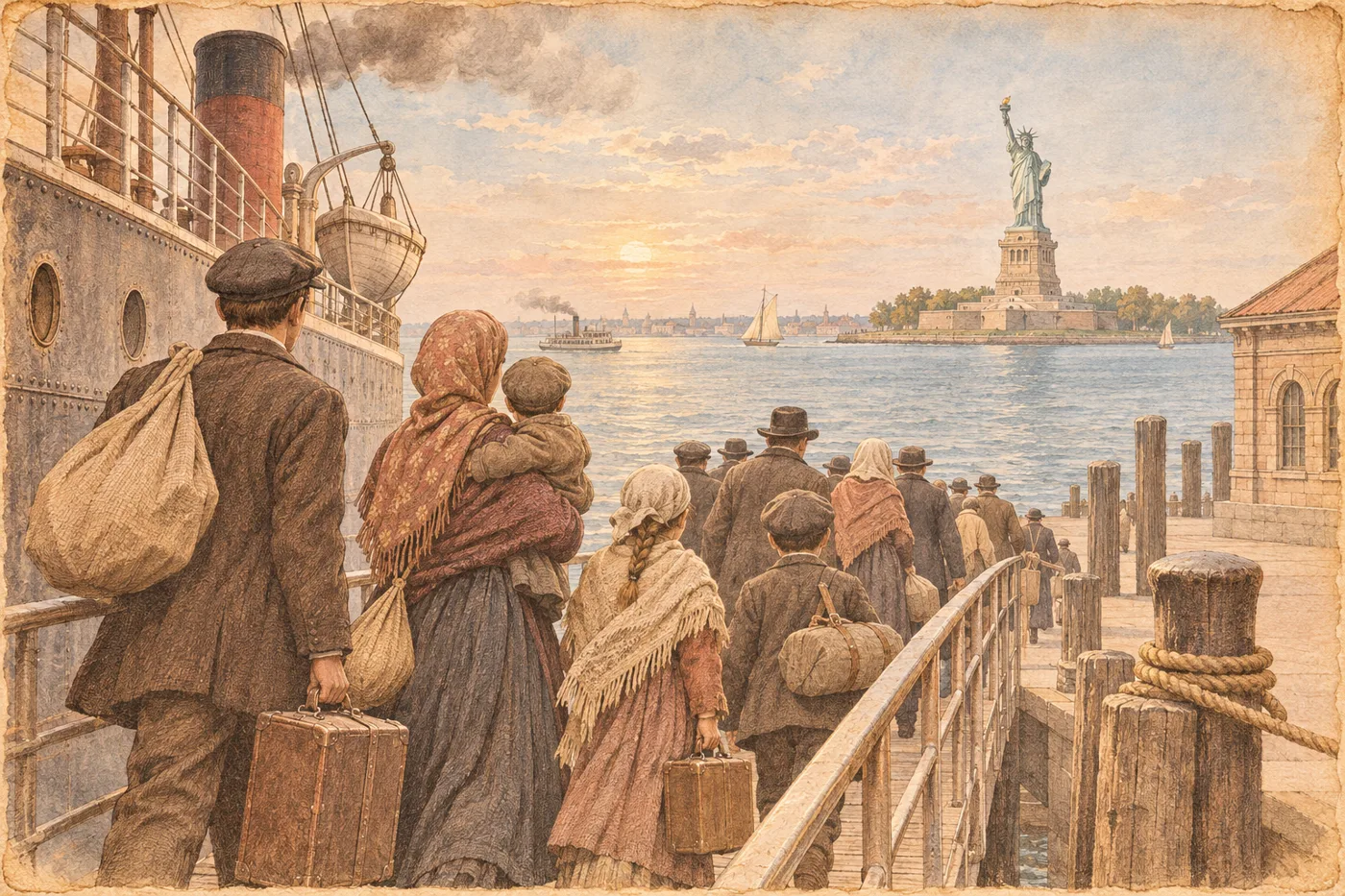
It was immigrants who powered those factories. From the 1880s through the 1920s, some twenty-odd million people, mainly from Europe, crossed the ocean—people from Ireland, Italy, Eastern Europe, and Jewish communities. The Ellis Island immigration station in New York, opened in 1892, is said to have received over ten million people in total.
There were also immigrants from Asia. Chinese laborers worked on railroad construction and other projects, but in 1882 a law restricting Chinese immigration was passed. Japanese also came to Hawaii and the West Coast. With the Immigration Act of 1924, immigration from Asia was almost completely prohibited. The 'nation of immigrants' was also a nation that chose whom to welcome and whom to exclude.
For Indigenous peoples, this was a harsh era. The Dawes Act of 1887 divided tribal lands into individual parcels, causing most of the land to be lost. In 1890, at Wounded Knee, many Sioux people were killed. Both in the United States and Canada, assimilation policies were enforced, sending Indigenous children to boarding schools to separate them from their languages and cultures.
In the Spanish-American War of 1898, the United States acquired the Philippines and other territories from Spain, expanding its overseas holdings. In World War I (1914–1918), it entered the war in 1917 and contributed to the victory. The 1920s saw an economic boom and women's suffrage was achieved (1920), but the stock market crash of 1929 triggered a global Great Depression. The New Deal, with active government involvement in the economy, was advanced under F. Roosevelt.
In 1941, the Japanese attack on Pearl Harbor brought the United States into World War II. During the war, the U.S. government forcibly interned about 120,000 people of Japanese descent on the West Coast. Canada also forcibly relocated Japanese Canadians. The war ended in 1945, and the United States entered a new era as the center of the global economy and military power.
Mini timeline
- 1892Ellis Island immigration station opens in New York
- 1898Spanish-American War; the U.S. acquires the Philippines and other territories
- 1913Ford begins assembling cars on the assembly line
- 1929Stock market crash triggers the Great Depression
- 1941Attack on Pearl Harbor; the U.S. enters World War II
People in this chapter
He came as a poor immigrant from Scotland, achieved great success in the steel industry, and later donated generously to libraries and education.
She opened Hull House in Chicago to support immigrants and the poor, and later received the Nobel Peace Prize.
Meanwhile, elsewhere
Connection to Japan
Japanese immigrants worked in agriculture and fishing in Hawaii and North America, building Japanese communities. The Treaty of Portsmouth in 1905 was mediated by the United States. After the outbreak of war in 1941, people of Japanese descent were forcibly interned.
Why it still matters
The Statue of Liberty in New York Harbor, completed in 1886, became a symbol welcoming immigrants. Even today, how to accept immigrants remains a major political issue in the United States and Canada.
Perspectives differ
- Number of immigrants
- Estimates vary depending on how periods are divided and how statistics are counted. The figures in this chapter should be read as approximate.
- Melting pot or salad bowl?
- There are multiple views on how to understand immigrant society: whether people of various backgrounds blend into one (melting pot) or coexist while preserving their own cultures (salad bowl).
- Internment of people of Japanese descent
- In 1988, the U.S. government apologized and provided compensation, stating the internment was unjust. There is also debate on how to evaluate the decision at the time from a security perspective.
- Evaluation of boarding schools
- In Canada, about 150,000 Indigenous children are said to have been forced into boarding schools, and the government formally apologized in 2008. The content of the schools and the extent of harm varied by region and period.
- Causes of the Great Depression
- The stock market crash was one trigger, but multiple factors—such as monetary policy and the structure of the international economy—have been pointed out, and debate among economists continues.
Facts checked (5, verified by AI on the web)
- Confirmed Ellis Island immigration station opened in 1892; over ten million people in total Ellis Island Chronology (NPS)
Opened January 1, 1892. From 1892 to 1954, it received over twelve million people. - Confirmed Spanish-American War in 1898; Treaty of Paris gave the U.S. the Philippines and others Treaty of Paris 1898 (Britannica)
Signed December 10, 1898. Recognized Cuban independence, ceded Guam and Puerto Rico, and transferred the Philippines for $20 million. - Corrected & confirmed Ford began producing cars on the assembly line in 1913 Ford Implements the Moving Assembly Line (Library of Congress)
Introduced in stages in 1913 (Library of Congress cites October 1913). Some sources give full implementation as 1914. The text's '1913' is a rough approximation and consistent. - Confirmed About 120,000 Japanese Americans interned (U.S.) Japanese-American Incarceration During World War II (National Archives)
Approximately 110,000 to 125,000. Executive Order 9066 was issued on February 19, 1942. There was also forced relocation in Canada. - Confirmed Jane Addams opened Hull House and later won the Nobel Peace Prize Jane Addams (Britannica)
Hull House opened in 1889; she won the Nobel Peace Prize in 1931.
Sources
NPS: Ellis Island Chronology
Britannica: Treaty of Paris (1898)
Library of Congress: Ford moving assembly line
National Archives: Japanese-American Incarceration
Britannica: Jane Addams
Jane Addams Hull-House Museum
* AI-drafted and cross-checked; human review is in progress. Status: