Westward Expansion and the Civil War — A Growing Nation, a Divided Country
Why did people of the same country end up fighting each other for four years?
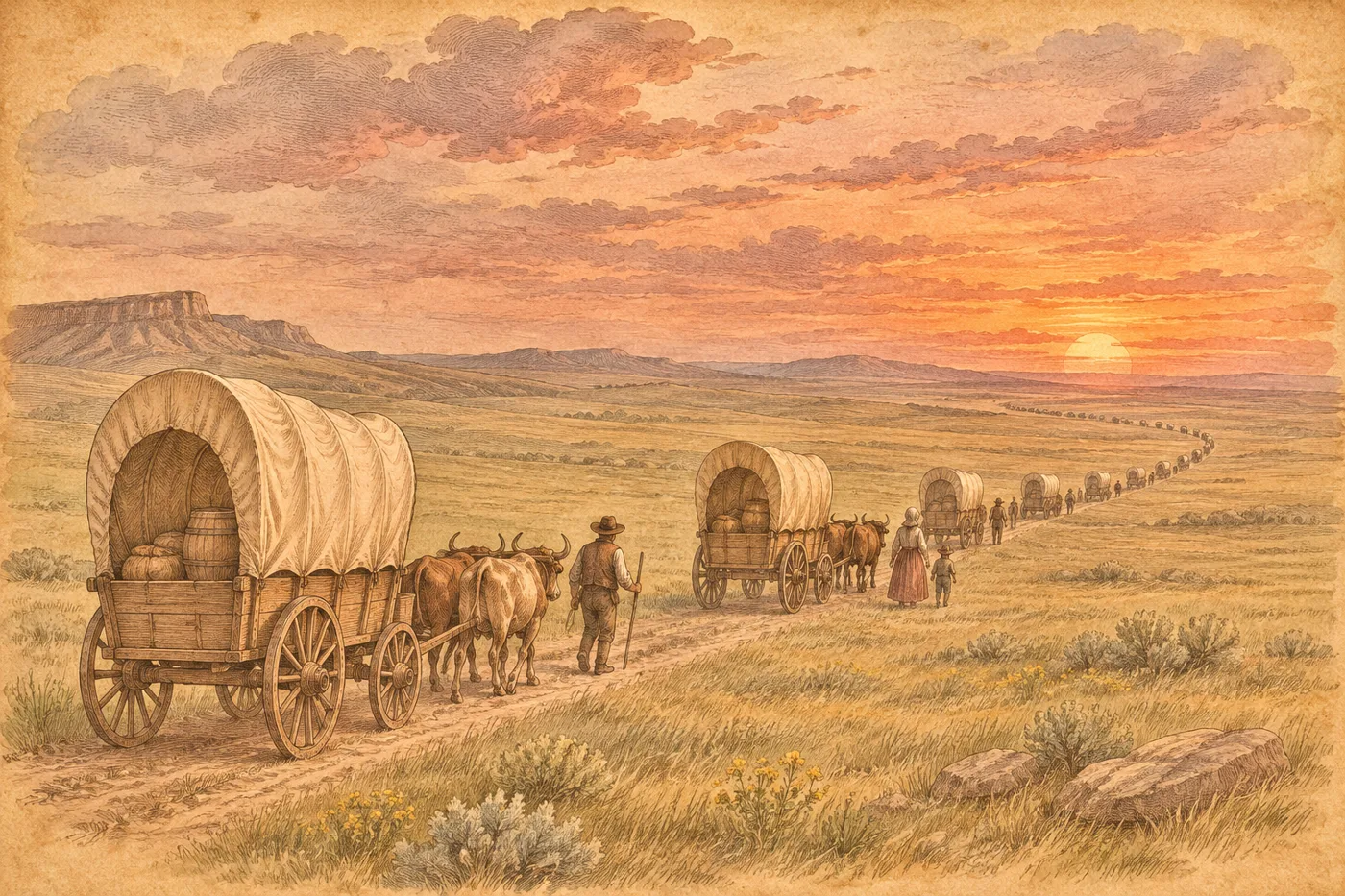
After independence, the United States expanded its territory westward. In 1803, it purchased from Napoleon of France the Louisiana Territory west of the Mississippi River, nearly doubling the size of the country. However, this vast land was originally home to many Native peoples, and what was 'bought' was only the claim from France, not the land itself.
In 1830, the Indian Removal Act was passed, forcing peoples such as the Cherokee in the Southeast to move west of the Mississippi. During the removal of 1838–39, many died from hunger, disease, and cold; it later became known as the 'Trail of Tears.' In the 1840s came the annexation of Texas and the Mexican-American War, and in 1848 the United States acquired a vast territory including California from Mexico. That same year, gold was discovered in California, sparking the Gold Rush.
As the country grew larger, a huge problem emerged: slavery. The North, centered on industry and commerce, had many free states; the South relied on enslaved labor for its cotton plantations. Political conflict deepened over whether new states would be 'slave states' or 'free states.' People like Harriet Tubman helped guide runaways north, and even to Canada, via the 'Underground Railroad.'
In 1860, when Abraham Lincoln, who opposed the expansion of slavery, was elected president, Southern states seceded one after another and formed the 'Confederate States of America.' In April 1861, the Civil War began with the shelling of Fort Sumter. The war lasted four years, with major battles such as Gettysburg (1863).
In 1863, Lincoln issued the Emancipation Proclamation, adding the abolition of slavery to the war's goals. Roughly 180,000 to 200,000 Black soldiers, many of them formerly enslaved, fought for the Union. In 1865, the South surrendered, and the Constitution was amended to abolish slavery. However, the war dead numbered about 620,000, with recent estimates at over 750,000, and Lincoln was assassinated at the war's end.
During the postwar 'Reconstruction,' citizenship and voting rights were granted to the freed people, and Black legislators emerged. However, in 1877, when federal troops withdrew from the South, many of these rights were taken away again. Meanwhile, in the North, the Transcontinental Railroad was completed in 1869, further advancing westward settlement. At the same time, conflicts with Native peoples and the loss of their lands intensified.
Mini timeline
- 1803Louisiana Purchase nearly doubles the size of the country.
- 1838–39Cherokee 'Trail of Tears'
- 1848Mexican-American War ends; California and other territories acquired.
- 1861Civil War begins.
- 1865South surrenders; slavery is abolished by constitutional amendment.
People in this chapter
He led the Union through the Civil War and issued the Emancipation Proclamation. He was assassinated at the war's end.
After escaping slavery, he advocated for abolition through speeches and newspapers, and advised Lincoln.
Meanwhile, elsewhere
Connection to Japan
In 1853, Perry arrived at Uraga, and Japan moved toward opening its borders. In 1860, a shogunate mission visited the United States. It is said that surplus guns left over from the Civil War were imported to Japan at the end of the Edo period.
Why it still matters
How to handle Confederate flags and statues is still debated in the United States today. In Canada, descendants of people who arrived via the Underground Railroad live there, and in 1867 Canada became a dominion and formed a federation.
Perspectives differ
- Causes of the Civil War
- Today, the mainstream view centers on the issue of slavery, but arguments emphasizing 'states' rights' or economic differences were once widely discussed. Which is emphasized changes how the war is remembered.
- Meaning of the Emancipation Proclamation
- The proclamation targeted only slaves in the rebellious areas during the war and did not free all slaves immediately. There are views that see it as a groundbreaking declaration that changed the war's purpose, and others that emphasize its military aspect.
- Number of war dead
- Long thought to be about 620,000, but recent research suggests around 750,000 or more.
- Casualties on the 'Trail of Tears'
- The number who died is estimated at several thousand, but figures vary depending on the source. Today, many regard the forced removal itself as 'unjust.'
- The term 'Purchase'
- The Louisiana Purchase did not buy Native land from the Native peoples. There are also calls to reconsider the term 'purchase' itself.
Facts checked (5, verified by AI on the web)
- Confirmed The Louisiana Purchase of 1803 nearly doubled the size of the country. Louisiana Purchase (Britannica)
About 828,000 square miles for $15 million. The treaty is dated April 30 (the signing is sometimes given as May 2). - Confirmed The Cherokee 'Trail of Tears' of 1838–39 resulted in thousands of deaths. Indian Treaties (Office of the Historian)
Of about 15,000–16,000 people, some 3,000–4,000 are thought to have died. Consistent with the text's 'thousands'. - Confirmed In 1848, the Mexican-American War ended, and California among other territories was acquired. Treaty of Guadalupe Hidalgo (Britannica: Manifest Destiny timeline)
The Treaty of Guadalupe Hidalgo was signed on February 2, 1848. Mexico lost about 55% of its territory. - Corrected & confirmed The Civil War death toll was long thought to be about 620,000, but some estimates now put it at over 750,000. Civil War Casualties (American Battlefield Trust)
The NPS puts it at 'at least 750,000.' Text: 'about 620,000, with recent estimates at over 750,000'. - Confirmed Slavery was abolished by constitutional amendment in 1865 (13th Amendment). National Archives: 13th Amendment to the U.S. Constitution: Abolition of Slavery
Confirmed by text: The 13th Amendment was passed by Congress on January 31, 1865, and ratified on December 6, 1865. It prohibits slavery (except as punishment for a crime).
Sources
Britannica: Louisiana Purchase
Office of the Historian: Indian Treaties
Britannica: Manifest Destiny timeline
American Battlefield Trust: Civil War Casualties
NPS: Death and Dying
National Archives: 13th Amendment to the U.S. Constitution: Abolition of Slavery
* AI-drafted and cross-checked; human review is in progress. Status: