The Yellow River and the Yangtze: Two Farming Worlds
Why did Chinese civilization begin along two great rivers?
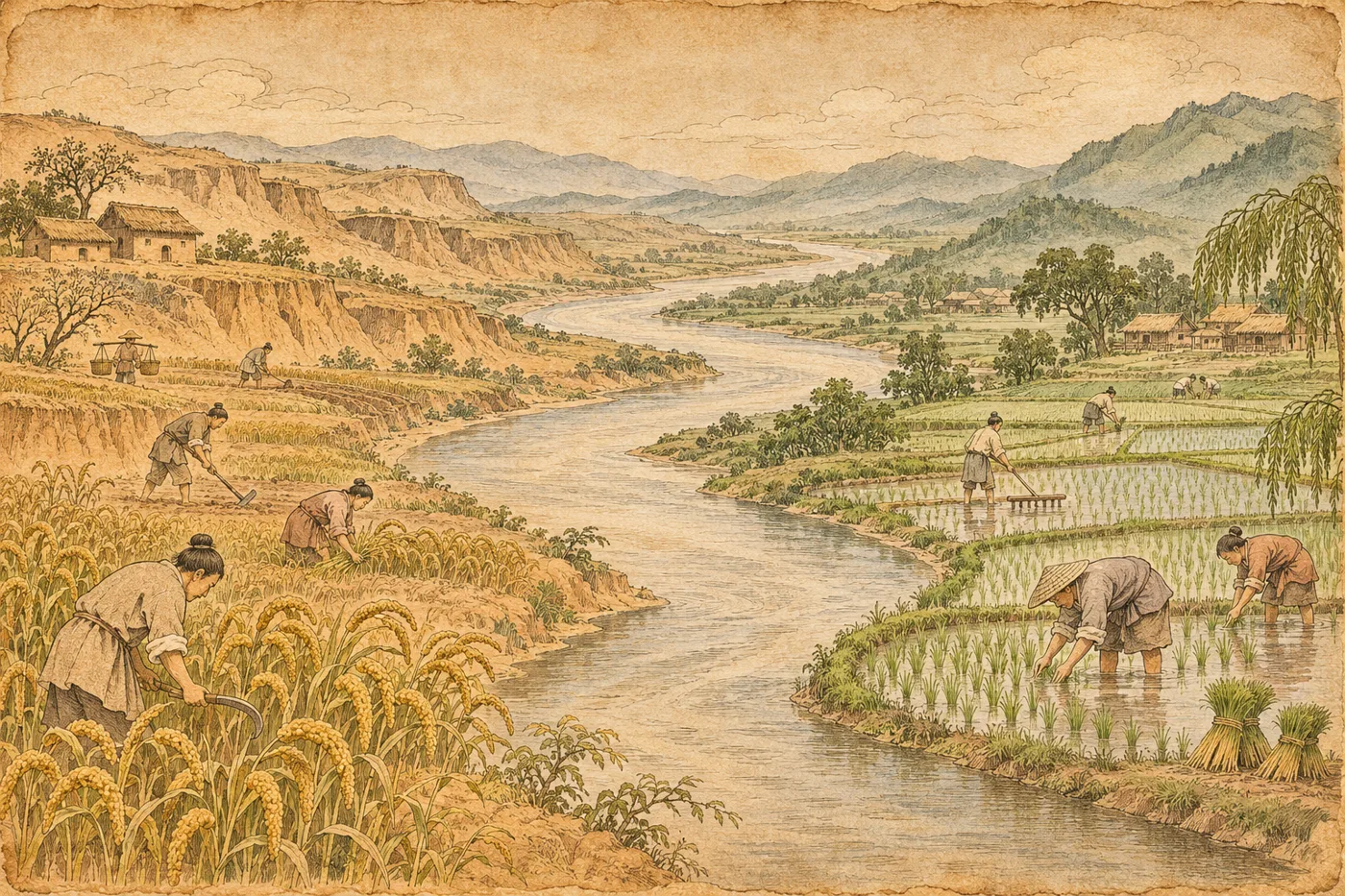
In East Asia, two great rivers flow eastward: the Yellow River in the north and the Yangtze in the south. The Yellow River carries fine soil from the Loess Plateau, turning its water yellow. This soil is soft and easy to farm, and people there began growing millet and foxtail millet. By about 7000 years ago, villages had formed in the Yellow River basin (known as the Yangshao culture and others).
The southern Yangtze basin, meanwhile, is warm and rich in water. Here, rice was cultivated. At the Hemudu site in Zhejiang Province, rice grains and wooden tools from around 7000 years ago have been found. In the north, dry fields; in the south, paddy fields. Even within the same China, lifestyles were very different.
Great rivers brought both blessings and disasters. The Yellow River often flooded and sometimes changed course. 'Flood control' has been a major task for leaders since ancient times. Legend says a man named Yu spent 13 years taming the floods and was chosen as king. Those who controlled the rivers united the people—a system of power grew from this.
In the lower Yangtze, the Liangzhu culture flourished from around 3300 BC. Large-scale water facilities and city-like ruins have been found, along with many ritual objects made of jade. This suggests a society with the skill to work jade and the power to mobilize people.
In the Yellow River basin, around the 16th century BC, a dynasty called Yin (which the people of the time called Shang) is said to have emerged. The Yin people, especially in the later period (from about 1200 BC), heated turtle shells and ox bones, then asked the gods about the future based on the cracks. They carved the questions and answers on the bones. This is oracle bone script, the ancestor of the Chinese characters used today.
Eventually, around the 11th century BC, the Zhou, who came from the west, overthrew the Yin. Advanced bronze-working technology and government using writing—the world nurtured by two rivers became the foundation of a long history, later leading to unified dynasties like Qin and Han.
Mini timeline
- 5000 BC or soFarming villages spread in the Yellow River basin; rice cultivation begins in the Yangtze basin
- 3300 BC or soLiangzhu culture flourishes in the lower Yangtze
- 16th century BC or soYin (Shang) is said to have emerged (oracle bone script from about 1200 BC)
- 11th century BC or soZhou overthrows Yin
People in this chapter
He is said to have become king after taming the floods. Whether he actually existed is unknown.
A Yin king whose name appears frequently in oracle bone inscriptions, confirming his historical existence.
Meanwhile, elsewhere
Connection to Japan
The Japanese archipelago was in the Jōmon period. Rice cultivation would reach Japan later (around 10th–4th centuries BC, with varying theories on the exact timing).
Why it still matters
Even today, northern China is said to center on wheat (noodles and dumplings) and southern China on rice. The ancient difference between 'dry fields' and 'paddy fields' lives on in food culture. Chinese characters are still used in Japan today.
Perspectives differ
- Did the Xia dynasty really exist?
- Legend says a dynasty called Xia existed before Yin. Some link the Erlitou site in Henan Province to Xia, but there are no contemporary written records, so it remains unconfirmed.
- Not just 'Yellow River civilization'
- It was once explained that Chinese civilization spread from the Yellow River basin. Now, a 'pluralistic' view, where civilization grew in multiple regions including the Yangtze basin, is dominant.
- Dates of Yin and Zhou
- The start of Yin and the year Zhou overthrew Yin vary by decades to over a century among researchers. The dates in this chapter are approximate.
- Was Liangzhu a 'state'?
- Some see strong authority from the large ruins, but whether it qualifies as a state is debated.
Facts checked (5, verified by AI on the web)
- Confirmed Traces of rice cultivation around 7000 years ago at the Hemudu site Hemudu Cultural Site Museum(China Daily)
Some researchers argue that the Hemudu people were not necessarily the first to cultivate rice - Confirmed The Yangshao culture in the Yellow River basin, c. 5000–3000 BC, with millet farming Britannica: Yangshao culture
- Confirmed The Liangzhu site from around 3300 BC (World Heritage listing targets the initial period c. 3300–3100 BC) UNESCO World Heritage Committee decision: Archaeological Ruins of Liangzhu City
- Corrected & confirmed Oracle bone script in the later Yin period (from about 1200 BC, reign of Wu Ding). Zhou's overthrow of Yin around the 11th century BC (c. 1046 BC is a leading theory) Columbia University, Asia for Educators: Oracle-Bone Inscriptions of the Late Shang Dynasty
Columbia University materials state that existing oracle bones date from the reign of Wu Ding (1198–1189 BC) and his successors, and that Chinese written history begins with these oracle bones around 1200 BC. The Yin period is roughly 1554 BC–1045/40 BC. The year of Zhou's overthrow (1046 BC theory) is not written on that page. - Confirmed The story of Yu spending 13 years on flood control World History Encyclopedia: Xia Dynasty(事典)
Encyclopedias state that Yu's flood control is said to have lasted 13 years, and that the academic consensus is that most of Xia's history is mythological (the text says 'legend says,' which is consistent).
Sources
Britannica: Yangshao culture
UNESCO World Heritage Committee decision: Liangzhu
Hemudu Cultural Site Museum(China Daily)
Columbia University, Asia for Educators: Oracle-Bone Inscriptions of the Late Shang Dynasty
高校世界史の教科書・用語集
World History Encyclopedia: Xia Dynasty(事典)
* AI-drafted and cross-checked; human review is in progress. Status: