Polynesian Voyaging — Crossing the Pacific by Stars and Waves
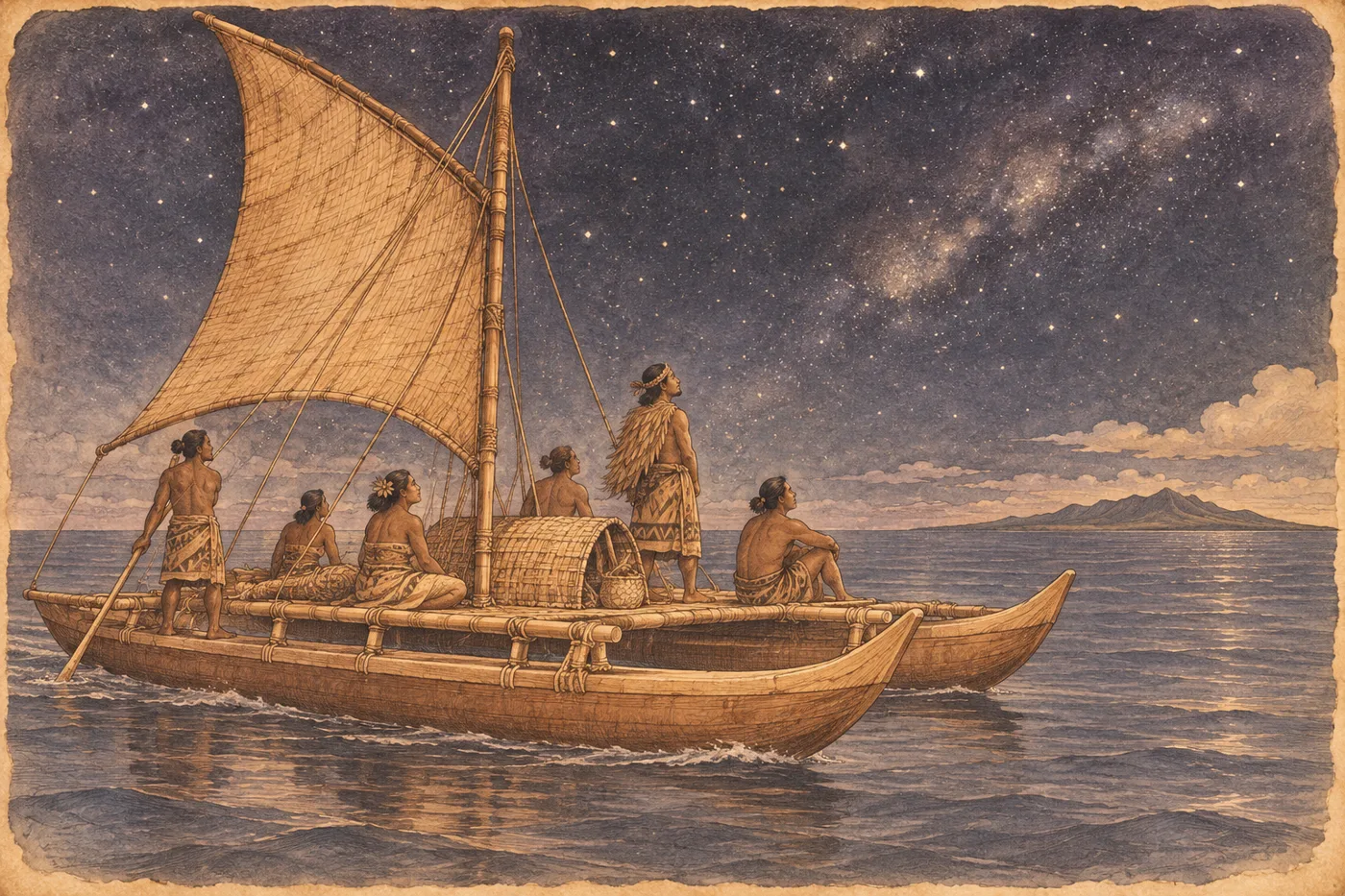
Why did people paddle out into the vast ocean, with no land in sight?
The Pacific Ocean is an immense sea, covering about one-third of the Earth's surface. Scattered across it are tiny islands like dots. When and how did people reach these islands? The answer is one of the most dramatic voyaging stories in world history.
The starting point is thought to be the islands of Southeast Asia and the area near New Guinea. Around 1500 BC, people known as the 'Lapita' spread eastward from places such as the Bismarck Archipelago, bringing pottery with distinctive patterns. They eventually reached Fiji, Tonga, and Samoa, arriving at the western gateway to Polynesia around 1000 BC.
After a long pause, voyaging became active again. People spread from the Society Islands (including Tahiti) further east, north, and south. They reached Hawaii, Easter Island (Rapa Nui), and, around the 13th century, New Zealand (Aotearoa). The triangle connecting these three points is called the 'Polynesian Triangle.'
They had no maps or compasses. Instead, they memorized the rising and setting positions of stars, the direction of ocean swells, cloud shapes, and the flight paths of birds. Their vessels were large 'double canoes' with two hulls lashed together. They loaded people, along with plants like taro, breadfruit, and coconut palms, and livestock such as pigs, chickens, and dogs (the cargo varied by island and climate), carrying the makings of a new life to each island.
This navigation knowledge is still passed down today. In 1976, the traditional Hawaiian canoe Hōkūleʻa sailed from Hawaii to Tahiti without using any instruments. At the helm was Mau Piailug, a navigator from the Micronesian island of Satawal. He proved that ancient people truly voyaged intentionally.
The languages of the Polynesian islands, though far apart, are very similar. This tells us that their ancestors were fellow travelers of the same sea. This voyage was a grand adventure, the last great expansion of human settlement in our long history. In the next chapter, European ships arrive in this ocean.
Mini timeline
- around 1500 BCLapita people begin spreading eastward
- around 1000 BCReach Tonga and Samoa
- from around the 11th–13th centuriesSpread to East Polynesia, including Hawaii and Easter Island (dates debated)
- around 13th centuryReach New Zealand
- 1976Hōkūleʻa sails from Hawaii to Tahiti without instruments
People in this chapter
He inherited the art of navigating by stars and waves and guided the Hōkūleʻa in 1976. Later, he passed on his skills to younger generations in Hawaii.
He is said to have fished up islands from the sea and is celebrated in stories across various islands. The tales differ slightly from island to island.
Meanwhile, elsewhere
Connection to Japan
Around 1500 BC, Japan was in the late Jōmon period. When Polynesians reached New Zealand around the 13th century, Japan was in the Kamakura period.
Why it still matters
In Hawaii, there is a growing movement to relearn the Hawaiian language, hula, and traditional navigation. The Hōkūleʻa completed a circumnavigation of the globe from 2014 to 2017. In New Zealand, Māori is one of the official languages.
Perspectives differ
- Timing of arrival in East Polynesia
- Estimates for reaching Hawaii and Easter Island range from 'around 800–1000 AD' to 'around 1200 AD', varying by study. Revisions of radiocarbon dating have produced new theories. For New Zealand, the 13th-century date is relatively well agreed upon.
- Intentional voyaging or drifting
- The theory that people 'drifted and arrived by accident' once existed, but the prevailing view today is that these were planned voyages guided by the stars and waves. The Hōkūleʻa voyage helped support this.
- Origins of the Lapita
- Whether the Lapita came from the islands of Southeast Asia or emerged near New Guinea is an ongoing debate in both archaeology and genetics.
- The 'collapse' narrative of Easter Island
- The story that 'society collapsed from overusing resources' is famous, but some studies place heavy emphasis on the impact of introduced rats or later contact with Europeans, so views remain divided.
- Contact with South America
- It is widely accepted that the sweet potato was introduced to Polynesia from South America. However, the route—whether Polynesians went to South America or South Americans came to Polynesia—is debated.
Facts checked (4, verified by AI on the web)
- Confirmed Lapita culture: c. 1600–500 BC. By around 2000 BC to the Bismarck Archipelago, by around 1000 BC to West Polynesia Britannica: Lapita culture
The text's 'around 1500 BC' is an acceptable approximation for the expansion - Confirmed Arrival in Tonga and Samoa around 1000 BC Britannica: History of Samoa
- Corrected & confirmed Arrival in East Polynesia (Hawaii, Easter Island, New Zealand) mainly 11th–13th centuries Wilmshurst et al. 2011(PNAS)高精度放射性炭素年代
Text revised: 'around 1000 AD–' changed to 'around 11th–13th centuries', New Zealand to 'around 13th century'. Estimates: Hawaii 1219–1266, Easter Island 1200–1253, New Zealand 1230–1282 - Confirmed Hōkūleʻa sailed from Hawaii to Tahiti in 1976. Navigator was Mau Piailug Polynesian Voyaging Society: 50th Anniversary of Hōkūleʻa's 1976 Maiden Voyage
Departed Hawaii on May 1, 1976; navigator Mau Piailug from Satawal Island. Arrived at Pape'ete, Tahiti on June 4 (docked at Mataiva Island on June 1). Arrival date varies between June 3 and 4 in sources. Mau Piailug's birth and death dates unconfirmed
Sources
Britannica: Lapita culture
Britannica: History of Samoa
Wilmshurst et al. 2011, PNAS
Polynesian Voyaging Society: 50th Anniversary of Hōkūleʻa's 1976 Maiden Voyage
高校世界史の教科書・用語集
* AI-drafted and cross-checked; human review is in progress. Status: