Aboriginal 60,000 Years — One of the World's Longest Continuing Cultures
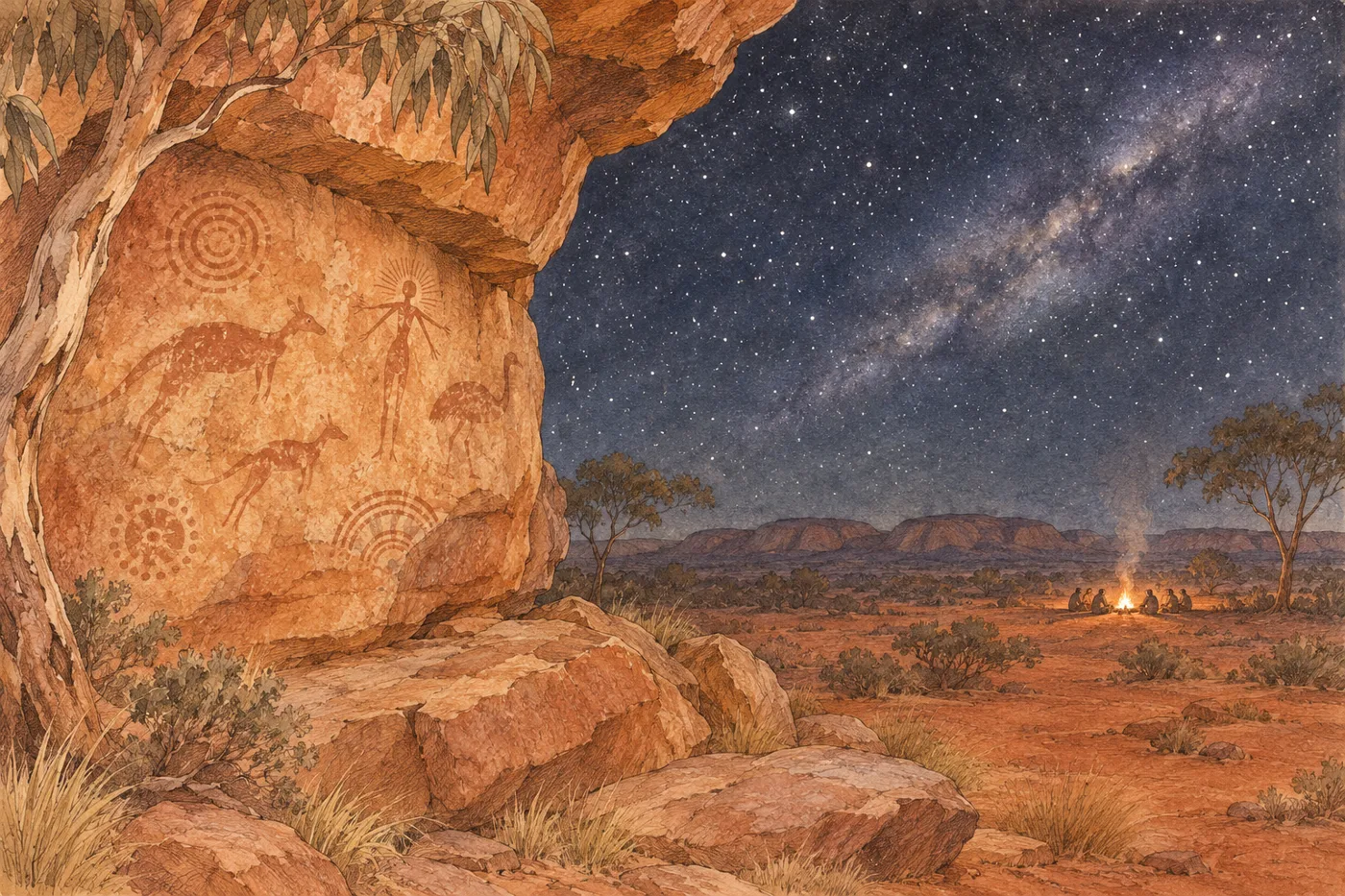
Why has Aboriginal culture lasted for 60,000 years?
Long before the Polynesian people spread across the Pacific islands, another continent was already inhabited: Australia. One study suggests people first arrived about 65,000 years ago (though other theories say 40,000 to 50,000 years ago). At that time, sea levels were lower, and Australia, New Guinea, and Tasmania were connected as one landmass, yet people still had to cross the sea for the final leg of their journey.
Australia's Indigenous peoples are collectively referred to as Aboriginal people and Torres Strait Islanders. Around the time of European arrival in 1788, there are thought to have been about 250 languages. Population estimates range from several hundred thousand to about one million. People lived deeply connected to the land and water.
They not only hunted and gathered but also carefully managed the land, such as by using fire to deliberately burn grasslands, encouraging new growth to attract animals. Some stone fish traps still remain today. Stone axes and red ochre were traded over long distances.
Their worldview includes the concept of the "Dreaming" (often translated into Japanese as Yume no Jidai, or the "Age of Dreams"). Ancestral beings walked the land, creating mountains, rivers, and living things. These stories are passed down through song, dance, and painting. Songlines, or paths of song, are like musical maps that convey travel routes and the locations of waterholes.
Some rock art is said to date back tens of thousands of years, making it among the oldest art in the world. One study suggests that when sea levels rose and islands formed about 10,000 years ago, the event may have been passed down in oral traditions. This preservation of memories over thousands of years is a great treasure of human culture.
In 1606, a Dutch ship reached northern Australia, leaving the first recorded European landing on the continent. Several other ships visited the coast afterward. Then, in 1770 and 1788, events changed dramatically. This story continues in the next chapter.
Mini timeline
- about 65,000 years agoPeople are thought to have arrived in Australia (multiple theories)
- about 10,000 years agoSea levels rose, separating New Guinea and Tasmania, forming coastlines closer to today's
- from tens of thousands of years agoRock art is thought to have begun
- 1606Dutch ship recorded landing
- 1788British fleet arrived, settlement began
People in this chapter
He took legal action to claim rights to his people's land, leading to the Mabo decision in 1992, after his death, which recognized Indigenous land rights.
From the Arrernte people. His watercolor paintings of the landscape gained international recognition.
Meanwhile, elsewhere
Connection to Japan
People are thought to have begun living in the Japanese archipelago around 38,000 years ago or later. Some research suggests that people may have reached Australia earlier than that.
Why it still matters
Since October 2019, climbing on the sacred site of Uluru (Ayers Rock) has been banned. This was in response to the wishes of the Indigenous Anangu people. Uluru is registered as a World Heritage Site (mixed natural and cultural heritage).
Perspectives differ
- Earliest arrival date
- Based on studies of the Madjedbebe site, there is a theory of about 65,000 years ago and another of about 40,000 to 50,000 years ago, with debate continuing among researchers.
- Population estimates
- Population estimates for 1788 range from 300,000 to over 1 million, and are not settled.
- Term 'Dreamtime'
- The translation 'Dreamtime' was given by outsiders; each local language has its own term. It cannot be summarized as a single religion.
- Extinction of large animals
- Regarding the cause of extinction of large animals such as giant kangaroos, there are theories citing human influence and climate change, with no conclusion.
Facts checked (4, verified by AI on the web)
- Views differ Some research suggests people reached Australia around 65,000 years ago, but there is also a theory of about 50,000 years ago Cosmos: First Australians arrived 65,000 years ago
Both views are included in the main text and debates. In 2025, a DNA study supporting about 50,000 years ago was published. - Confirmed About 250 languages at the time of European arrival AIATSIS: National Indigenous Languages Survey
Britannica says 200–300 languages. - Corrected & confirmed Population estimates range from several hundred thousand to about one million Britannica Students: Australian Aboriginal peoples
Text revised: 'over one million' changed to 'about one million' (estimates range 250,000 to 1 million). - Confirmed A Dutch ship (Janszoon) reached northern Australia in 1606 National Museum of Australia: Janszoon maps northern Australian coast
There is a theory that Portuguese arrived earlier, but it is not confirmed.
Sources
Cosmos: First Australians arrived 65,000 years ago
AIATSIS: National Indigenous Languages Survey
Britannica Students: Australian Aboriginal peoples
NMA: Janszoon maps northern Australian coast
(no direct source confirmed)
* AI-drafted and cross-checked; human review is in progress. Status: