Cook's Arrival: The Land That Was 'Discovered' and the People Who Welcomed Him
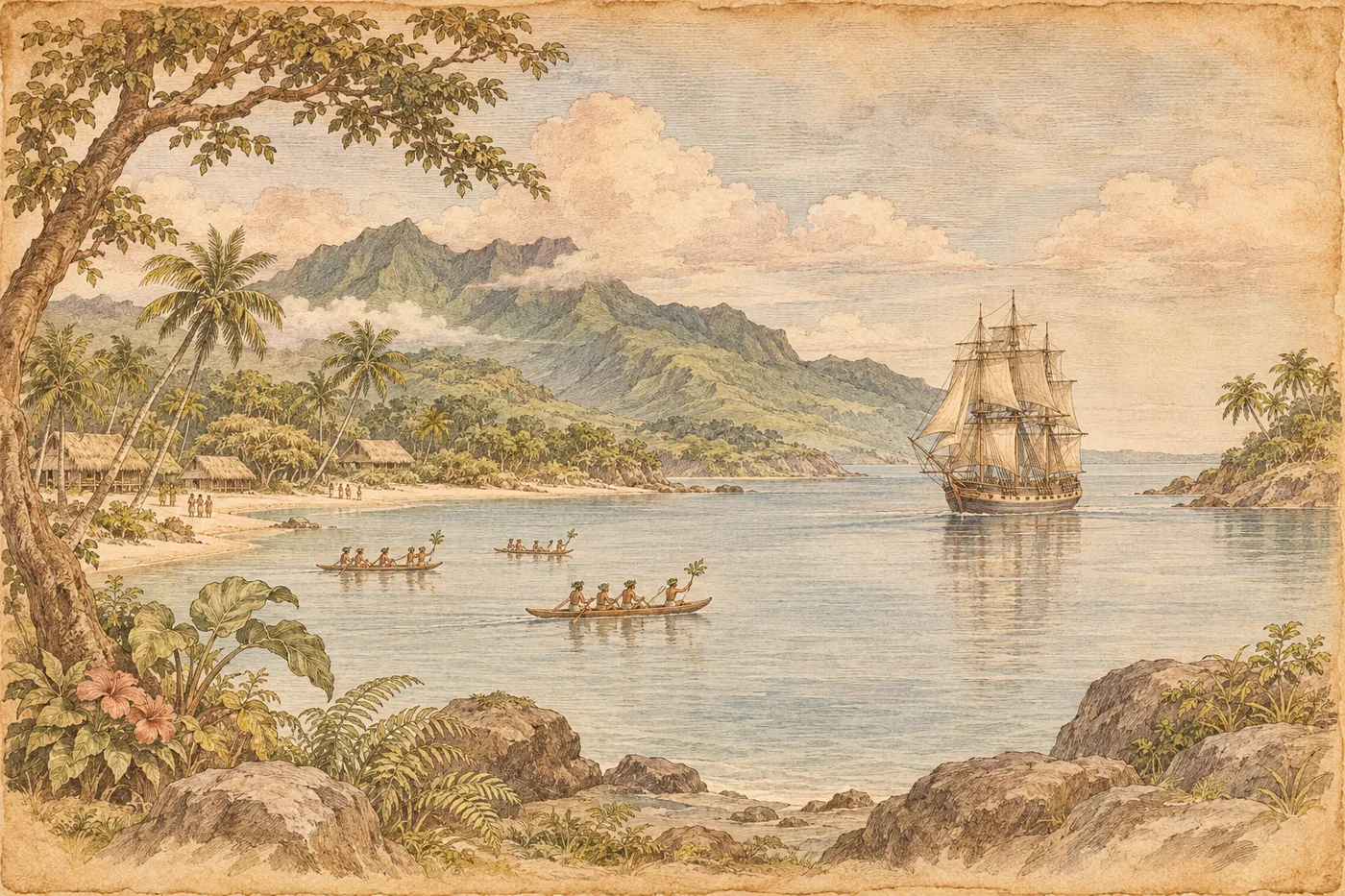
For whom was it a 'discovery'?
In the 17th century, Dutch ships reached the northern and western coasts of Australia. In 1642, Tasman reached the island later called Tasmania and the coast of New Zealand. But Europeans still did not know much about what this 'southern continent' was like.
In the 18th century, science became a major goal of voyages. In 1768, British Navy captain James Cook set out on the Endeavour to observe the transit of Venus across the Sun. After completing the observation in Tahiti in 1769, the ship headed south and charted the coast of New Zealand. On board was botanist Joseph Banks.
An important role was played by Tupaia, a Tahitian navigator and priest. He sailed with Cook and is said to have been surprised that he could speak in his own language with the people of New Zealand. It was evidence that the Polynesian islands were connected by the same language.
In April 1770, Cook's ship reached the east coast of Australia. The bay where they landed was later called 'Botany Bay' because of the many plant species. After that, they sailed north and claimed the land for Britain. But people had already been living there for tens of thousands of years.
Cook made two more Pacific voyages. He approached the Antarctic Circle and also reached the Hawaiian Islands. In 1779, on the Big Island of Hawaii, he lost his life in a conflict with local people. Cook's voyages greatly redrew the map of Europe and, at the same time, marked a starting point that dramatically changed the lives of the people of the Pacific islands.
In 1776 the American colonies declared independence, and Britain could no longer send convicts to America, as it had until then. So Britain turned its attention to the east coast of Australia, which Cook had reported on. It is also pointed out that the word 'discovery' lacks the perspective that 'this was someone's home.'
Mini timeline
- 1606A Dutch ship is recorded as landing in Australia
- 1642Tasman reaches Tasmania and New Zealand
- 1769Cook explores the coast of New Zealand
- 1770Cook reaches the east coast of Australia
- 1779Cook dies in Hawaii
People in this chapter
He charted vast areas of the Pacific on three voyages.
He accompanied Cook's voyage and shared knowledge of the Pacific islands.
Meanwhile, elsewhere
Connection to Japan
Japan was in the mid-Edo period, under the so-called 'national seclusion,' trading with the Dutch and Chinese at Nagasaki (other contact points existed at Tsushima, Satsuma, and Matsumae).
Why it still matters
Cook's name remains in many place names in Australia, New Zealand, and Hawaii. In recent years, alongside his achievements, the history seen from the perspective of indigenous peoples has also been told.
Perspectives differ
- The word 'discovery'
- Calling land where people already lived a 'discovery' has been criticized. Some researchers use the phrase 'first contact by Europeans' instead.
- Cook's death
- The circumstances of his death in Hawaii in 1779 are described differently in British records and Hawaiian oral traditions.
- The concept of 'terra nullius'
- Europeans regarded indigenous land as 'nobody's land' (terra nullius), but this idea was rejected in Australian law by the Mabo decision in 1992.
- Claims of earlier arrivals
- There are theories that Chinese fleets or the Portuguese came earlier, but reliable evidence is said to be insufficient.
Facts checked (4, verified by AI on the web)
- Confirmed Tasman reached Tasmania (Van Diemen's Land) and New Zealand in 1642 Britannica Students: Abel Tasman
- Confirmed Cook departed in 1768 to observe Venus, reached Tahiti and New Zealand in 1769, and the east coast of Australia in 1770 National Museum of Australia: The early voyage (Endeavour)
- Confirmed Tupaia accompanied the voyage as interpreter and mediator, and died of illness in Batavia in 1770 Britannica Students: Tupaia
Date of death unconfirmed in this search - Confirmed Cook died in Hawaii in 1779 Royal Museums Greenwich: The Death of Captain James Cook, 14 February 1779
The UK National Maritime Museum records that Cook died at Kealakekua Bay, Hawaii, on 14 February 1779.
Sources
Britannica Students: Abel Tasman
National Museum of Australia: Endeavour voyage
Britannica Students: Tupaia
高校世界史の教科書・用語集
Royal Museums Greenwich: The Death of Captain James Cook, 14 February 1779
* AI-drafted and cross-checked; human review is in progress. Status: