The Indus Civilization — Planned Cities
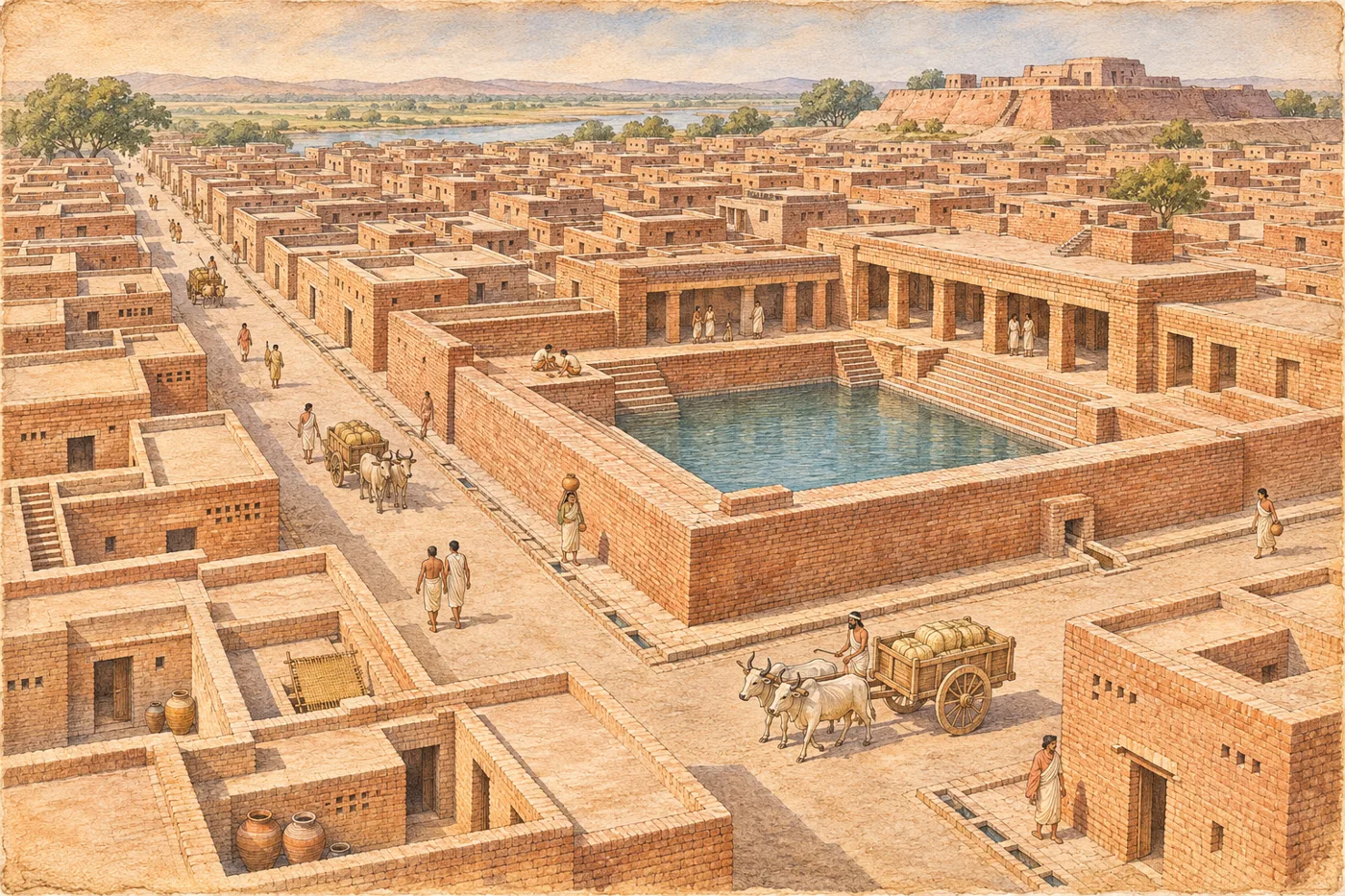
Why, over 4,000 years ago, were cities with roads and sewers built?
The Indus River gathers meltwater from the Himalayas and Tibet, flowing north to south through modern-day Pakistan. From around 2600 BC, large cities appeared in this river basin, extending into present-day northwestern and western India. This is the Indus civilization. Its extent is thought to have far surpassed that of the contemporary Mesopotamian or Egyptian civilizations.
Representative cities are Mohenjo-Daro and Harappa. The cities were neatly divided by streets that intersected at right angles. Buildings were made of uniformly sized fired bricks, and houses had wells and bathrooms; wastewater flowed into drains beneath the roads. Over 4,000 years ago, there were cities that considered urban hygiene to this degree.
At Mohenjo-Daro, a large water tank called the 'Great Bath' has also been found. It is thought to have been used for rituals. Meanwhile, the massive royal tombs, palaces, and unmistakable weapons common in other ancient civilizations have scarcely been found.
The people actively traded with distant lands. Stone weights were standardized, apparently used for measuring goods. Square stone 'seals' were engraved with animal motifs and mysterious script. The 'Meluhha' appearing in Mesopotamian records is thought to refer to the Indus region, and it seems that gemstones and timber were transported across the sea.
However, from around 1900 BC, the cities gradually declined. It is thought that people left the cities and moved to smaller villages to the east and south. Several theories exist for the cause, including climate drying and changes in river courses.
The world only learned of this civilization about a hundred years ago. When Harappa and Mohenjo-Daro were excavated in the 1920s, the world realized for the first time that there was a civilization as ancient as Mesopotamia and Egypt (though the ruins themselves had been known since the 19th century). The script remains undeciphered, and what the people were saying is still a mystery.
Mini timeline
- Around 2600 BCCities begin to appear in the Indus River basin
- Around 2300 BCTrade with Mesopotamia (Meluhha) flourishes
- Around 1900 BCCities begin to decline
- 1921–22Excavations of Harappa and Mohenjo-Daro begin
People in this chapter
As Director-General of the Archaeological Survey of India, he announced the discovery of the Indus civilization in 1924. On-site excavations were carried out by Sahni and Banerji, among others.
A statue of a bearded man. Whether he is a king or a priest is unknown; 'Priest-King' is a later name.
Meanwhile, elsewhere
Connection to Japan
The Japanese archipelago was in the Jōmon period. While the people of the Indus civilization lived in well-ordered cities, in Japan life still centered on pottery-making, hunting, and gathering.
Why it still matters
Mohenjo-Daro was registered as a UNESCO World Heritage site in 1980. Preservation efforts continue to protect the ruins from rising river levels and salt damage. The city-planning wisdom still resonates with modern cities.
Perspectives differ
- Can the script be read?
- There are said to be about 400 types of symbols, but they remain undeciphered. Some argue they are not a script but mere symbols.
- Cause of decline
- There are many theories: aridification, river course changes, floods, decline in trade, etc. No decisive cause has been established.
- The 'Aryan invasion' theory
- It was once explained that the civilization was destroyed by outsiders, but today this view is largely rejected due to lack of evidence.
- Was there a ruler?
- Since royal tombs and palaces are inconspicuous, some see it as an egalitarian society, while others argue there was strong rule in a less visible form.
- Dates
- The start and end dates of the civilization vary by researcher, with a range of several centuries.
Facts checked (5, verified by AI on the web)
- Confirmed Peak period around 2600–1900 BC World History Encyclopedia: Indus Valley Civilization
WHE gives the mature period as around 2800–1900 BC in the text and around 2600–1900 BC in map notes. Start dates vary among sources. Some views place the decline around 2000–1750 BC (Britannica). - Confirmed Cause of decline is multiple theories including climate drying and river changes Britannica: India — The end of the Indus civilization
Explicitly stated that 'there is no consensus on the cause.' Consistent with the text's phrasing. - Corrected & confirmed Marshall as Director-General of the Archaeological Survey of India announced the discovery of the Indus civilization in 1924. Harappa was excavated from 1921, Mohenjo-Daro from 1922 Royal Asiatic Society: The discovery of the Indus Civilisation
Confirmed from the Royal Asiatic Society page that Marshall as Director-General announced the Indus civilization on September 20, 1924; local excavations were carried out by Sahni at Harappa from 1921 and by Banerji et al. at Mohenjo-Daro from 1922. Not stated that Marshall himself directed excavations, so text corrected. - Confirmed Meluhha is equated with the Indus region Levitt, Meluhha(journal.fi)
Common theory, but there are also theories placing it elsewhere; written in a non-assertive manner for consistency. - Confirmed Purpose of the Great Bath at Mohenjo-Daro (ritual theory) and that the Indus script remains undeciphered Britannica Kids: Mohenjo-daro
The purpose is widely thought to be ritual but not confirmed. The script is undeciphered.
Sources
World History Encyclopedia: Indus Valley Civilization
Britannica: India — The end of the Indus civilization
Royal Asiatic Society: The discovery of the Indus Civilisation
Levitt, Meluhha(journal.fi)
Britannica Kids: Mohenjo-daro
* AI-drafted and cross-checked; human review is in progress. Status: