The Buddha and the Vedas — The Forests and Rivers Where Questions Were Born
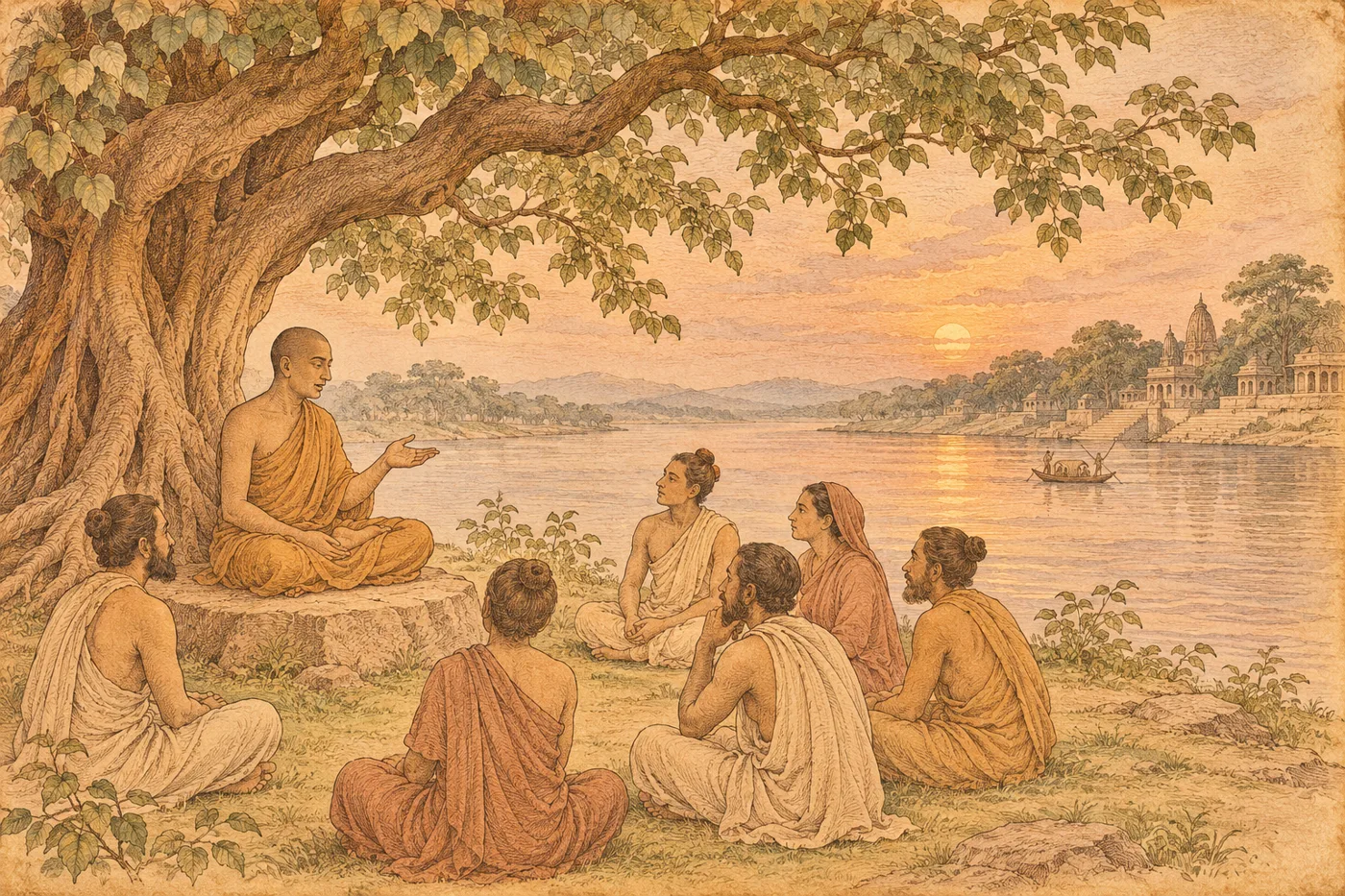
Why did the question, 'How can we become free from suffering?' arise along the banks of the Ganges?
After the decline of the Indus Valley Civilization, it is thought that people who herded cattle and sheep entered northern India from the northwest. The hymns they sang in praise of their gods were collected in the Rig Veda, which is said to have been passed down orally from around 1500 BC. It was transmitted with astonishing accuracy, not in writing, but from mouth to mouth.
In time, the center of population shifted to the Ganges River basin. Rice cultivation spread, and several cities and small kingdoms emerged. Society was divided by a system of social classes called varna, and the power of the priests (Brahmins) who performed rituals grew stronger.
Amid this, people began to ask, 'Is ritual enough?' and 'What happens to a person after death?' The Upanishads, the final part of the Vedas, taught that the ultimate source of the universe (Brahman) and one's true self (Atman) are one. The idea of samsara—the cycle of rebirth driven by the results of one's actions—also spread during this period.
According to tradition, around the 5th century BC (the date is debated), Siddhartha Gautama (the Buddha) was born as a prince in a small kingdom near present-day Nepal's border. It is said that after encountering old age, sickness, and death, he renounced the world, practiced severe austerities, and attained enlightenment under a bodhi tree. He observed that desire gives rise to suffering and taught a 'Middle Way' that avoids extremes, offering a path to freedom from that suffering.
At roughly the same time, Vardhamana (Mahavira) preached non-violence (ahimsa)—never harming any living being—and Jainism was born. Both Buddhism and Jainism emphasized a person's actions over their birth status, and they were accepted by merchants and kings alike.
After the Buddha's death, his disciples gathered to confirm and compile his teachings. A king would eventually arise who used these teachings as a great force to build a kingdom.
Mini timeline
- c. 1500 BCThe Rig Veda is said to have begun to be passed down orally.
- c. 1000 BCThe center of population shifts to the Ganges River basin.
- c. 800–500 BCThe Upanishads take shape.
- c. 6th century BCThe 'Sixteen Great States' emerge in the Ganges basin.
- c. 5th century BCThe Buddha and Mahavira preach their teachings (dates are debated).
People in this chapter
He left his princely life to seek the cause of suffering and a path to freedom from it.
He preached strict non-violence, and his teachings continue to be followed by Jains today.
Meanwhile, elsewhere
Connection to Japan
Around this time, Japan was transitioning from the Jōmon to the Yayoi period (the exact timing is debated). Buddhism would not reach Japan until about a thousand years later, in the 6th century; the year of its introduction is given as either 538 or 552.
Why it still matters
In India, the Vedas are still chanted today. The roots of yoga and meditation culture are said to trace back to the ascetic traditions of this era. Lumbini, where the Buddha is said to have been born, is a UNESCO World Heritage site.
Perspectives differ
- Dates of the Buddha's birth and death
- The view placing his life around 563–483 BC was once widely used, but another influential view places it around 480–400 BC, leaving a gap of several decades.
- How to interpret the 'Aryan invasion'
- For a long time, the view that Indo-European-speaking peoples entered from the northwest was influential. However, there is also the view that it was not an 'invasion' but a long-term migration and cultural exchange; debates continue over its scale and timing.
- Dating the Vedas
- The period when the Rig Veda was composed ranges from around 1500 BC to 1000 BC. It was written down much later.
- When did the 'caste system' begin?
- The concept of varna has existed since ancient times, but scholars disagree on how rigid the so-called caste system, which includes hereditary occupational groups (jati), was in antiquity.
Facts checked (5, verified by AI on the web)
- Confirmed The Rig Veda was composed around 1500 BC and was transmitted orally Britannica: Rigveda
Composition is around 1500 BC (some see a range of 1500–1200 BC). It was written down much later. - Confirmed The Buddha's dates are debated; he lived around the 5th century BC World History Encyclopedia: The Dates of the Buddha
There is a newer view placing his death around 400 BC and a traditional view placing it around 486 BC. Consistent with the 'various theories' in the main text. - Confirmed Debate over the Buddha's dates (a death date around 400 BC is influential) Open University: The dates of the Buddha
- Confirmed Mahavira was roughly contemporary with the Buddha and the founder of Jainism Britannica: Mahavira
The traditional birth year (599 BC) is seen by many scholars as too early by up to a century. The main text notes the dates as 'debated', which is consistent. - Confirmed The Upanishads were composed around 800–500 BC, and the Sixteen Great States existed around the 6th century BC World History Encyclopedia: Upanishads
The principal Upanishads date from around 800–500 BC (consistent with WHE and Britannica). Some scholars give a wider range of 900–200 BC. The Met dates the Sixteen Great States to the 8th–6th centuries BC, while WHE notes that four states including Magadha rose to power in the 6th century BC; the main text's 'around the 6th century BC' is a broad approximation.
Sources
Britannica: Rigveda
World History Encyclopedia: The Dates of the Buddha
Open University: The dates of the Buddha
Britannica: Mahavira
World History Encyclopedia: Upanishads
Metropolitan Museum of Art: South Asia, 1000 B.C.–1 A.D.
* AI-drafted and cross-checked; human review is in progress. Status: