The Journey of Buddhism — A Teaching Born in India Crosses Asia
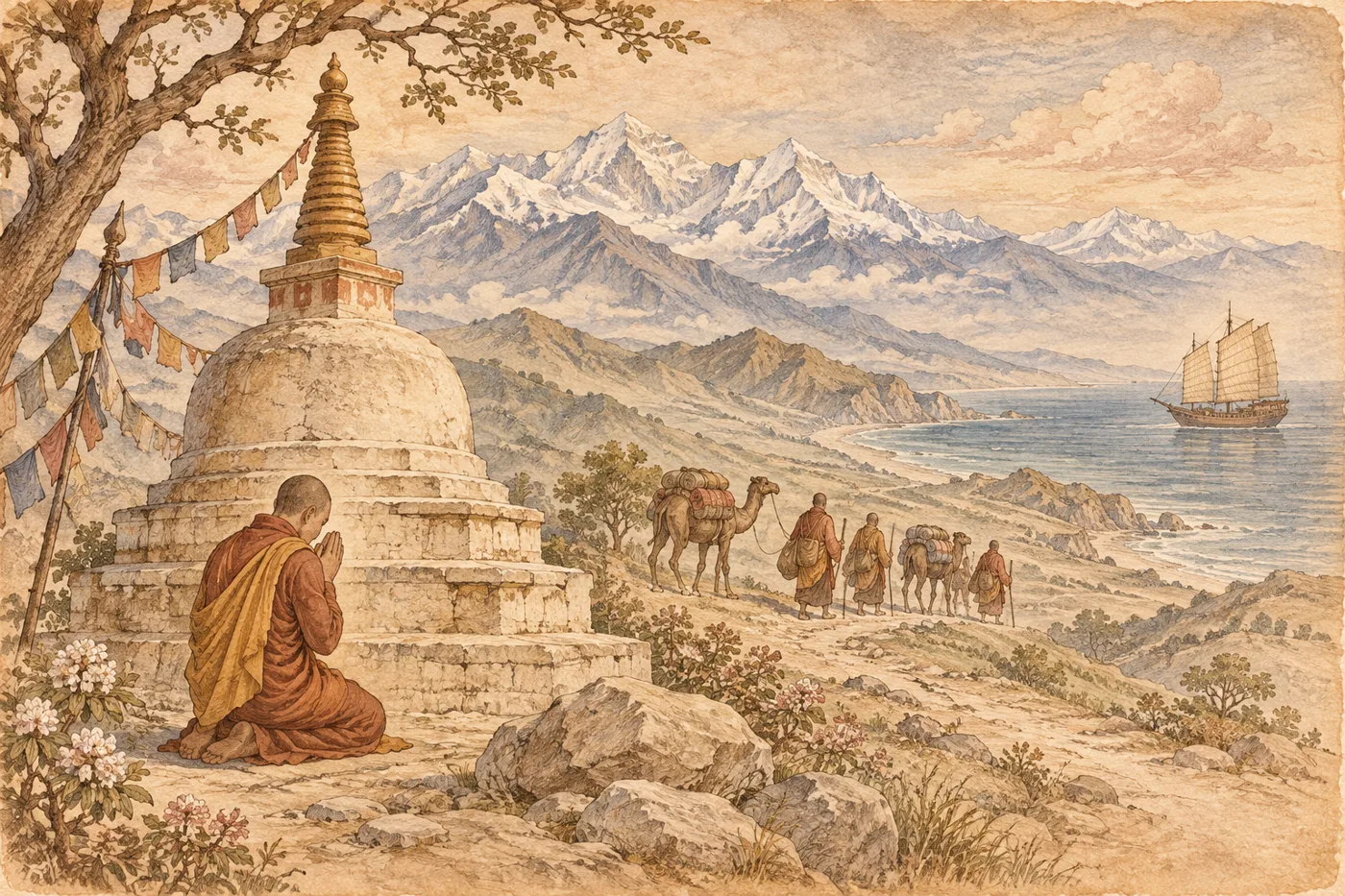
How did a teaching born in India cross mountains, deserts, and seas to reach Japan?
Buddhism was born in northern India around the 5th century BC. It was founded by Siddhartha, said to have been a prince of the Shakya clan, later known as the Buddha (the Awakened One). There are various theories about when he lived, with estimates ranging from around the 5th century BC to the 4th century BC. He is said to have traveled through the Ganges River basin, preaching his teachings to the people.
A key figure often credited with spreading the teachings far and wide was King Ashoka of the Maurya dynasty (3rd century BC). The king revered Buddhism and sought to govern not by force but through 'Dharma' (righteous law), leaving inscribed pillars and rock edicts across his realm. According to ancient Sri Lankan chronicles, Mahinda, who is said to have been the king's son, brought Buddhism to Sri Lanka. This tradition became Theravada Buddhism, which was preserved in Sri Lanka and later took firm root in Myanmar, Thailand, and beyond from the 11th century onward.
The other major stream is Mahayana Buddhism. From around the turn of the Common Era, a movement in India that emphasized the bodhisattva—one who seeks to save all beings—gained ground. Very broadly speaking, while earlier Buddhism (such as Theravada) emphasized the path of monastic practice, Mahayana preached salvation for a wider audience. However, the boundary between the two is not that simple in practice.
The land route was the Silk Road. Merchants and monks carried Buddhism, linking the oasis cities of Central Asia. In Bamiyan, Afghanistan, around the 6th to 7th centuries, colossal Buddha statues were carved into the cliff face. Buddhism is thought to have reached China between around the turn of the Common Era and the 1st century AD, and records of it appear as early as the Han dynasty. Sutras were translated into Chinese over a long period.
It wasn't just the teachings that traveled. The Chinese monk Faxian set out for India around 399, and Xuanzang around 629, seeking scriptures. Xuanzang traveled the land route and is said to have devoted himself to translating the scriptures he brought back. There was also a sea route. In the 7th century, Yijing traveled to India by sea, leaving records of the thriving Buddhist communities he encountered in Southeast Asia. Mahayana was also widespread there at the time, as exemplified by the Borobudur temple complex on Java (8th–9th centuries).
Buddhism reached Japan via the Korean peninsula. It was likely known earlier through immigrants, but it is officially recorded as having been transmitted in the mid-6th century, when a Buddha image and sutras were sent from Baekje (there are theories for both 538 and 552). Meanwhile, in its homeland of India, Buddhism gradually declined, largely fading by around the 13th century. Its later forms are said to have been preserved in Tibet and elsewhere. It is a curious history: declining in its birthplace yet taking root across vast areas of Asia.
Mini timeline
- Around 5th century BCThe Buddha preaches in northern India
- 3rd century BCBuddhism is said to have reached Sri Lanka during the reign of King Ashoka
- Around the turn of the Common Era to the 1st century ADBuddhism is said to have reached China
- Mid-6th centuryBuddhism is said to have been officially transmitted to Japan
- Around 629Xuanzang departs for India
People in this chapter
Known for patronizing Buddhism and spreading its teachings to various regions.
Traveled to India via the land route, brought back scriptures, and translated them.
Meanwhile, elsewhere
Connection to Japan
In Japan, during the Asuka period, Prince Shōtoku is said to have honored Buddhism. The Great Buddha of Tōdai-ji in Nara was created around the mid-8th century.
Why it still matters
Today, Theravada Buddhism continues as a major stream in Sri Lanka, Myanmar, Thailand, and elsewhere, while Mahayana Buddhism continues in China, the Korean peninsula, Japan, and Vietnam. Buddhism derived from later Indian traditions is found in Tibet and Mongolia. The Mahabodhi Temple in Bodh Gaya, India, was registered as a World Heritage Site in 2002, and pilgrims visit from around the world.
Perspectives differ
- The dates of the Buddha's life
- There are variations ranging from several decades to about 150 years, including the traditional Theravada date (placing his death around 544 BC), the date of around 483 BC used by many scholars, and a more recent theory of around 400 BC. Here, we use 'around the 5th century BC' as a guide.
- The date of Buddhism's transmission to China
- The legend of Emperor Ming of the Eastern Han seeing a golden figure in a dream (1st century) is famous, but some researchers believe it had already arrived earlier through merchants and others.
- The year of Buddhism's transmission to Japan
- There are theories for 538 and 552, and no consensus has been reached on which is correct.
- The distinction between Theravada and Mahayana
- 'Hinayana' is a term used from the Mahayana perspective and is less commonly used today. There is also a cautious view against oversimplifying the differences between the two.
Facts checked (7, verified by AI on the web)
- Corrected & confirmed King Ashoka's son Mahinda is said to have brought Buddhism to Sri Lanka World History Encyclopedia: Ashoka the Great
The World History Encyclopedia records that Ashoka's son Mahinda led a Buddhist mission to Sri Lanka (sourced from historical chronicles). The specific details of the mission come from chronicle traditions. Our text maintains the phrasing 'the chronicles say he transmitted [it]'. - Confirmed The official introduction of Buddhism to Japan has theories for 538 and 552 (from Baekje) World History Encyclopedia: Buddhism in Ancient Japan
The World History Encyclopedia cites the traditional dates of 538 or 552 for the transmission from Baekje, noting that Buddhism was already practiced among immigrants. This aligns with our text's mention of 'prior transmission via immigrants'. - Confirmed The Bamiyan Buddhas were carved into the cliff face around the 6th–7th centuries NYU ISAW Papers 22: Three-dimensional experiences of monuments destroyed in modern conflict (Bamiyan)
A paper by NYU ISAW states that the two figures, 38m and 55m tall, were carved directly into the sandstone cliff, with construction in the 6th–7th centuries. Our text has been revised from 'around the 6th century' to 'around the 6th–7th centuries'. - Confirmed The Mahabodhi Temple in Bodh Gaya was registered as a World Heritage Site in 2002 UNESCO: Mahabodhi Temple Complex at Bodh Gaya
Confirmed by search results for 2002 registration. - Corrected & confirmed Faxian departed around 399, Xuanzang around 629, and Yijing took the sea route in the 7th century Chinese Pilgrims to India (ancient-buddhist-texts.net)
Some accounts give Xuanzang's departure as 627. Yijing left from Guangzhou by sea in 671. We use 'around' to accommodate this. - Corrected & confirmed The Buddha's dates are around the 5th century BC BuddhaNet: dating the Buddha
Theories include 543/44 BC, 483/86 BC, and around 400 BC, and the matter is unresolved. The 'debates' section has been updated accordingly. - Confirmed Theravada Buddhism became established in Myanmar and Thailand from the 11th century onward Britannica: Buddhism: Southeast Asia
Britannica confirms Theravada spread in Myanmar from the late 11th century (Pagan period) and in Thailand from the late 13th century, with earlier Buddhist influence from the Mon people.
Sources
World History Encyclopedia: Ashoka the Great
World History Encyclopedia: Buddhism in Ancient Japan
NYU ISAW Papers 22: Three-dimensional experiences of monuments destroyed in modern conflict (Bamiyan)
UNESCO: Mahabodhi Temple Complex at Bodh Gaya
Britannica: Buddhism: Southeast Asia
* AI-drafted and cross-checked; human review is in progress. Status: