King Ashoka — The king who chose the path of righteousness after battle
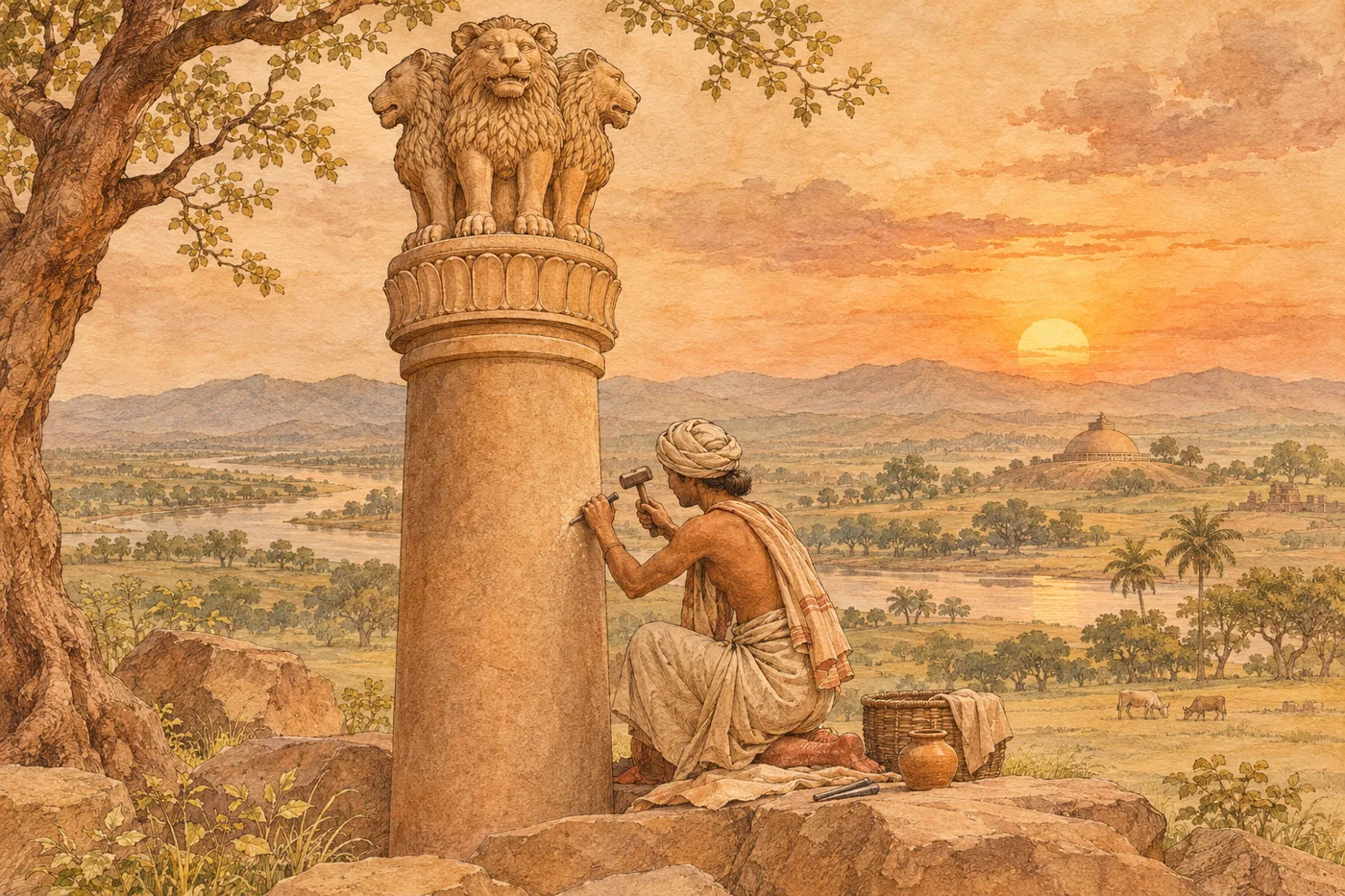
Why did a victorious king choose to renounce war?
In 326 BC, the army of Alexander the Great of Greece advanced into northwestern India. The Great King turned back with his army, but in the power vacuum that followed, Chandragupta is said to have overthrown the Magadha kingdom in the Ganges basin and founded the Maurya dynasty (late 4th century BC, traditionally said to be around 321 BC).
The capital was Pataliputra (near present-day Patna). He united a vast kingdom using the army, officials, and intelligence gatherers. The Greek envoy Megasthenes is said to have visited the court and recorded his observations.
The third king, Ashoka (traditionally said to have reigned from about 268 BC to about 232 BC), attacked the Kalinga kingdom on the east coast around 261 BC and was victorious. Later inscriptions record that 100,000 people were killed and 150,000 taken away in this war. However, the accuracy of the numbers is uncertain.
In inscriptions that he had carved on rocks and stone pillars, Ashoka speaks of his deep regret over this war. He advocated governance based on Dharma (righteousness). Dharma is a code of conduct: respect for life, reverence for parents and elders, and tolerance toward other religions. The king himself is said to have been a devout follower of Buddhism.
Inscriptions were erected in various locations across India and as far as present-day Afghanistan. In Kandahar, inscriptions in Greek and Aramaic have also been found. The inscriptions also record that he provided shade along roads, dug wells, built rest houses, and planted medicinal herbs. Buddhist scriptures say that the king's son went to Sri Lanka as an envoy, and Buddhism crossed the sea.
After Ashoka's death, the Maurya dynasty declined and ended around 185 BC. Yet the king's words carved in stone were deciphered more than 2,000 years later, and Ashoka's name is passed down even in the flag of modern India.
Mini timeline
- 326 BCAlexander the Great's army advances into northwestern India
- Late 4th century BCChandragupta founds the Maurya dynasty (traditionally said to be around 321 BC)
- About 261 BCKing Ashoka attacks the Kalinga kingdom
- 3rd century BCInscriptions expounding Dharma are erected in various places
- About 185 BCThe Maurya dynasty ends
People in this chapter
In his own inscriptions, he speaks of regretting war and aiming for governance through Dharma.
He created a kingdom that unified a wide area of India from the Ganges basin.
Meanwhile, elsewhere
Connection to Japan
Japan was in the early Yayoi period, when rice cultivation was spreading across the land.
Why it still matters
The navy-blue wheel with 24 spokes at the center of India's flag is called the Ashoka Chakra, based on the dharma wheel carved on Ashoka's pillars. The national emblem is also taken from the lion capital of an Ashokan pillar.
Perspectives differ
- Years of reign and year of accession
- Ashoka's accession is said to be around 268 BC or around 270 BC, with a range of several years depending on historical sources. There are also differing theories about the founding year of the Maurya dynasty, such as 321 BC or 317 BC.
- Numbers in the inscriptions
- The figures '100,000 killed and 150,000 taken away' appear in the king's own inscriptions, but it is unclear whether they represent actual scale or are an expression emphasizing regret.
- Whether Buddhism was made the 'state religion'
- Ashoka is said to have been a Buddhist, but his inscriptions call for respecting other religions as well. Many researchers believe that rather than making Buddhism the state religion, he promoted 'Dharma' that transcended specific religions.
- Extent of rule and degree of centralization
- How far the Maurya dynasty directly ruled is inferred from the distribution of inscriptions. The prevailing view is that the central region was under strong control, while peripheral areas were more loosely governed.
- Composition of the 'Arthashastra'
- The 'Arthashastra,' a treatise on politics and economics, is traditionally attributed to Chandragupta's minister Kautilya, but there are various theories about its date of composition, and later additions have been pointed out.
Facts checked (5, verified by AI on the web)
- Confirmed Ashoka's reign was about 268 BC to about 232 BC, and the Kalinga war was about 261 BC World History Encyclopedia: Mauryan Empire
WHE: reign 268–232 BC, Kalinga conquest around 260 BC. Britannica-related entries give 262 BC. The text uses 'about' for consistency. - Confirmed The inscriptions record 100,000 killed and 150,000 deported (the king's own figures) World History Encyclopedia: The Edicts of Ashoka the Great
WHE translation of Edict 13: 150,000 deported, 100,000 killed, and many more died. These are the king's own figures, consistent with the text's 'accuracy is uncertain'. - Confirmed A Greek and Aramaic inscription exists in Kandahar Encyclopaedia Iranica: Kandahar, Pre-Islamic Monuments and Remains
Discovered in 1958. A bilingual inscription in Greek and Aramaic, dating to the 3rd century BC (Iranica). - Confirmed Chandragupta founded the Maurya dynasty (around 321 BC). The capital was Pataliputra Britannica: Chandragupta
WHE gives 321 BC (some records also give 322 BC). There are various theories about the starting year. - Confirmed The Maurya dynasty ended around 185 BC World History Encyclopedia: Mauryan Empire
WHE: the last king was assassinated in 185 BC according to the text, and 187 BC in the timeline. The text's 'about 185 BC' is consistent with 'about'.
Sources
World History Encyclopedia: The Edicts of Ashoka the Great
Encyclopaedia Iranica: Kandahar, Pre-Islamic Monuments and Remains
Britannica: Chandragupta
World History Encyclopedia: Mauryan Empire
* AI-drafted and cross-checked; human review is in progress. Status: