The Gupta Empire and Hinduism — The Age of Zero and Stories
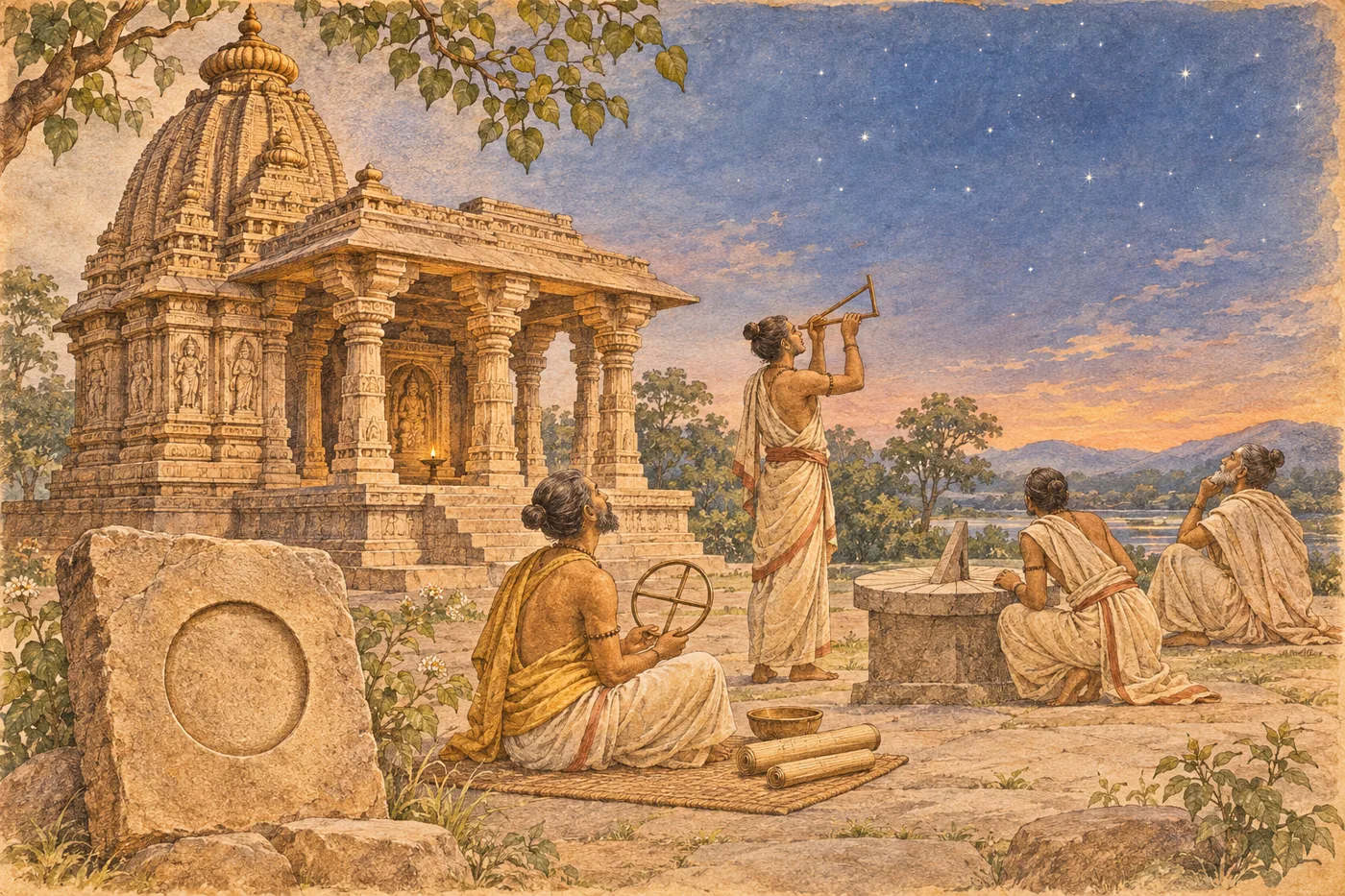
Why was India able to conceive the idea of 'zero'?
After the Mauryan Empire, India split into several kingdoms. Around the beginning of the 4th century (c. 320), Chandragupta I founded the Gupta Empire in northern India, and during the 4th–5th centuries it united much of the north. In the early 5th century, the Chinese monk Faxian traveled through India and recorded conditions in various regions.
During this period, the form of modern Hinduism took shape. Hinduism is not a religion with a single founder. It emerged over a long period as a blend of Vedic beliefs, worship of local deities, and influences from Buddhism and Jainism. Shiva, Vishnu, goddesses, and others were widely worshipped, and the two great epics, the Mahabharata and Ramayana, are said to have approached their present form around this time.
Culture also flourished. The poet Kalidasa (thought to have lived around the 4th–5th centuries, though his birth and death dates are unknown) is said to have written the play Shakuntala and other works in Sanskrit. The Ajanta Caves preserve beautiful murals believed to have been painted around the 5th century.
In scholarship, mathematics and astronomy advanced. Aryabhata (born 476) calculated a precise value for pi and is also interpreted as having believed that the Earth rotates. The place-value decimal system and the concept of zero were also refined in India over the course of several centuries from this period onward.
Buddhist scholarship also thrived. The Nalanda monastery is said to have been built around the 5th century, and in the 7th century the Chinese monk Xuanzang studied there. Scholar-monks from all over Asia are said to have gathered there.
Around the end of the 5th century, a people called the Hephthalites invaded from the northwest. The empire lost its strength, and around the mid-6th century the Gupta Empire came to an end. Several centuries later, an era began in which Islamic dynasties entered northern India from the northwest.
Mini timeline
- c. 320Chandragupta I founds the Gupta Empire
- Early 5th centuryChinese monk Faxian travels through India
- First half to mid-5th centuryNalanda monastery is said to have been built
- 476Aryabhata is born
- c. 550The Gupta Empire ends
People in this chapter
For his beautiful works depicting nature and love, he is sometimes called 'India's Shakespeare' even today.
He is said to have calculated a precise value for pi and written works on astronomy.
Meanwhile, elsewhere
Connection to Japan
Japan was in the Kofun period. Buddhism is said to have reached Japan around the mid-6th century (with theories for both 538 and 552), near the end of the Gupta Empire.
Why it still matters
The digits '0–9' we use were developed in India and spread worldwide through the Arabic-speaking world. Traces of this can be found in the work of al-Khwarizmi, who appeared in the previous 'Middle East' chapter.
Perspectives differ
- Was the Gupta period a 'Golden Age'?
- Because of its cultural flourishing, the Gupta period has been called the 'Golden Age of classical culture.' However, whether it was truly exceptional compared to other periods or simply stands out due to the abundance of historical sources is being re-examined.
- Origins of Zero
- Symbols for zero and the concept of place value are thought to have arisen independently in Mesopotamia and among the Maya as well. The earliest example in India is considered to be the Bakhshali manuscript, but scholars' opinions on its date vary widely, from the 3rd–4th centuries to the 7th–8th centuries. One of the earliest records setting out rules for using zero as a number in calculations is the work of Brahmagupta in 628.
- The Name 'Hinduism'
- 'Hindu' was originally a Persian term used by outsiders to refer to the people beyond the Indus River. Referring to their traditions as a single religion called 'Hinduism' came in a later period.
- Dating of the Epics
- The Mahabharata and Ramayana took shape over several centuries, and there are various theories about the process by which they reached their current form.
Facts checked (5, verified by AI on the web)
- Confirmed The Gupta Empire was founded around 320 Britannica Kids: Gupta dynasty
Britannica gives c. 320–330. The Gupta era begins in 319–320. - Confirmed Faxian traveled to India in the early 5th century (399–412) Britannica: Faxian
His entry into India is given as either 402 or 405 depending on the source. - Confirmed Aryabhata was born in 476. He calculated a precise value of pi and proposed the Earth's rotation. Britannica: Aryabhata I
The year 476 is widely accepted. His birthplace is given as Ashmaka or Kusumapura. The Aryabhatiya, from around 499, gives pi as 3.1416. Multiple sources mention the idea of the Earth's rotation. - Confirmed Nalanda monastery was built in the 5th century Nalanda University (official): History and Revival
Nalanda University's official history gives a founding date of 427 by King Kumaragupta. The founding year is estimated, and dates differ by source (World History Encyclopedia gives an active period of 'c. 300–1200 CE'). The text's 'said to have been built around the 5th century' remains consistent. - Confirmed Xuanzang studied at Nalanda in the 7th century Internet Encyclopedia of Philosophy: Xuanzang
The IEP states he left Chang'an in 629 and became a disciple of Shilabhadra in 636 (some sources give 627 for his departure).
Sources
Britannica Kids: Gupta dynasty
World History Encyclopedia: Gupta Empire
Britannica: Faxian
Britannica: Aryabhata I
Nalanda University (official): History and Revival
Internet Encyclopedia of Philosophy: Xuanzang
* AI-drafted and cross-checked; human review is in progress. Status: