The Chola Dynasty and the Maritime India — The Southern Kingdom Crossed the Sea
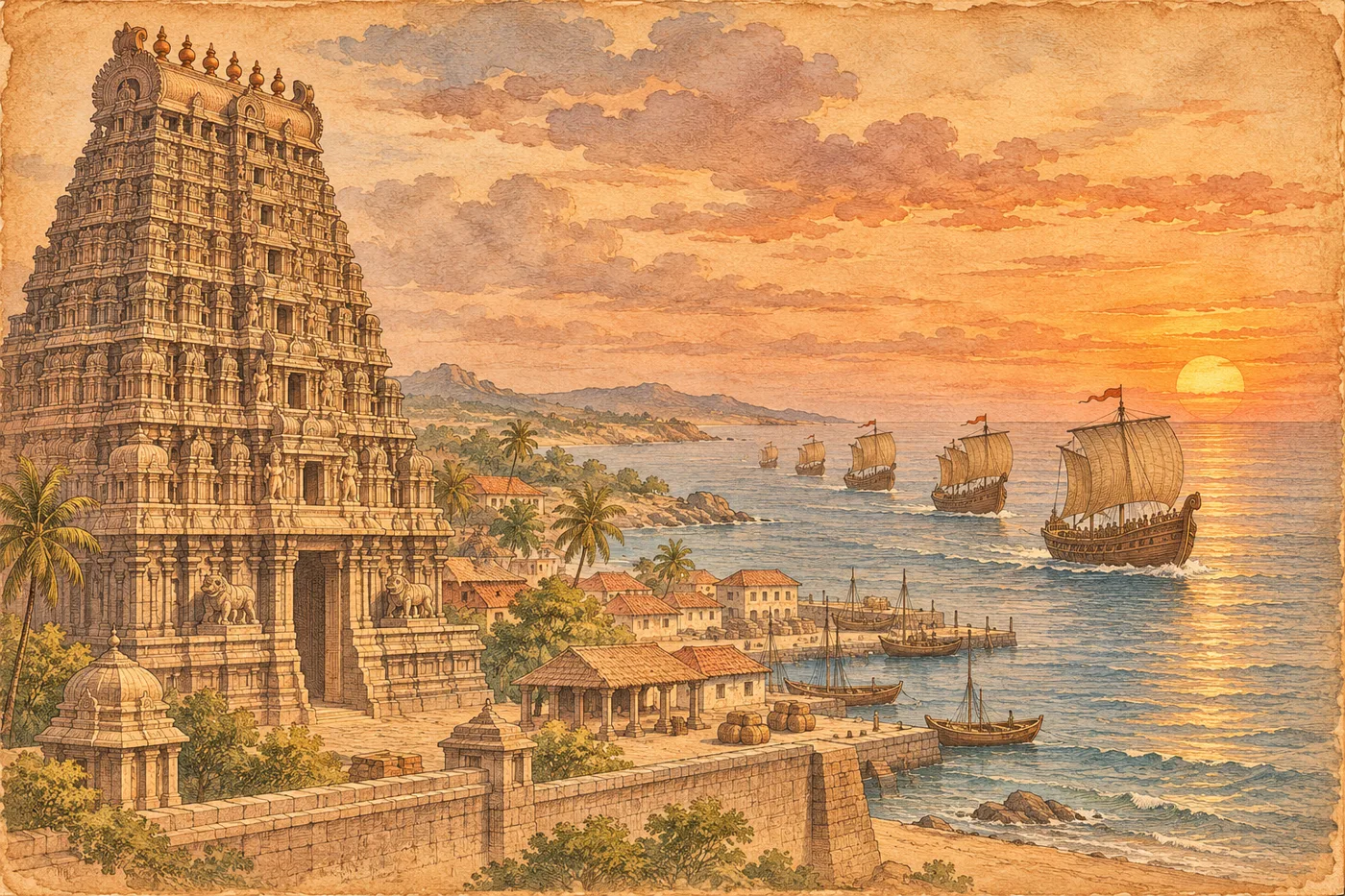
Why did an Indian kingdom send ships across the sea to distant lands?
When people think of Indian history, they tend to imagine the northern dynasties along the Ganges. But at the southern tip, there was also a great maritime kingdom: the Tamil-speaking Chola dynasty. This royal house appears even in ancient times, but it regained power around the mid-9th century (c. 850) and by the 11th century had become a strong state ruling most of South India.
The king at its peak was Rajaraja I (reigned c. 985–1014; some sources give 1016). He extended his influence across various parts of South India and into northern Sri Lanka. In his capital Thanjavur, he built the massive stone Brihadeeswarar Temple (completed c. 1010). With a tower over 60 meters tall, this temple is still a World Heritage Site that welcomes visitors today.
The next king, Rajendra I (reigned c. 1012–44), was even bolder. Around 1025, it is said that a Chola fleet crossed the Bay of Bengal and attacked the Southeast Asian maritime kingdom of Srivijaya—a rare instance of an Indian kingdom launching an overseas expedition. He is also said to have sent troops as far as the Ganges basin, and he built a new capital.
The wealth of the Chola dynasty came not only from agricultural harvests. The ports of South India lay at the center of sea routes connecting China, Southeast Asia, and the Arabian Peninsula. Cotton cloth, spices, gems, and elephants were traded. Records show that merchant guilds sent ships to various regions, and that envoys were sent to Song China. This story connects to the Southeast Asian port towns and Indian Ocean trade we saw earlier.
This kingdom also left a major cultural legacy. Temples were inscribed with poems praising the gods, and the bronze statue of the dancing Shiva Nataraja remains world-famous. It is also known that village assemblies managed land and taxes, and recorded them in inscriptions. Hinduism, Indian scripts, and architecture had spread to Southeast Asia from much earlier times, and the Chola maritime activities can be seen as part of that long-standing cross-sea exchange.
Entering the 13th century, other South Indian kingdoms grew stronger, and the Chola dynasty gradually declined, disappearing from history around 1279. Still, the memory of the Tamil people’s connection with the world through sea routes lives on today in the temples and language of Tamil Nadu.
Mini timeline
- c. 850Chola dynasty regains power
- 985Rajaraja I ascends the throne
- c. 1010Brihadeeswarar Temple completed
- c. 1025Overseas expedition (Srivijaya)
- c. 1279Chola dynasty ends
People in this chapter
He unified South India and built a huge stone temple.
He is known for the expedition across the Bay of Bengal.
Meanwhile, elsewhere
Connection to Japan
Japan was in the middle of the Heian period. Around the time Murasaki Shikibu wrote *The Tale of Genji* (early 11th century), a huge stone temple was completed in South India.
Why it still matters
The Brihadeeswarar Temple in Thanjavur is still used as a place of worship. Tamil is considered one of the world's oldest living literary languages and is also spoken in Singapore, Sri Lanka, Malaysia, and elsewhere.
Perspectives differ
- Was the Chola dynasty a strong centralized state?
- While some view the king as wielding strong power, others argue that villages, temples, and local elites held considerable influence; there is debate among scholars.
- Purpose of the 1025 expedition
- Various theories exist—to protect trade routes, for the king's prestige, to check Srivijaya—but it is not clear.
- The label 'Maritime Empire'
- Some call the Chola a 'maritime empire,' but other researchers are cautious, noting that actual control was limited in scope.
- Height of the temple
- The tower of the Brihadeeswarar Temple is given as about 61 meters in UNESCO descriptions, and commonly said to be 66 meters; figures vary by source.
Facts checked (4, verified by AI on the web)
- Confirmed Around 1025, Rajendra I attacked Srivijaya by sea Cambridge University Press (ISEAS): Naval expeditions of the Cholas in the context of Asian history
A Cambridge University Press chapter summary confirms that in 1025 Rajendra (Chola) sent a navy to attack Srivijaya and other Southeast Asian ports (Thanjavur temple inscription), and that the motive for the expedition remains debated. - Corrected & confirmed The Brihadeeswarar Temple was completed around 1010, with a tower over 60 meters UNESCO: Great Living Chola Temples
Completion in 1010 is consistent. UNESCO gives 61 m, while 66 m is commonly cited. The main text was revised to 'over 60 meters' and the note added to the debates section. - Corrected & confirmed Rajaraja I reigned c. 985–1014, Rajendra I reigned c. 1014–44 Smithsonian National Museum of Asian Art: Chola Dynasty (9th-13th Century)
The Smithsonian National Museum of Asian Art gives Rajaraja I as 985–1016 and Rajendra as 1012–44 (sources differ on exact start/end years, so the main text uses 'c.' to match this source). - Unverified The Chola dynasty revived around 850 and ended around 1279 Smithsonian National Museum of Asian Art: Chola Dynasty
Partially. Smithsonian writes 'royal family dominated the region from the mid-9th century,' '9th to 13th centuries,' not contradicting an ~850 start but not specifying the year. End ~1279 not found in accessible official sources (Oxford History of India suggests decline in the 13th century, disappearing early 14th century). UNESCO and Britannica return 403.
Sources
Cambridge University Press (ISEAS): Naval expeditions of the Cholas in the context of Asian history
UNESCO: Great Living Chola Temples
Smithsonian National Museum of Asian Art: Chola Dynasty (9th-13th Century)
* AI-drafted and cross-checked; human review is in progress. Status: